130 Years Ago...
Today is the 130th anniversary of Kentucky's Deadliest Tornado. According to the National Weather Service in Louisville, it happened Thursday, March 27, 1890 between 8:00pm and 8:30pm and killed approximately 76-120 people and injured 200 more. It had one of the highest single-building death tolls ever recorded in the United States. It was rated an F-4 on the original Fujita Scale and caused an estimated 2.15-2.5 million dollars in damage.

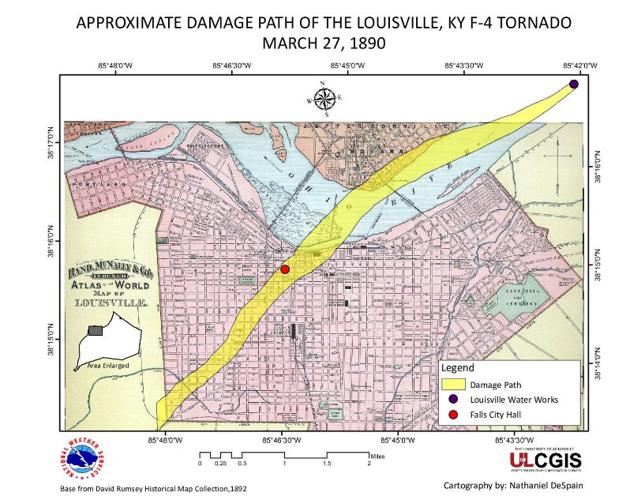
The path illustrated shows the tornado taking an abrupt right turn after hitting Jeffersonville, Indiana. The path shown here does not include the beginning of the path southwest of Louisville, nor does it show the location of the Louisville Water Works northeast of the city that were seriously damaged by the tornado. The omission of the water works caused the path to turn too sharply to the right on this map as the tornado left Jeffersonville.

A Visual Path...
Video Credit: Nathaniel DeSpain
The Forecast...
In 1890, the Signal Service office in Washington, DC prepared forecasts for much of the nation. (Forecasting duties would move to the Weather Bureau upon its creation in 1891, which then became the National Weather Service in 1970.) The local office in Louisville, which in 1890 was located in the same building as the Courier-Journal, received the bulletins from Washington for use locally.
According to the head of the Louisville office, Sergeant Frank Burke, as quoted in the Louisville Courier-Journal, "We were officially advised from Washington early this morning to expect a violent atmospheric disturbance sometime within the next 24 hours, and were ordered to make special observations. The evening reports from other stations in the area warned us that Louisville was likely to experience, more or less severely, the force of the storm. Our own local observations sufficiently indicated this also. All through the day the barometer sank steadily lower. As the (low pressure system) progressed (from Kansas into Nebraska) it had become what was predicted for it, the most intense cyclone storm of the present season. Winds gusted to 48 mph ahead of the tornado, and to 53 mph around 8:30pm as the tornado passed within about five blocks of the weather office. Of course we could not compel (citizens) to take precautionary measures, but the office of the Signal Service ended with the simple warning notice of the approach of a dangerous disturbance. In this case, the value and reliability of the service is amply proven, and, amid all the sorrow and ruin wrought by the tornado, we can, at least, honestly assure ourselves that no point of duty has been neglected. If any (damage to boats on the river) has occurred it is because they failed to regard the plain and timely warning given in the Times during the afternoon.”
The Destruction...
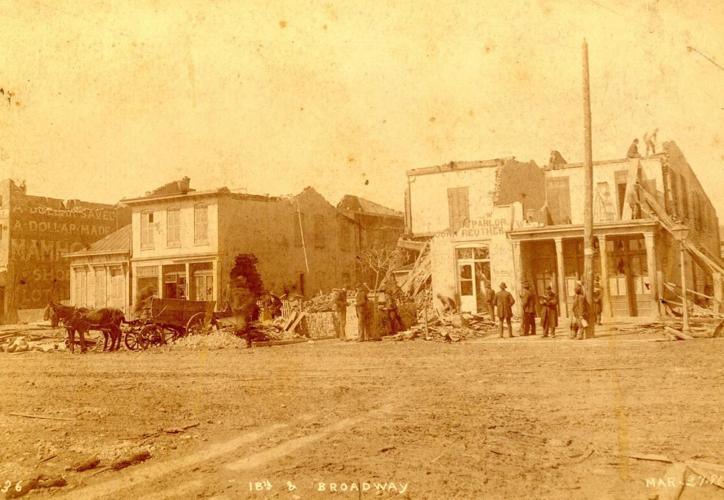
Barkeeper John Thome ran out of the saloon at the corner of 18th and Broadway, into the storm. He was lifted into the air and carried to Magazine Street (about a block away) where he was thrown to the ground but not seriously hurt.
Photograph courtesy of The Filson Historical Society, Louisville, KY (TOR 1890 21).
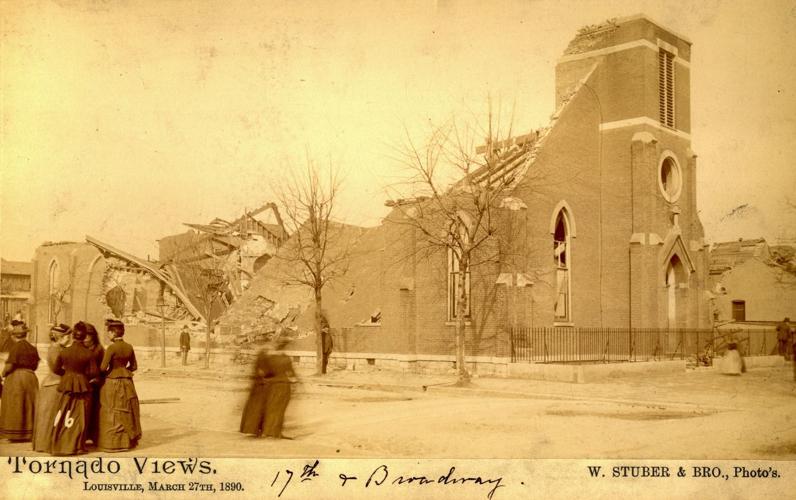
At Sacred Heart Catholic Church the church, rectory, and school were all damaged. One nun was killed.
Photograph 1-3 courtesy of The Filson Historical Society, Louisville, KY (Stuber Flat-16, TOR 1890 7 and TOR 1890 5).
Photograph 4 courtesy of The Gutenberg Project: Louisville, KY. After the Cyclone, by E. Klauber.
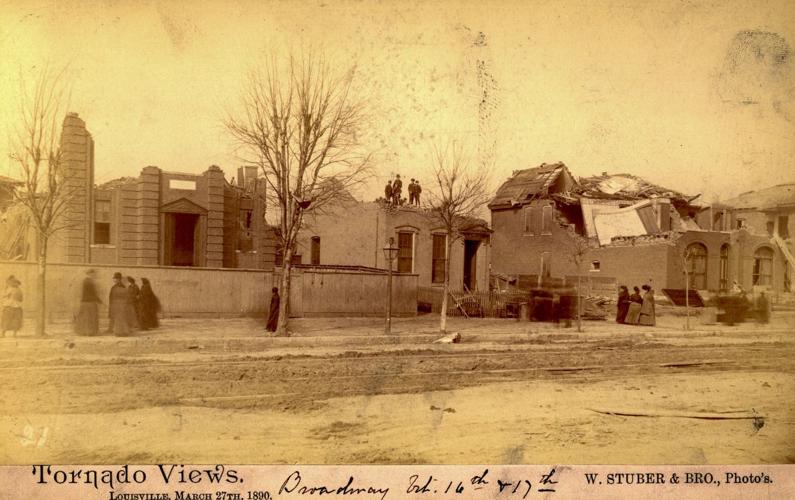
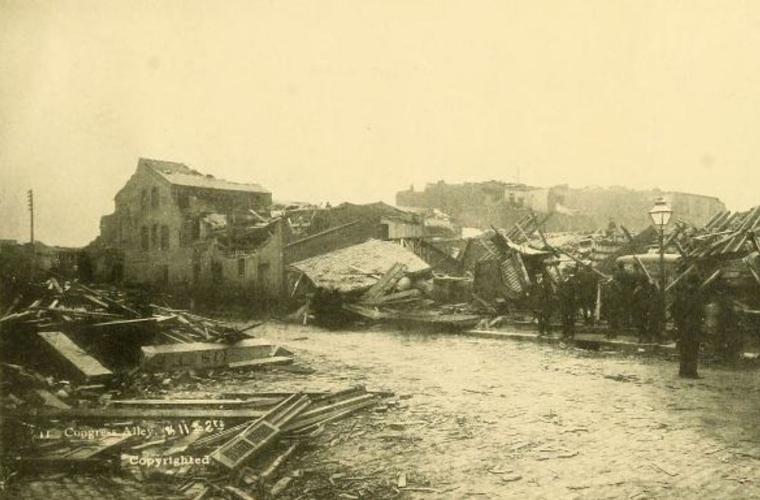
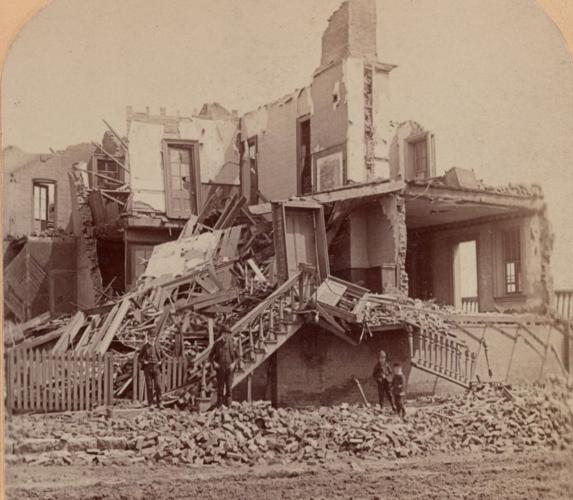
At Colgan Street and 17th Street a new brick home was struck. The lady of the house and her nephew ran to the front door and were swept into the air and carried about 40 feet where they were hurled against a fence. The house was destroyed but the victims survived their ordeal.
Photograph courtesy of The Filson Historical Society, Louisville, KY (Stuber Flat-21).
Photograph 2 and 3 courtesy of The Gutenberg Project: Louisville, KY. After the Cyclone, by E. Klauber.
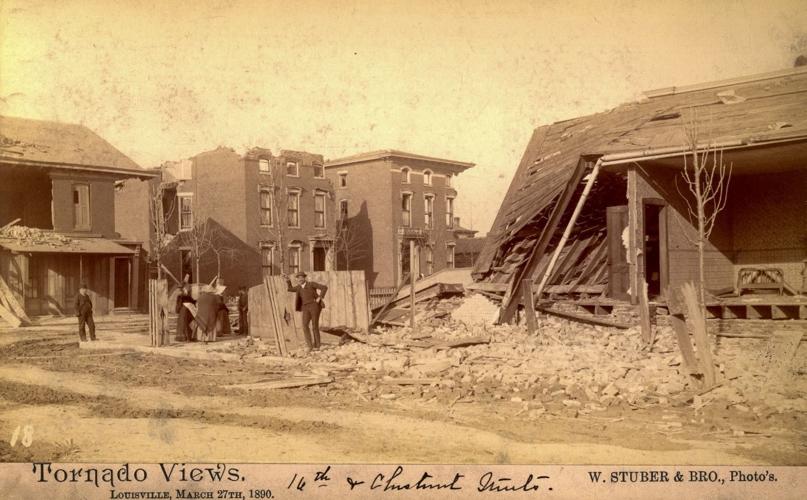
The Third Presbyterian Church at 16th and Chestnut streets was destroyed. Its steeple was thrown across the street and crushed a 2-story building that housed a grocery on its main floor.
Photograph courtesy of The Filson Historical Society, Louisville, KY (Stuber Flat-18).
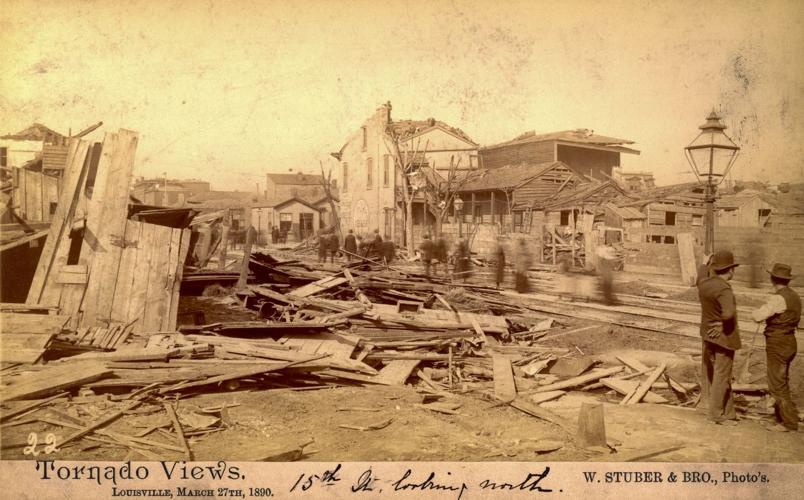
Houses were demolished along 15th Street between Magazine and Chestnut, along Chestnut from 16th to 13th, and along Magazine from 17th to 15th.
Photograph courtesy of The Filson Historical Society, Louisville, KY (Stuber Flat-22) and (003PC5_24).
Photograph 2 courtesy of The Gutenberg Project: Louisville, KY. After the Cyclone, by E. Klauber.
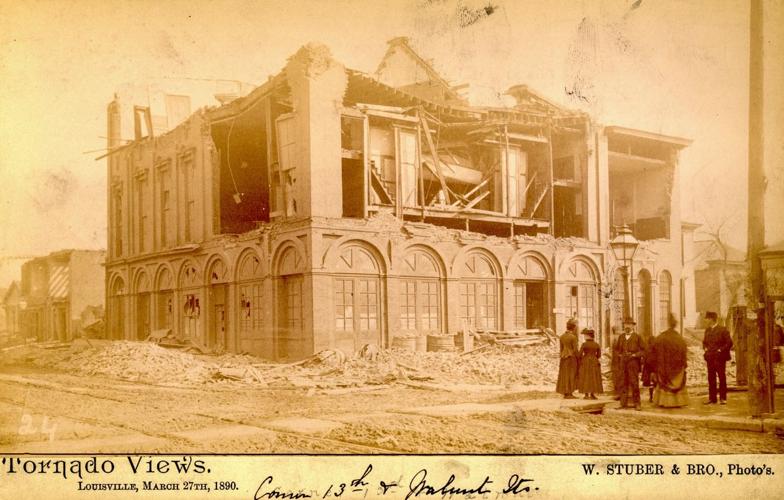
The top story of the Odd Fellows Hall was swept away by the storm, and fire damaged what was left. Loeb's Dry Goods, diagonally across the street from the hall, was demolished.
Photograph 1 courtesy of The Filson Historical Society, Louisville, KY (Stuber Flat-24).
Photograph 2 and 3 courtesy of The Library of Congress.
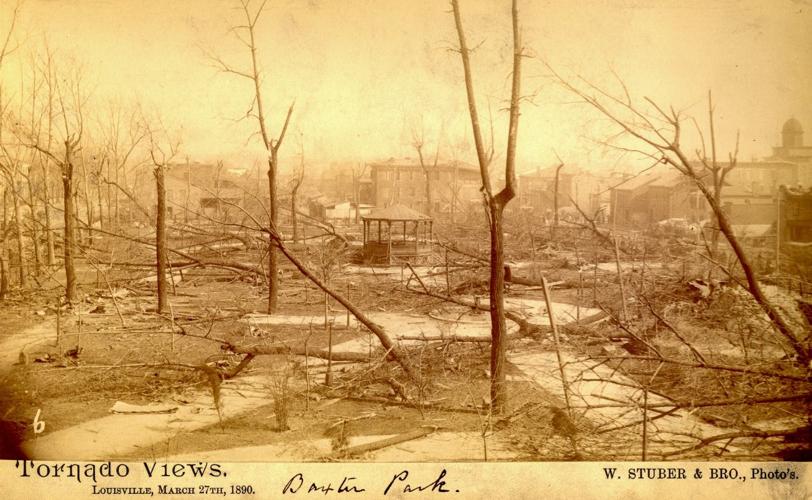
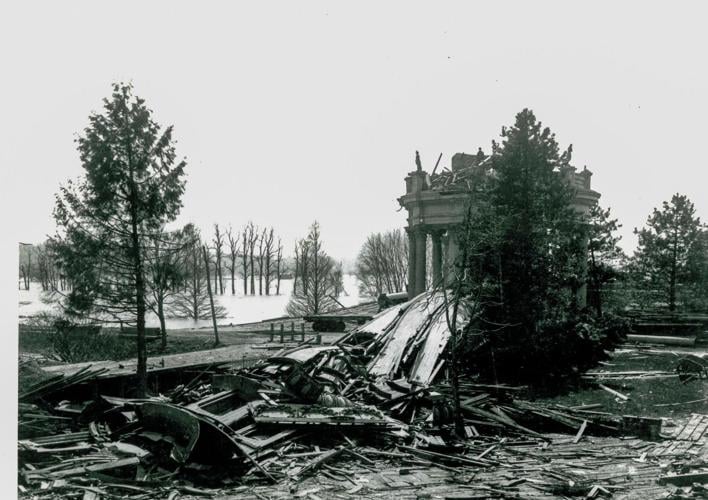
Baxter Park was devastated by the tornado. Many of the trees were over 50 years old.
Photograph 1 courtesy of The Filson Historical Society, Louisville, KY (Stuber Flat-06).
Photographs 2 , 3 and 4 courtesy of The Library of Congress.
Photograph 5 courtesy of The Gutenberg Project: Louisville, KY. After the Cyclone, by E. Klauber.
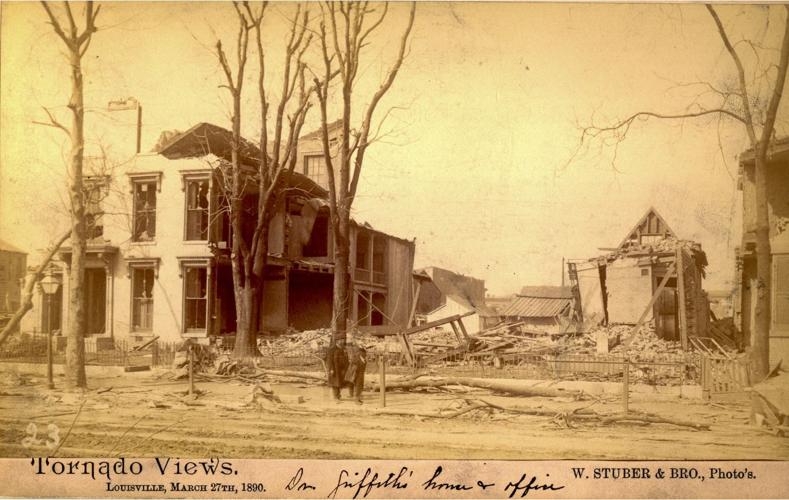
During the destruction of Dr. George Griffith's fine brick home, the doctor and his wife were away on a trip. However, their three children and several friends were in the parlor on the first floor. The storm threw everyone into the front yard, but they were otherwise unhurt.
Photograph 1 and 2 courtesy of The Filson Historical Society, Louisville, KY (Stuber Flat-23 and TOR 1890 33).
Photograph 3 courtesy of The Gutenberg Project: Louisville, KY. After the Cyclone, by E. Klauber.
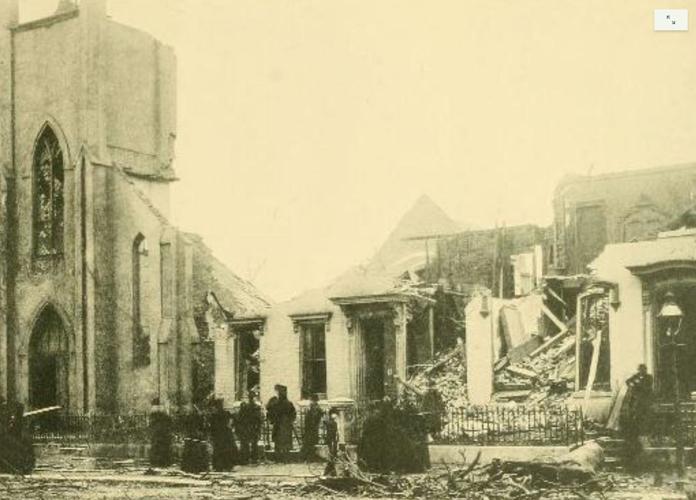
The wife of St John's Episcopal Church's pastor, Stephen E. Barnwell, escaped harm but was so upset by the storm that physicians placed her "under the influence of powerful opiates, and at midnight (Mrs. Barnwell) was resting easily, but still (unaware) of the awful reality" that her husband and son, Dudley, had been killed. Both the church and the parsonage were destroyed.
Photograph 1 courtesy of The Gutenberg Project.
Photograph 2 courtesy of The Library of Congress.
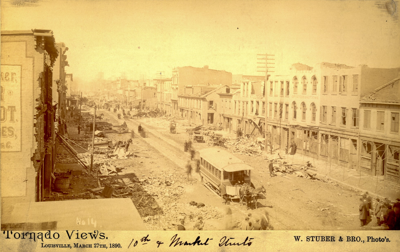
Street-car No. 158 had just reached 10th and Jefferson when it was picked up and turned completely around, throwing the driver into the gutter, killing one of the mules, and landing upside-down. The driver suffered a fractured skull, broken arm, and internal injuries. Fortunately there were no passengers aboard at the time.
Photograph courtesy of The Gutenberg Project: Louisville, KY. After the Cyclone, by E. Klauber.
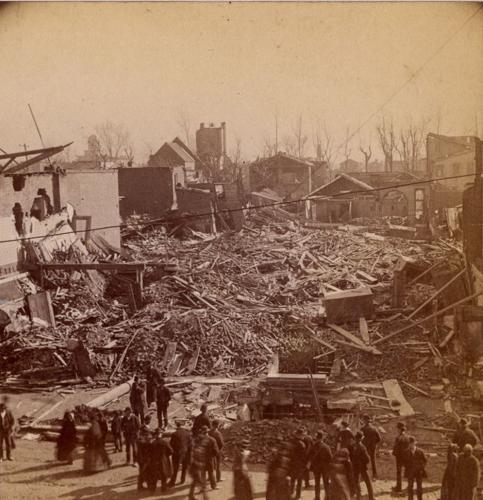
It is estimated that 44 people died in the destruction of Falls City Hall, which is the 2nd highest single-building tornado death toll recorded in the United States. Please see the section immediately following the photographs for the story of the tragic events that befell this popular meeting place.
Photograph 1 courtesy of The Filson Historical Society, Louisville, KY (TOR 1890 30).
Photograph 2 courtesy of The Gutenberg Project: Louisville, KY. After the Cyclone, by E. Klauber.
Photographs 3 courtesy of The Library of Congress.
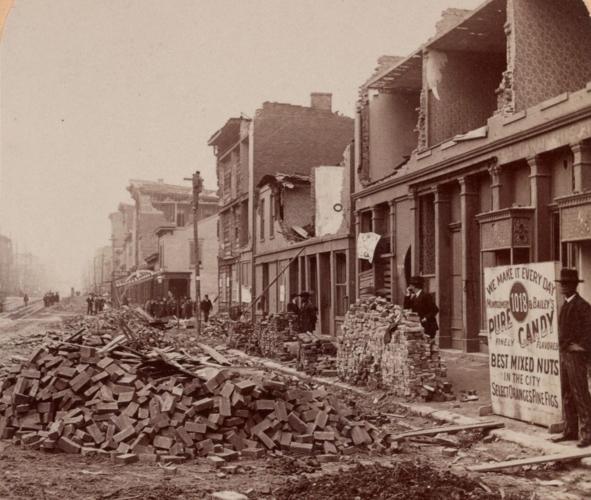
Mattie Nelson, a servant sleeping on the second floor of a building on West Market Street when the tornado struck, fell out of the window and caught on the sill of the first floor, then slid down a post to the street.
Photograph 1 and 2 courtesy of the Library Congress.
Photograph 3 courtesy of The Gutenberg Project: Louisville, KY. After the Cyclone, by E. Klauber.
Photograph 4 and 5 courtesy of The Filson Historical Society, Louisville, KY (TOR 1890 17) and (TOR 1890 9).
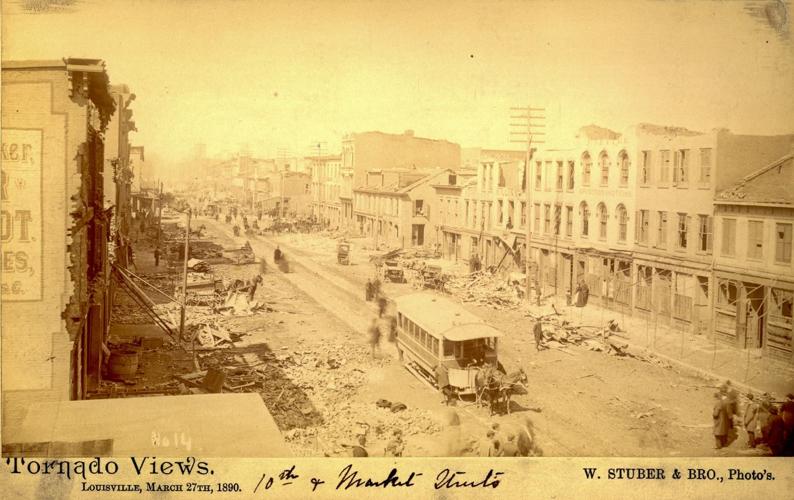
The damage path through the city was up to 800 yards wide. Damaged or destroyed were 5 churches, 1 railroad depot, 2 public halls, 3 schools, 260 stores, 32 manufacturing establishments, 10 tobacco warehouses, and 532 residences in the city. In addition, in Parkland it damaged or destroyed 30 residences, and in Cane Run 22 buildings were affected. Damage totaled $2,150,000 (about $61 million in 2020 dollars).
Photograph courtesy of The Filson Historical Society, Louisville, KY (Stuber Flat-14).
Photograph 2 and 3 courtesy of The Gutenberg Project: Louisville, KY. After the Cyclone, by E. Klauber.
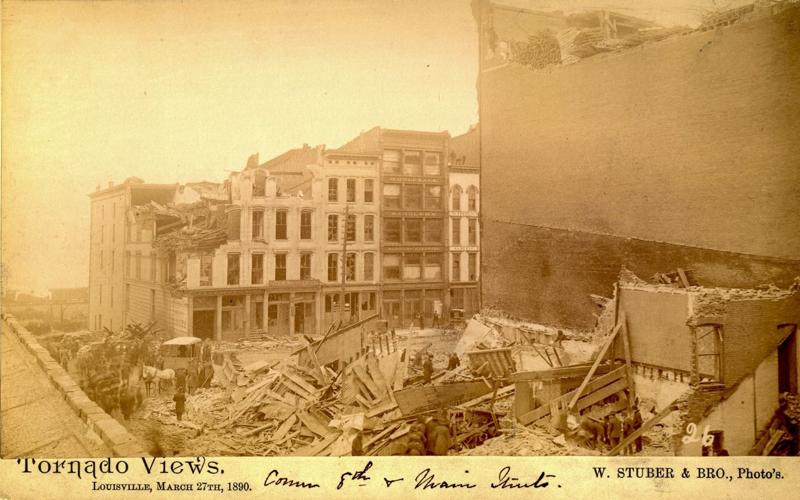
The building across the street on the farthest right, with the three men standing on the roof, houses the Kentucky Science Center today. All of the buildings facing the photographer in this picture were repaired and still stand.
Photograph courtesy of The Filson Historical Society, Louisville, KY (Stuber Flat-26), (Stuber Flat-27) and (Stuber Flat-25).
Photograph 4 courtesy of The Gutenberg Project: Louisville, KY. After the Cyclone, by E. Klauber.
5th photograph courtesy of The Library of Congress.
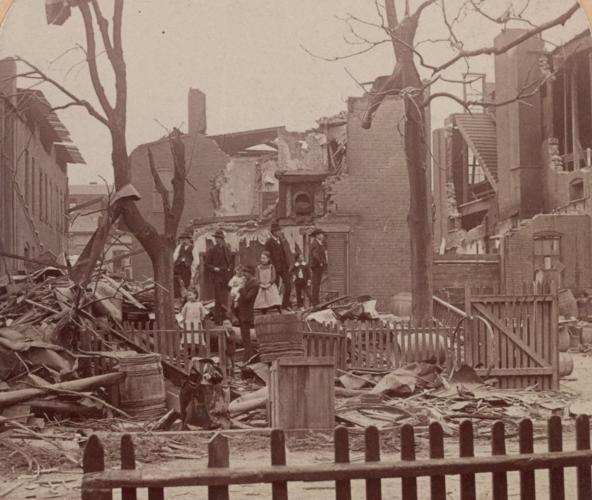
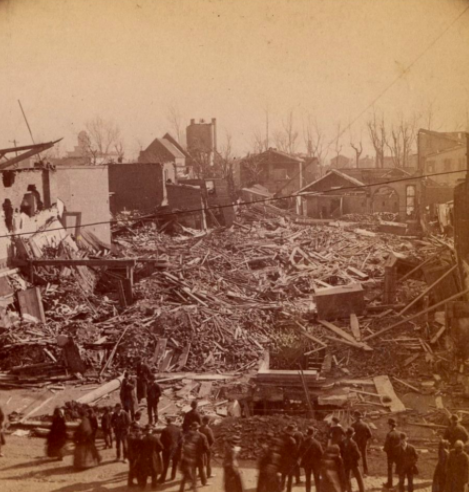
"Wreck, ruin, death, destruction. Tongue cannot describe nor pen portray the fearful extent of the disaster that has overtaken Louisville." -- The Indianapolis Journal
Photograph courtesy of the Library of Congress.
Photograph 2 courtesy of The Gutenberg Project: Louisville, KY. After the Cyclone, by E. Klauber.
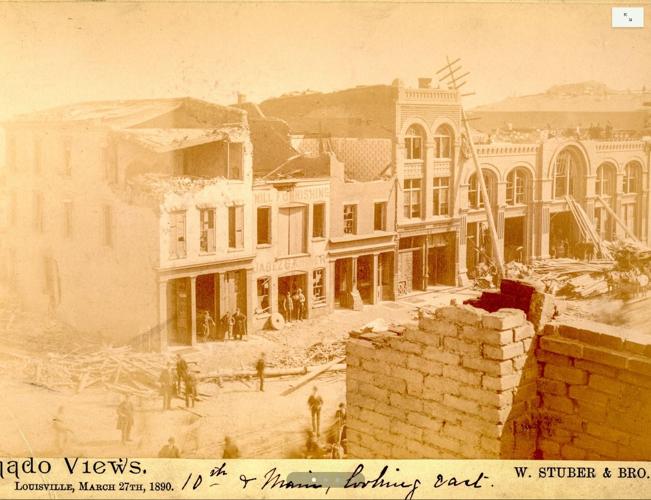
“The wind began to blow with a mournful sound, which soon increased to a fearful shriek as it swept over the doomed portion of the city...the streets were filled with flying debris, falling trees, walls, and telegraph poles.” -- From the official report of the Board of Trade Relief Committee that coordinated recovery efforts
Photograph courtesy of The Filson Historical Society, Louisville, KY (Stuber Flat-04), (003PC5_08) and (Stuber Flat-11).
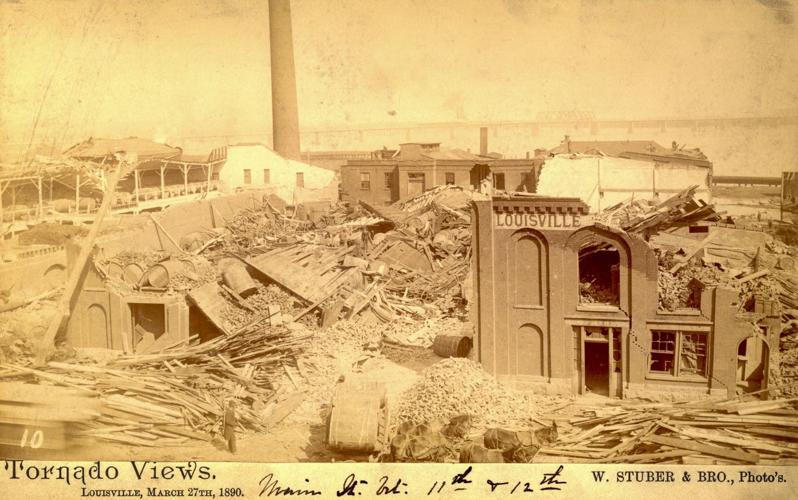
A brick wall on 12th Street showed where a heavy piece of timber entered it and was broken off, leaving a piece piercing the wall.
Photograph courtesy of The Filson Historical Society, Louisville, KY (Stuber Flat-10), (Stuber Flat-28) and (TOR 1890 20).
Photograph 4 courtesy of the Library of Congress.
“While the calamity is a great one, our citizens feel able to cope with it and are not cast down but will at once proceed to repair and resume on the channels now interrupted.” -- Chairman of the Board of Trade Relief Committee
Photograph courtesy of The Filson Historical Society, Louisville, KY (Stuber Flat-09) and (TOR 1890 19).
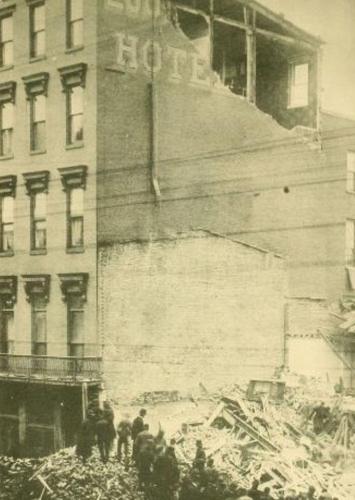
The Louisville Hotel covered the square from 6th to 7th on the south side of Main Street. Two large locomotive headlights were procured and used to illuminate the debris where rescuers were working.
A number of young women employed in the laundry were in their rooms on an upper floor when the storm arrived. Several of them were caught in the debris, two were killed.
A man was pinned beneath bricks and mortar from the damaged hotel. In his hand he held a pistol, with which he was trying to end his sufferings. His arm was so badly bruised, however, he was unable to pull the trigger. He was rescued, though unable to walk.
Photograph courtesy of The Gutenberg Project: Louisville, KY. After the Cyclone, by E. Klauber.
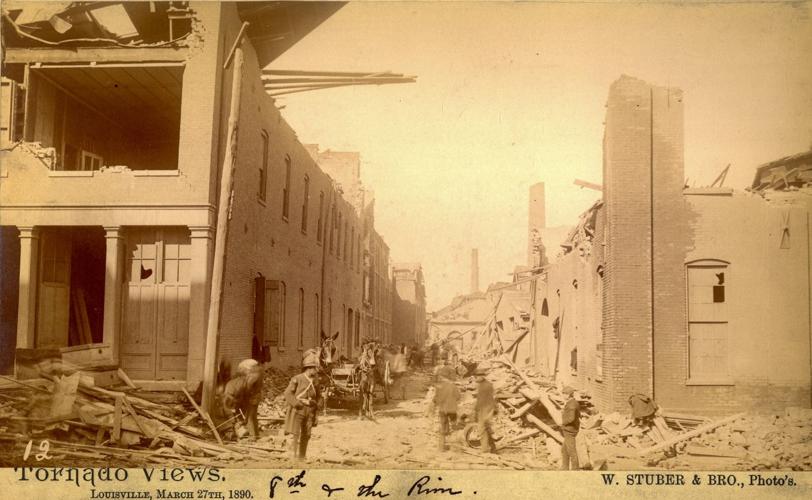
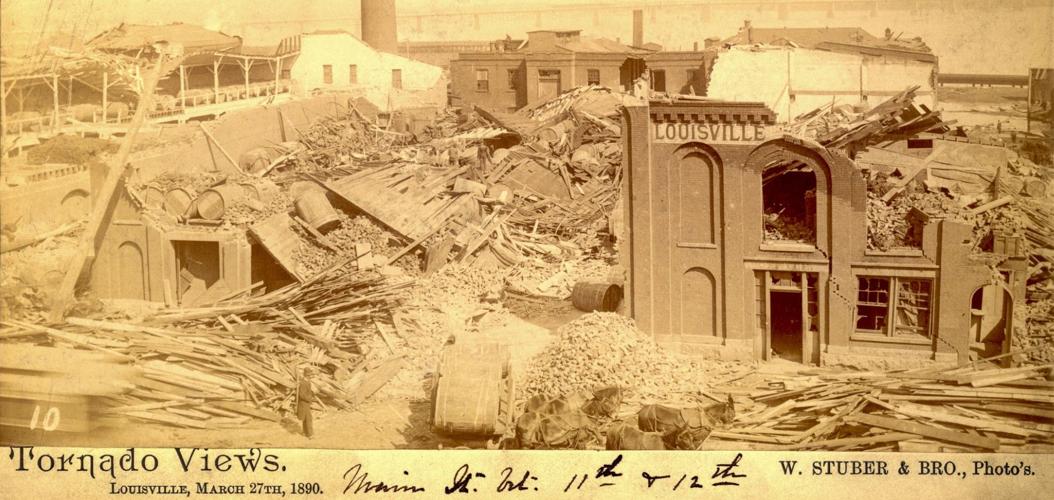
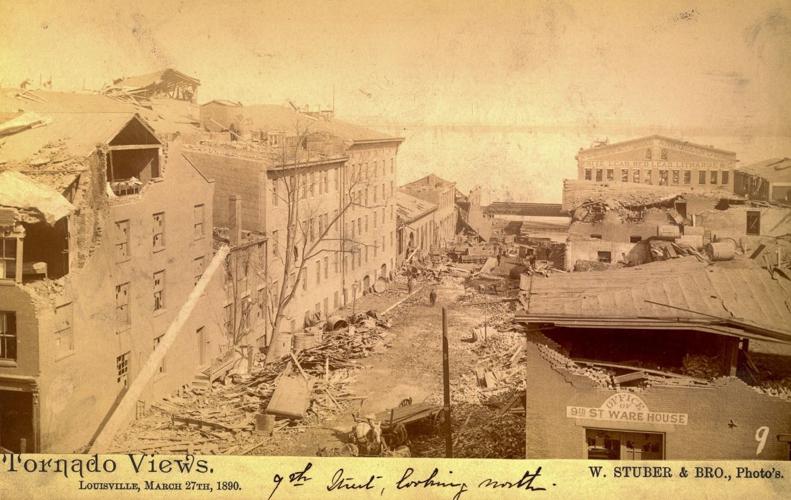
A four-story building at the foot of 8th Street was reduced to little more than a pile of bricks. At 8th and Main the facade of the upper four stories of a 5-story building was blown into the street.
Photograph courtesy of The Filson Historical Society, Louisville, KY (Stuber Flat-12).
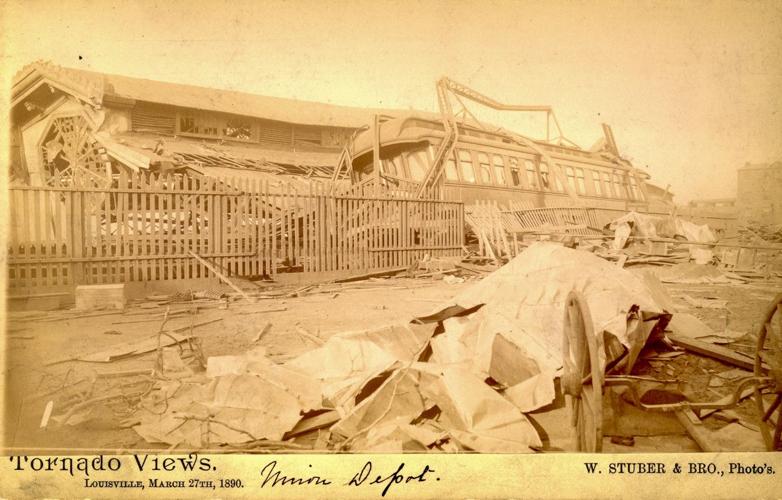
The tornado demolished the Union Depot at the foot of 7th Street, carrying great sections of it into the flooded Ohio River and burying three trains of cars. About 50 people, and several horses, were in the building at the time of the destruction.
Afterwards, thieves came down the river to rob passengers' luggage and the depot's ticket office. Police informed them that there were too many to many to arrest, so they would be shot instead.
Photograph courtesy of The Filson Historical Society, Louisville, KY (Stuber Flat-01 and TOR 1890 6).
Photograph 3 and 4 courtesy of The Library of Congress.
Photograph 5 courtesy of The Gutenberg Project: Louisville, KY. After the Cyclone, by E. Klauber.
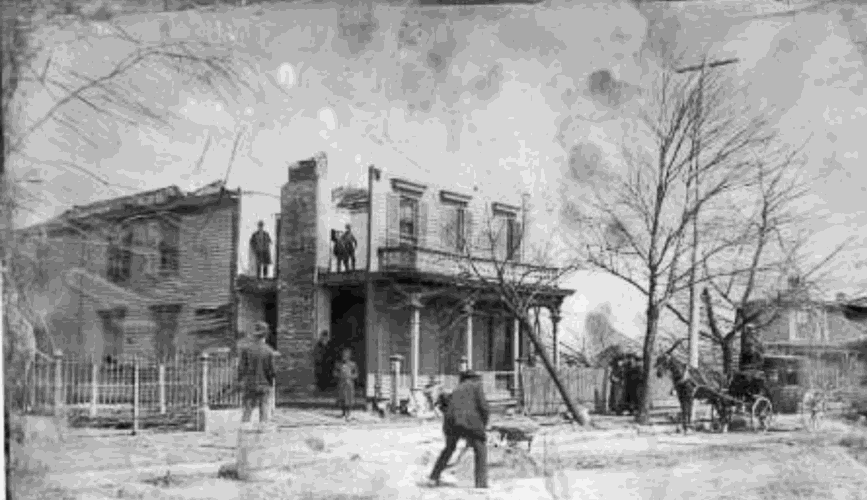
The Fitch home lost much of its second story. While the walls simply fell out and down from the structure, the 6 pine doors on that floor disappeared. Mr. Fitch searched for several blocks around, but hadn’t found them by the time his story was printed in the newspaper.
Photograph courtesy of University of Louisville Archives and Special Collections. https://digital.library.louisville.edu/cdm/singleitem/collection/howard/id/1588/rec/12
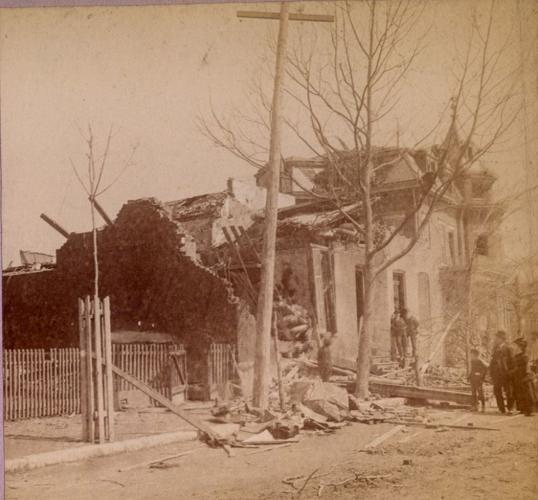
Those in Jeffersonville who saw the approaching tornado said that it had the appearance of a grayish-black cloud, preceded by a mass of dust and flying timbers up to 60 feet in the air. Some reported a distinct roaring sound that was heard miles away, while others reported being unaware of the tornado until it was nearly on top of them.
Photograph courtesy of The Filson Historical Society, Louisville, KY (TOR 1890 27).
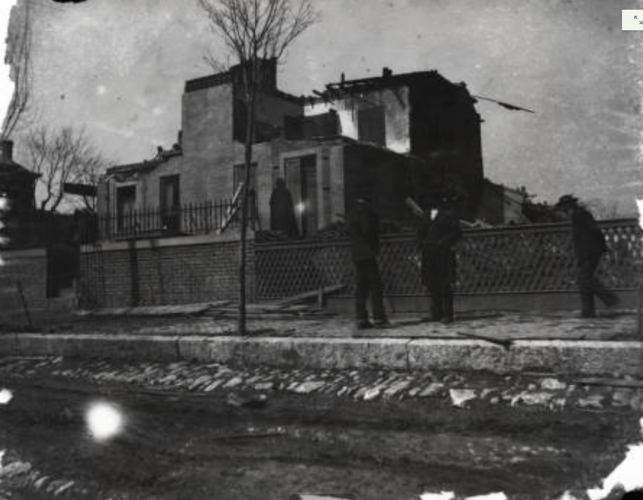
The tornado entered Jeffersonville at Broadway and Front Street (Riverside Drive about where Buckhead Mountain Grill is today). T. G. Bosley noticed the approach of the storm as his home’s walls began to vibrate. He told his wife and children to follow him out into the yard, which they did. The last child was barely out of the doorway when the residence, a 2-story brick building, collapsed.
Photograph courtesy of University of Louisville Archives and Special Collections. https://digital.library.louisville.edu/cdm/singleitem/collection/howard/id/1586/rec/3
Photograph 2 courtesy of The Filson Historical Society, Louisville, KY (TOR 1890 25).
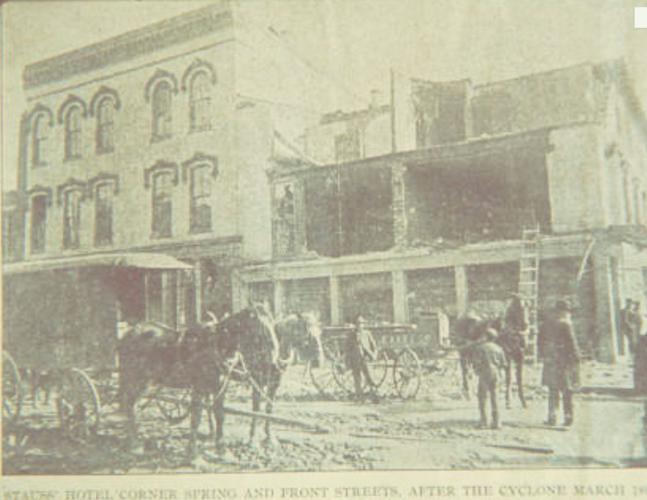
The wind blowing across the river ahead of the tornado drove the water level about four feet higher, covering the streets and wharf in Jeffersonville with thick mud after the water receded.
Photograph courtesy of Jeffersonville Township Public Library (Clark County Visual History).
At the water works all the windows of the pumping station were blown out and the 160 foot tall standpipe was toppled.
When the water tower was destroyed, workers couldn’t reach it due to flooding. The day after the storm the river level at McAlpine Lower was 63.3 feet, more than eight feet above flood stage.
Louisville had only about 6 days’ worth of water stored in the city reservoir.
Photographs courtesy of Louisville Water Company.
Scroll Through 30 Images from Kentucky's Deadliest Tornado
Barkeeper John Thome ran out of the saloon at the corner of 18th and Broadway, into the storm. He was lifted into the air and carried to Magazine Street (about a block away) where he was thrown to the ground but not seriously hurt.
Photograph courtesy of The Filson Historical Society, Louisville, KY (TOR 1890 21).
At Sacred Heart Catholic Church the church, rectory, and school were all damaged. One nun was killed.
Photograph 1-3 courtesy of The Filson Historical Society, Louisville, KY (Stuber Flat-16, TOR 1890 7 and TOR 1890 5).
Photograph 4 courtesy of The Gutenberg Project: Louisville, KY. After the Cyclone, by E. Klauber.
At Colgan Street and 17th Street a new brick home was struck. The lady of the house and her nephew ran to the front door and were swept into the air and carried about 40 feet where they were hurled against a fence. The house was destroyed but the victims survived their ordeal.
Photograph courtesy of The Filson Historical Society, Louisville, KY (Stuber Flat-21).
Photograph 2 and 3 courtesy of The Gutenberg Project: Louisville, KY. After the Cyclone, by E. Klauber.
The Third Presbyterian Church at 16th and Chestnut streets was destroyed. Its steeple was thrown across the street and crushed a 2-story building that housed a grocery on its main floor.
Photograph courtesy of The Filson Historical Society, Louisville, KY (Stuber Flat-18).
Houses were demolished along 15th Street between Magazine and Chestnut, along Chestnut from 16th to 13th, and along Magazine from 17th to 15th.
Photograph courtesy of The Filson Historical Society, Louisville, KY (Stuber Flat-22) and (003PC5_24).
Photograph 2 courtesy of The Gutenberg Project: Louisville, KY. After the Cyclone, by E. Klauber.
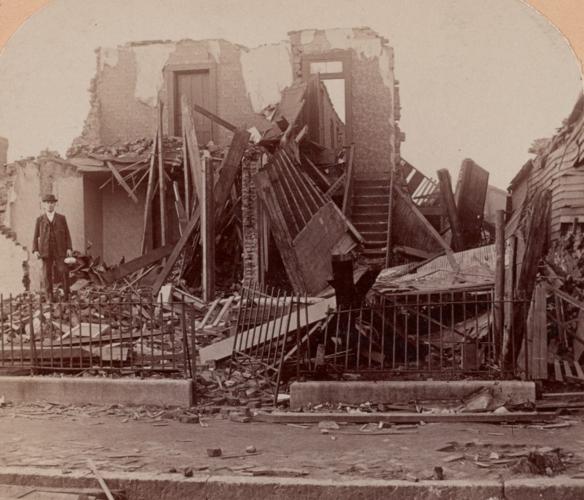
A policeman was killed when rushing to rescue a victim in the rubble of a building at the corner of Madison and 16th. A wall fell on the officer, killing him instantly.
Photograph courtesy of The Library of Congress.
The top story of the Odd Fellows Hall was swept away by the storm, and fire damaged what was left. Loeb's Dry Goods, diagonally across the street from the hall, was demolished.
Photograph 1 courtesy of The Filson Historical Society, Louisville, KY (Stuber Flat-24).
Photograph 2 and 3 courtesy of The Library of Congress.
Baxter Park was devastated by the tornado. Many of the trees were over 50 years old.
Photograph 1 courtesy of The Filson Historical Society, Louisville, KY (Stuber Flat-06).
Photographs 2 , 3 and 4 courtesy of The Library of Congress.
Photograph 5 courtesy of The Gutenberg Project: Louisville, KY. After the Cyclone, by E. Klauber.
During the destruction of Dr. George Griffith's fine brick home, the doctor and his wife were away on a trip. However, their three children and several friends were in the parlor on the first floor. The storm threw everyone into the front yard, but they were otherwise unhurt.
Photograph 1 and 2 courtesy of The Filson Historical Society, Louisville, KY (Stuber Flat-23 and TOR 1890 33).
Photograph 3 courtesy of The Gutenberg Project: Louisville, KY. After the Cyclone, by E. Klauber.
The wife of St John's Episcopal Church's pastor, Stephen E. Barnwell, escaped harm but was so upset by the storm that physicians placed her "under the influence of powerful opiates, and at midnight (Mrs. Barnwell) was resting easily, but still (unaware) of the awful reality" that her husband and son, Dudley, had been killed. Both the church and the parsonage were destroyed.
Photograph 1 courtesy of The Gutenberg Project.
Photograph 2 courtesy of The Library of Congress.
Street-car No. 158 had just reached 10th and Jefferson when it was picked up and turned completely around, throwing the driver into the gutter, killing one of the mules, and landing upside-down. The driver suffered a fractured skull, broken arm, and internal injuries. Fortunately there were no passengers aboard at the time.
Photograph courtesy of The Gutenberg Project: Louisville, KY. After the Cyclone, by E. Klauber.
It is estimated that 44 people died in the destruction of Falls City Hall, which is the 2nd highest single-building tornado death toll recorded in the United States. Please see the section immediately following the photographs for the story of the tragic events that befell this popular meeting place.
Photograph 1 courtesy of The Filson Historical Society, Louisville, KY (TOR 1890 30).
Photograph 2 courtesy of The Gutenberg Project: Louisville, KY. After the Cyclone, by E. Klauber.
Photographs 3 courtesy of The Library of Congress.
Mattie Nelson, a servant sleeping on the second floor of a building on West Market Street when the tornado struck, fell out of the window and caught on the sill of the first floor, then slid down a post to the street.
Photograph 1 and 2 courtesy of the Library Congress.
Photograph 3 courtesy of The Gutenberg Project: Louisville, KY. After the Cyclone, by E. Klauber.
Photograph 4 and 5 courtesy of The Filson Historical Society, Louisville, KY (TOR 1890 17) and (TOR 1890 9).
The damage path through the city was up to 800 yards wide. Damaged or destroyed were 5 churches, 1 railroad depot, 2 public halls, 3 schools, 260 stores, 32 manufacturing establishments, 10 tobacco warehouses, and 532 residences in the city. In addition, in Parkland it damaged or destroyed 30 residences, and in Cane Run 22 buildings were affected. Damage totaled $2,150,000 (about $61 million in 2020 dollars).
Photograph courtesy of The Filson Historical Society, Louisville, KY (Stuber Flat-14).
Photograph 2 and 3 courtesy of The Gutenberg Project: Louisville, KY. After the Cyclone, by E. Klauber.
The building across the street on the farthest right, with the three men standing on the roof, houses the Kentucky Science Center today. All of the buildings facing the photographer in this picture were repaired and still stand.
Photograph courtesy of The Filson Historical Society, Louisville, KY (Stuber Flat-26), (Stuber Flat-27) and (Stuber Flat-25).
Photograph 4 courtesy of The Gutenberg Project: Louisville, KY. After the Cyclone, by E. Klauber.
5th photograph courtesy of The Library of Congress.
"Wreck, ruin, death, destruction. Tongue cannot describe nor pen portray the fearful extent of the disaster that has overtaken Louisville." -- The Indianapolis Journal
Photograph courtesy of the Library of Congress.
Photograph 2 courtesy of The Gutenberg Project: Louisville, KY. After the Cyclone, by E. Klauber.
“The wind began to blow with a mournful sound, which soon increased to a fearful shriek as it swept over the doomed portion of the city...the streets were filled with flying debris, falling trees, walls, and telegraph poles.” -- From the official report of the Board of Trade Relief Committee that coordinated recovery efforts
Photograph courtesy of The Filson Historical Society, Louisville, KY (Stuber Flat-04), (003PC5_08) and (Stuber Flat-11).
A brick wall on 12th Street showed where a heavy piece of timber entered it and was broken off, leaving a piece piercing the wall.
Photograph courtesy of The Filson Historical Society, Louisville, KY (Stuber Flat-10), (Stuber Flat-28) and (TOR 1890 20).
Photograph 4 courtesy of the Library of Congress.
“While the calamity is a great one, our citizens feel able to cope with it and are not cast down but will at once proceed to repair and resume on the channels now interrupted.” -- Chairman of the Board of Trade Relief Committee
Photograph courtesy of The Filson Historical Society, Louisville, KY (Stuber Flat-09) and (TOR 1890 19).
The Louisville Hotel covered the square from 6th to 7th on the south side of Main Street. Two large locomotive headlights were procured and used to illuminate the debris where rescuers were working.
A number of young women employed in the laundry were in their rooms on an upper floor when the storm arrived. Several of them were caught in the debris, two were killed.
A man was pinned beneath bricks and mortar from the damaged hotel. In his hand he held a pistol, with which he was trying to end his sufferings. His arm was so badly bruised, however, he was unable to pull the trigger. He was rescued, though unable to walk.
Photograph courtesy of The Gutenberg Project: Louisville, KY. After the Cyclone, by E. Klauber.
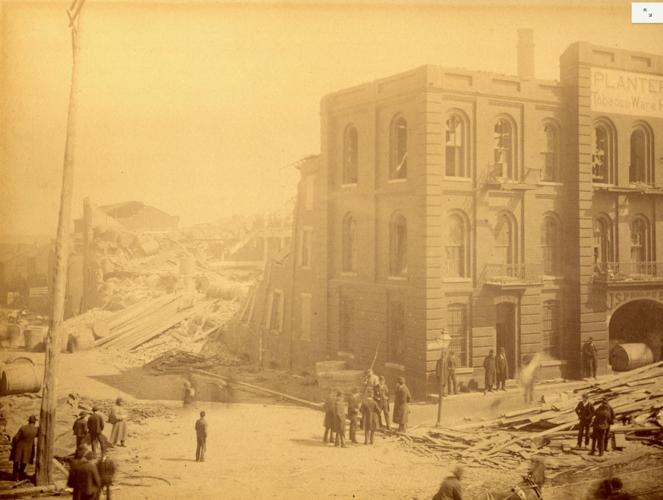
"May Louisville never again see such awful scenes as were presented last night." -- Louisville Courier-Journal
Photograph courtesy of The Filson Historical Society, Louisville, KY (TOR 1890 10).
A four-story building at the foot of 8th Street was reduced to little more than a pile of bricks. At 8th and Main the facade of the upper four stories of a 5-story building was blown into the street.
Photograph courtesy of The Filson Historical Society, Louisville, KY (Stuber Flat-12).
The tornado demolished the Union Depot at the foot of 7th Street, carrying great sections of it into the flooded Ohio River and burying three trains of cars. About 50 people, and several horses, were in the building at the time of the destruction.
Afterwards, thieves came down the river to rob passengers' luggage and the depot's ticket office. Police informed them that there were too many to many to arrest, so they would be shot instead.
Photograph courtesy of The Filson Historical Society, Louisville, KY (Stuber Flat-01 and TOR 1890 6).
Photograph 3 and 4 courtesy of The Library of Congress.
Photograph 5 courtesy of The Gutenberg Project: Louisville, KY. After the Cyclone, by E. Klauber.
The Fitch home lost much of its second story. While the walls simply fell out and down from the structure, the 6 pine doors on that floor disappeared. Mr. Fitch searched for several blocks around, but hadn’t found them by the time his story was printed in the newspaper.
Photograph courtesy of University of Louisville Archives and Special Collections. https://digital.library.louisville.edu/cdm/singleitem/collection/howard/id/1588/rec/12
Those in Jeffersonville who saw the approaching tornado said that it had the appearance of a grayish-black cloud, preceded by a mass of dust and flying timbers up to 60 feet in the air. Some reported a distinct roaring sound that was heard miles away, while others reported being unaware of the tornado until it was nearly on top of them.
Photograph courtesy of The Filson Historical Society, Louisville, KY (TOR 1890 27).
The tornado entered Jeffersonville at Broadway and Front Street (Riverside Drive about where Buckhead Mountain Grill is today). T. G. Bosley noticed the approach of the storm as his home’s walls began to vibrate. He told his wife and children to follow him out into the yard, which they did. The last child was barely out of the doorway when the residence, a 2-story brick building, collapsed.
Photograph courtesy of University of Louisville Archives and Special Collections. https://digital.library.louisville.edu/cdm/singleitem/collection/howard/id/1586/rec/3
Photograph 2 courtesy of The Filson Historical Society, Louisville, KY (TOR 1890 25).
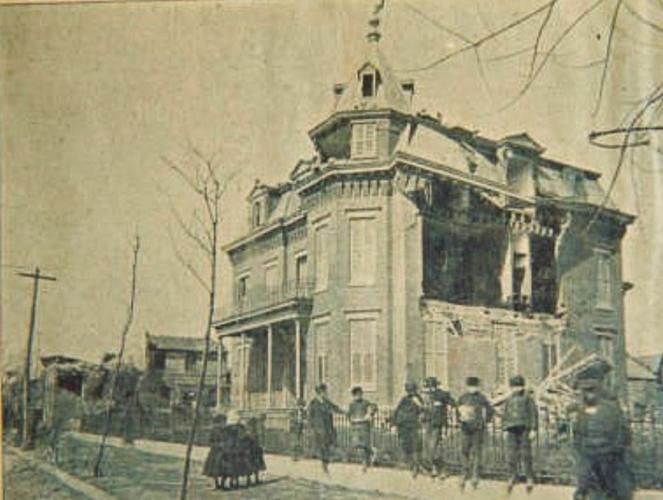
Fortunately the Ransom House was unoccupied at the time of the storm.
Photograph courtesy of Jeffersonville Township Public Library (Clark County Visual History).
The wind blowing across the river ahead of the tornado drove the water level about four feet higher, covering the streets and wharf in Jeffersonville with thick mud after the water receded.
Photograph courtesy of Jeffersonville Township Public Library (Clark County Visual History).
Damage in Jeffersonville was confined to within about a block of the river as the tornado skimmed along the shore.
Photograph courtesy of The Library of Congress.
At the water works all the windows of the pumping station were blown out and the 160 foot tall standpipe was toppled.
When the water tower was destroyed, workers couldn’t reach it due to flooding. The day after the storm the river level at McAlpine Lower was 63.3 feet, more than eight feet above flood stage.
Louisville had only about 6 days’ worth of water stored in the city reservoir.
Photographs courtesy of Louisville Water Company.
The Epicenter...
Falls City Hall was a three-story building used for civic activities. On the evening of March 27, 1890, there may have been as many as 250 people in the building. Three lodges were in session on the top floor, a German band was rehearsing on the second floor, and children were attending a dancing school with their mothers on the main floor. The dance class had ended before the tornado arrived, but the approaching storm caused the students and their mothers to remain inside to wait it out. As the winds increased and the building began to quake, there was a mad rush for the exits. Some people may have been trampled.
The tornado slammed into the building, and the entire structure collapsed into its basement. George Capito was on the top floor when the building collapsed: "The shrieks and groans of those imprisoned (in the debris) formed a chorus that, in connection with the howling of the storm, made my very heart sick."
Many people were not killed instantly, but were trapped under the mountain of boards and bricks. Some of the victims who perished were later found with comparatively little injury, and were likely asphyxiated by gas seeping from broken lines.
Smoke was drifting up from the rubble. As some debris were lifted in order to reach buried victims, oxygen was supplied to the source of the smoke and leaking gas lines, and soon the entire mass was aflame. The blaze was extinguished, but workers spent the night and next day "recovering charred and dismembered bodies."
Ten women were found with arms interlocked. Rescuer James Hanson went to extricate the women from the destruction, and the first person he came upon was his wife, who died in his arms. Of the ten women, nine were dead.
Neighboring buildings were used as morgues. From a witness in a saloon across the street from Falls City Hall: "One poor girl, who had been attending the dancing school, was brought in...and at once realized her doom. Turning her eyes to the men around her, she said feebly, 'I am dying. Pray for me.' There was silence for a moment, then every man silently uncovered and bowed his head. No one uttered a word for a moment, but finally a rough-looking man offered a brief and simple prayer for the dying girl. Her breath came shorter and shorter...and (she) passed quietly away with a brighter look on her face. Strong men wept like children at the scene as we folded her hands across her breast and watched her die."
Relief...
The Louisville Board of Trade organized a Relief Committee the morning following the disaster. An office was quickly set up where citizens could apply for assistance. 482 families were served. The Building Committee repaired or rebuilt 311 homes, including outside Louisville in Parkland and Cane Run. 74% of the relief funds were donated by private citizens. Expenses included funeral costs (57 funerals were paid for), replacement of furniture, making homes inhabitable, and establishing a fund for families who lost their wage-earner (38 of the 76 dead were the families' bread-winners) providing a small sum of money to families for up to 18 months following the storm. Color of skin was not a factor. Via this committee, the city of Louisville paid in full all losses sustained by those who could not afford to do so themselves.
The Permanent Relief Committee helped with health care costs, both physical and mental.
"Thank God for the spirit of sympathy which pulsated through every vein of this great Nation, which, although at times swayed by contending parties and sectional animosities, in the face of any great disaster, knows no North, no South, no East, no West.”
By the first week of April the streets had been mostly cleared of rubble. Temporary machinery installed at the water-works was tested on April 2 and was found to be satisfactory.
Mayor Charles Donald Jacob, in the final year of his fourth term as the city's leader, issued a proclamation appointing Friday, April 11, as "a day of fasting and (humility) in view of the visitation of the tornado.


