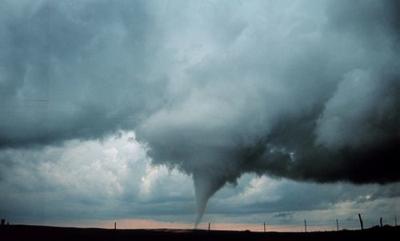
Think you know everything about tornadoes? Think again. Research suggests tornadoes may form from the ground up instead of the long-held idea they form at the base of a cloud and reach down toward the ground. (Image Credit above: NWS)
Last week during the meeting of the American Geophysical Union new research was presented about some older data from the 2013 El Reno tornado that killed several storm chasers. It was the widest tornado to be observed, and is now the most widely studied tornado in history.
Jana Houser and four other authors showed that the El Reno tornado may have formed from the ground up. You can click here to see their submission for the meeting. They noticed a signature making it look like the tornado started at the ground then formed together up toward the cloud. Then they looked for other similar radar signatures and found the same pattern in five (total) tornadoes that they studied.
This idea of tornadoes forming from the ground up is not a new idea, but this set of data is important for further research. The information was gathered by mobile radar units that can be driven toward storms likely to produce tornadoes. Their antennas can be positioned differently to observe storms in different ways.
The widely accepted theory that tornadoes form at the base of the cloud then extend down toward the earth is supported by scientific study and visual evidence (photographs and videos). The problem is tornadoes are hard to capture for study. They form quickly, and it's difficult to watch the entire tornado-genesis process to see what is happening. They are also tough to replicate in a laboratory environment like we can do with some other weather events.
With such a small dataset (only five tornadoes) more research still needs to be done even though this is not the first this idea has been proposed. At the very least, it tells us we still don't know everything about tornadoes and that their impacts may be felt at the ground before tight rotation appears higher up in the storm cloud.