When you see a snowfall forecast, is that number telling you how much snow will fall or how much snow will accumulate on the ground? Are those things different? How do we know if those forecasts were good or bad?
The National Weather Service is responsible for the snowfall record, but the measurements are actually taken by the weather observers at the airport in addition to what the NWS employees measure at their office (which is not at the airport).
They are recording three things:
- fallen snow (how much new snow has fallen)
- snow depth (how much snow is on the ground)
- liquid equivalent (if you took all the snow that has fallen and let it melt to liquid water, how much liquid would it be)
That liquid equivalent element is important because that's how we forecast snow. Forecast models don't handle snow well because they are built to forecast liquid. Knowing how much liquid made up that particular snowfall event helps us make better snow forecasts moving forward.
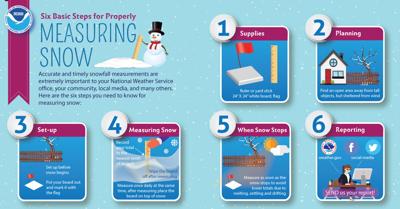
We all know how widely snow totals can vary across our area, so the NWS also relies heavily on reports that come in from the public to get a bigger picture of how much snow fell. You can measure those same variables at your house, too. You don't even need any fancy equipment to measure those things. To make the official measurements and to measure at your house, you need:
- a ruler or yardstick (measuring to a tenth of an inch for snow, a hundredth of an inch for liquid equivalent)
- a snowboard (16x16 or 24x24 piece of plywood painted white)
- the National Weather Service has a manual rain gauge with one cylinder inside another. To measure liquid equivalent, they remove the inner cylinder and allow snow to collect in that outer cylinder. Then they melt that snow to find the liquid equivalent.
To get setup at home to measure well:
- set up your snowboard on a level surface away from buildings or trees (maybe 20-30 feet away from any of those things if you have enough space for that)
- use your measuring stick - placed perpendicular to the ground - and get on eye level to make an accurate measurement
- measure fallen snow 1-4 times a day. Once a day (as soon as the event is over) is ideal, but if the snow event is rapidly changing you can measure as often as every six hours. After you measure, clean the snow off your snow board. You only need to measure snow depth (on the ground) once a day.

Image Credit: NWS
The snowboard is important so you don't measure newly fallen snow directly from the grass. You don't want to measure in the grass because snow doesn't fall all the way down to the ground; it sticks in the grass. So you're actually measuring grass and snow instead of just snow. You also don't want to measure in a snow drift where you are picking up artificial accumulations, and you should take a few measurements and average those measurements to get your total.
In a perfect world the snow would fall perfectly and not melt before you could measure it, but we know snow events are never perfect. You do want to try to measure the snow before it starts to melt, but the wind will also distort your measurement. If the wind is strong, it will blow snow away from your measurement area or blow snow off your snow board so you don't get as high a measurement as what actually fell. Don't change your numbers to try to account for that, but keep these things in mind when trying to get an accurate measurement.
For the record, our snowfall forecasts we share with you are telling you how much snow we expect will accumulate on the ground, which is not necessarily the same as how much will fall from the sky.


