HOW TO FIND MARS:
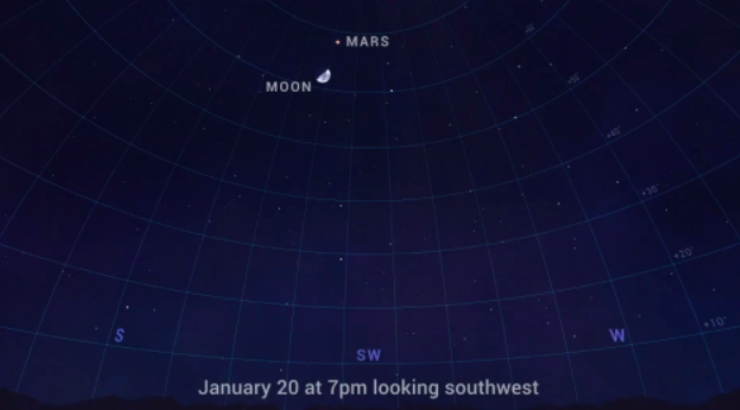
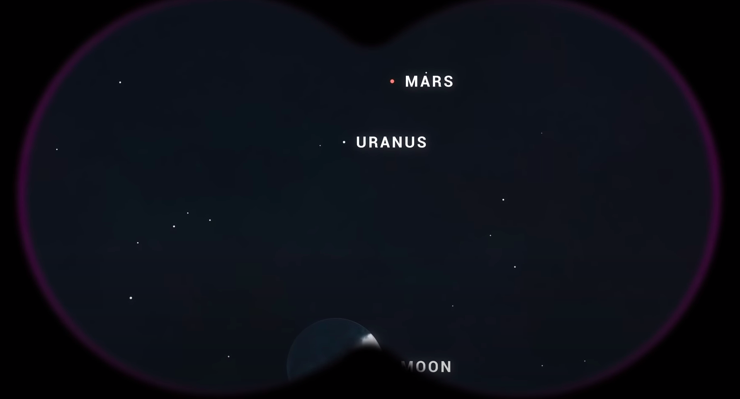
This evening into early Thursday morning, Jan. 20 to 21, 2021, the bright planet Mars will appear above the half-full Moon. As evening twilight ends (at 6:17 p.m. EST), Mars will appear about 8 degrees to the upper right of the Moon. The pair will appear to shift gradually closer together until the Moon sets in the west-northwest on Thursday morning shortly after midnight. By Thursday evening, the Moon will appear to have shifted to about 9 degrees to the other side of the planet Mars, and the pair will continue to separate as the evening progresses.
HOW TO FIND URANUS:
If you have access to binoculars or a telescope, then you might want to haul them out tonight, which offers an easy opportunity to view the planet Uranus. The distant, outer planet is too faint for most of us to see with the unaided eye, and it can be tough to locate in the sky without a computer-guided telescope. But tonight, Uranus will be located right between the Moon and Mars. This evening, find the crescent Moon and the Red Planet in the couple of hours after it gets dark. Scan your way over from Mars toward the Moon, and you should be able to find the faint, bluish disk of Uranus.
HOW TO FIND INTERNATIONAL SPACE STATION:
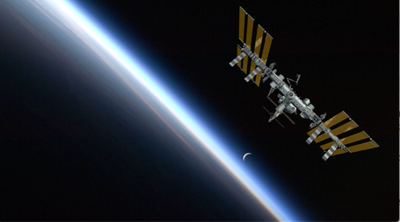
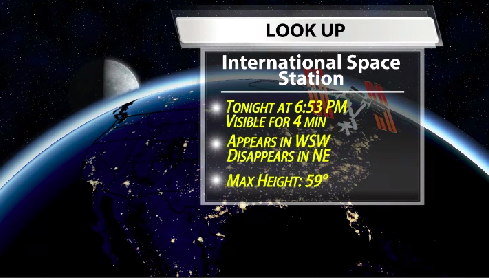
The ISS will be visible tonight at 6:53 PM for 4 minutes. The ISS will appear about 33 degrees above the horizon in the WSW part of the sky and move toward the northeast. It will set below the horizon in the NE part of the sky. The ISS will reach a peak elevation of 59 degrees above the horizon. So it will in the upper half of the sky.
CONDITIONS FOR VIEWING:
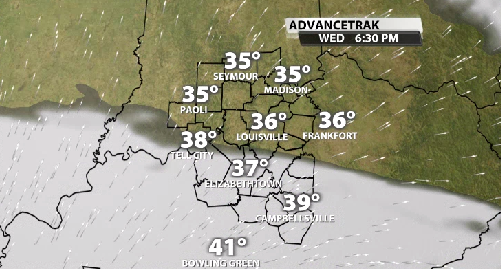
Clouds will be increasing this evening, especially in our southern communities, in Kentucky. I think many of us (especially in southern Indiana) will still have clear enough skies to see the action in sky this evening!