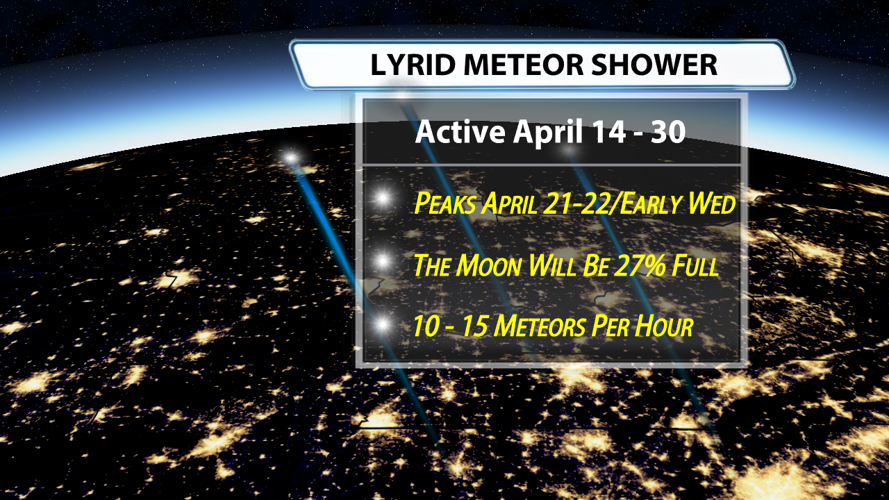

The Lyrid meteor shower, which peaks late April, is one of the oldest known meteor showers. How old? Well, the Lyrids have been observed for 2,700 years! The first recorded sighting of a Lyrid meteor shower goes back to 687 BC by the Chinese. In 2026, our peak will fall on April 21-22nd or early Wednesday morning. The Moon will be 27% full muting only the dimmest meteors. Expect 10 - 15 meteors per hour if you get away from city lights. These meteors also usually lack persistent trains but can produce fireballs. We will keep you updated on viewing conditions as the peak approaches later this month.

About the Meteor Shower
The Lyrids are known for their fast and bright meteors. Though not as fast or as plentiful as the famous Perseids in August, Lyrids can surprise watchers with as many as 100 meteors seen per hour. Sightings of these heavier showers occurred in 1803 (Virginia), 1922 (Greece), 1945 (Japan), and 1982 (U.S.). In general, 10-20 Lyrid meteors can be seen per hour during their peak.
Lyrids don’t tend to leave long, glowing dust trains behind them as they streak through the Earth's atmosphere, but they can produce the occasional bright flash called a fireball.
Viewing Tips
The Lyrids are best viewed in the Northern Hemisphere during the dark hours (after moonset and before dawn).
Find an area well away from city lights or street lights. Come prepared with a sleeping bag, blanket, or lawn chair. Lie flat on your back with your feet facing east and look up, taking in as much of the sky as possible. After about 30 minutes in the dark, your eyes will adapt and you will begin to see meteors. Be patient – the show will last until dawn, so you have plenty of time to catch a glimpse.
Where Do Meteors Come From?
Meteors come from leftover comet particles and bits from broken asteroids. When comets come around the Sun, they leave a dusty trail behind them. Every year Earth passes through these debris trails, which allows the bits to collide with our atmosphere where they disintegrate to create fiery and colorful streaks in the sky.
The Comet
The pieces of space debris that interact with our atmosphere to create the Lyrids originate from comet C/1861 G1 Thatcher. Comet Thatcher was discovered on April 5, 1861, by A. E. Thatcher.
The Radiant
Their radiant – the point in the sky from which the Lyrids appear to come – is near the constellation Lyra, the harp. Lyrids appear to radiate from the area near the star Vega, the brightest star in this constellation. (Helpful Hint: Vega is one of the brightest stars in the night sky and is easy to spot in even light-polluted areas.) The constellation of Lyra is also where we get the name for the shower: Lyrids.
It is actually better to view the Lyrids away from their radiant: They will appear longer and more spectacular from this perspective. If you do look directly at the radiant, you will find that the meteors will be short – this is an effect of perspective called foreshortening.