
Article by Caela Barry and Ernie Wright
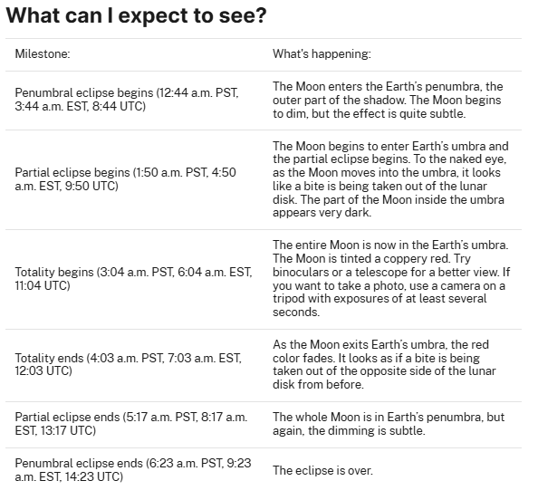
On March 3, 2025, the Moon enters the Earth's shadow, creating a total lunar eclipse, the first visible in the Americas since March of 2025. This animation shows the changing appearance of the Moon as it travels into and out of the Earth's shadow, along with times at various stages. Celestial north is up in this imagery, corresponding to the view from mid-northern latitudes. Rotating the images by 180 degrees would create the south-up view for southern hemisphere observers.
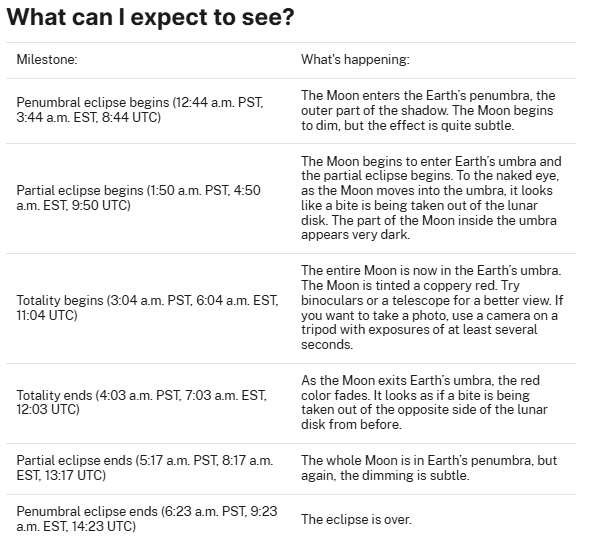
The penumbra is the part of the Earth’s shadow where the Sun is only partially covered by the Earth. The umbra is where the Sun is completely hidden. The Moon's appearance isn't affected much by the penumbra. The real action begins when the Moon starts to disappear as it enters the umbra at about 1:50 a.m. PST. An hour and a half later, entirely within the umbra, the Moon is a ghostly copper color. The totally eclipsed Moon is 10 or more f-stops dimmer than a normal full Moon. This is captured in the animation by simulating an abrupt change of exposure near the start and end of totality. Totality lasts for about an hour before the Moon begins to emerge from the central shadow. During the eclipse, the Moon is moving through the constellation Leo.
Credit: NASA's Goddard Space Flight Center/Scientific Visualization Studio
Ernie Wright (USRA): Lead Visualizer
This video can be freely shared and downloaded at https://svs.gsfc.nasa.gov/5604. While the video in its entirety can be shared without permission, the music and some individual imagery may have been obtained through permission and may not be excised or remixed in other products. Specific details on such imagery may be found here: https://svs.gsfc.nasa.gov/5604. For more information on NASA’s media guidelines, visit https://www.nasa.gov/nasa-brand-center/images-and-media/.
If you liked this video, subscribe to the NASA Goddard YouTube channel: https://www.youtube.com/NASAGoddard
Follow NASA’s Goddard Space Flight Center
· Instagram: http://www.instagram.com/nasagoddard
· X: http://twitter.com/NASAGoddard
· Facebook: http://www.facebook.com/NASAGoddard
· Flickr: http://www.flickr.com/photos/gsfc
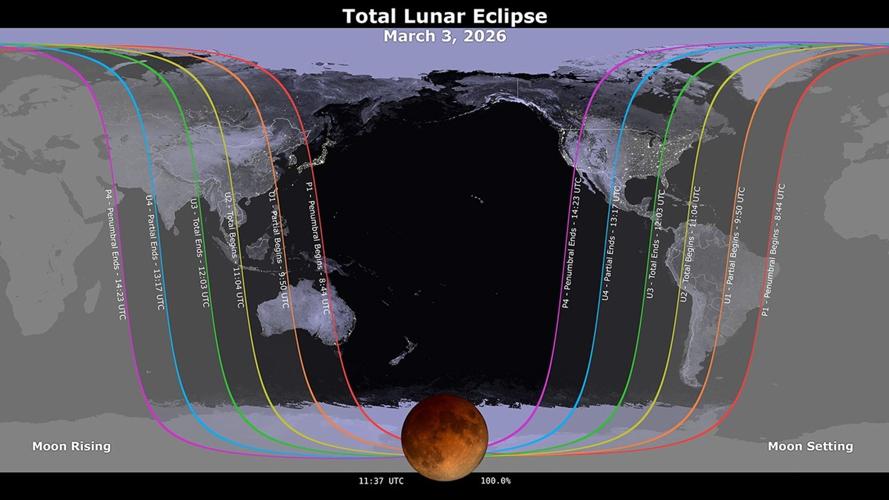
On Tuesday, March 3, 2026, a total lunar eclipse will take place across several time zones. In this data visualization, the Moon moves from right to left, passing through Earth's shadow and leaving in its wake an eclipse diagram with the times (in UTC) at various stages of the eclipse. Credit: NASA’s Scientific Visualization Studio
A total lunar eclipse will redden the Moon in the early morning hours of March 3, 2026. Here’s what you need to know.
How does a lunar eclipse work?
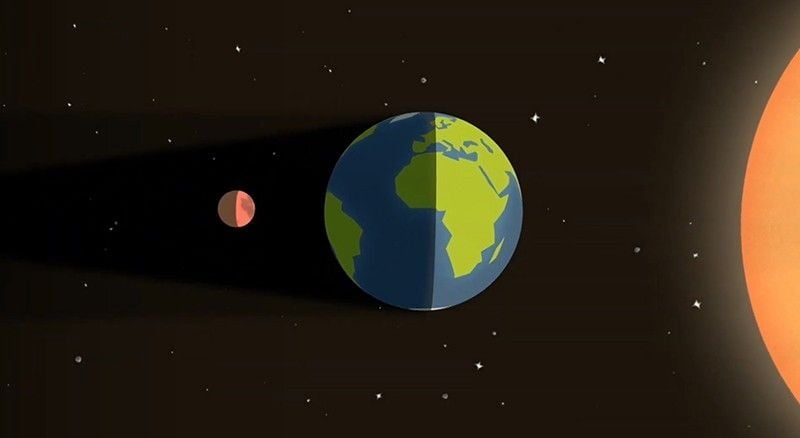
A lunar eclipse occurs when Earth passes directly between the Sun and Moon, casting a gigantic shadow across the lunar surface and turning the Moon a deep reddish-orange. This alignment can only occur during a full Moon phase.
How can I observe the eclipse?
You can observe a lunar eclipse without any special equipment. All you need is a line of sight to the Moon! For a more dramatic observing experience, seek a dark environment away from bright lights. Binoculars or a telescope can also enhance your view.
On March 3, totality will be visible in the evening from eastern Asia and Australia, throughout the night in the Pacific, and in the early morning in North and Central America and far western South America. The eclipse is partial in central Asia and much of South America. No eclipse is visible in Africa or Europe.

Why is a lunar eclipse sometimes called a “blood Moon”?
During a total lunar eclipse, the Moon appears dark red or orange. This is because our planet blocks most of the Sun’s light from reaching the Moon, and the light that does reach the lunar surface is filtered through a thick slice of Earth’s atmosphere. It’s as if all of the world’s sunrises and sunsets are projected onto the Moon.
Learn more: Why does the Moon turn red during a solar eclipse?
The March 3, 2026 total lunar eclipse is the first one visible in the Americas since March of 2025. Celestial north is up in this imagery, corresponding to the view from mid-northern latitudes. Rotating the images by 180 degrees would create the south-up view for southern hemisphere observers. The obscuration percentage in the table is the fraction of the Moon covered by the Earth's umbra, the part of its shadow in which the Sun is completely blocked. The part of the shadow in which the Sun is only partially blocked is called the penumbra.
The animations on this page run from 8:06:00 to 15:38:50 UTC, which is also the valid range of times for this Dial-a-Moon. The exposure setting of the virtual camera changes around totality in order to capture the wide dynamic range of the eclipse. The parts of the Moon outside the umbra during the partial phases are almost as bright as an ordinary full moon, making the obstructed parts appear nearly black. But during totality, our eyes adjust and reveal a range of hues painted on the Moon by all of Earth's sunrises and sunsets.
All phases of a lunar eclipse are safe to view, both with your naked eye and an unfiltered telescope.
Credit: NASA's Goddard Space Flight Center/Scientific Visualization Studio
Ernie Wright (USRA): Lead Visualizer
This video can be freely shared and downloaded at https://svs.gsfc.nasa.gov/5605. While the video in its entirety can be shared without permission, the music and some individual imagery may have been obtained through permission and may not be excised or remixed in other products. Specific details on such imagery may be found here: https://svs.gsfc.nasa.gov/5605. For more information on NASA’s media guidelines, visit https://www.nasa.gov/nasa-brand-center/images-and-media/.
If you liked this video, subscribe to the NASA Goddard YouTube channel: https://www.youtube.com/NASAGoddard
Follow NASA’s Goddard Space Flight Center
· Instagram: http://www.instagram.com/nasagoddard
· X: http://twitter.com/NASAGoddard
· Facebook: http://www.facebook.com/NASAGoddard
· Flickr: http://www.flickr.com/photos/gsfc
Data visualization showing a telescopic view of the Moon as the March 2026 total lunar eclipse unfolds. Credit: NASA’s Scientific Visualization Studio
What else can I observe on the night of the eclipse?
As Earth's shadow dims the lunar surface, constellations may be easier to spot than they usually are during a full Moon. At the time of the eclipse, the Moon will be in the constellation Leo, under the lion's hind paws.
Several days later, on March 8, look for a “conjunction” of Venus and Saturn: from our perspective on Earth, these two planets will appear close to each other in the sky (though they’ll still be very distant from each other in space).
Visit our What's Up guide for more skywatching tips, and find lunar observing recommendations for each day of the year in our Daily Moon Guide.


