
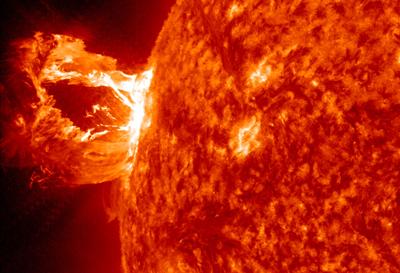
In a teleconference with reporters on Tuesday, representatives from NASA, the National Oceanic and Atmospheric Administration (NOAA), and the international Solar Cycle Prediction Panel announced that the Sun has reached its solar maximum period, which could continue for the next year.
The solar cycle is a natural cycle the Sun goes through as it transitions between low and high magnetic activity. Roughly every 11 years, at the height of the solar cycle, the Sun’s magnetic poles flip — on Earth, that’d be like the North and South poles swapping places every decade — and the Sun transitions from being calm to an active and stormy state.
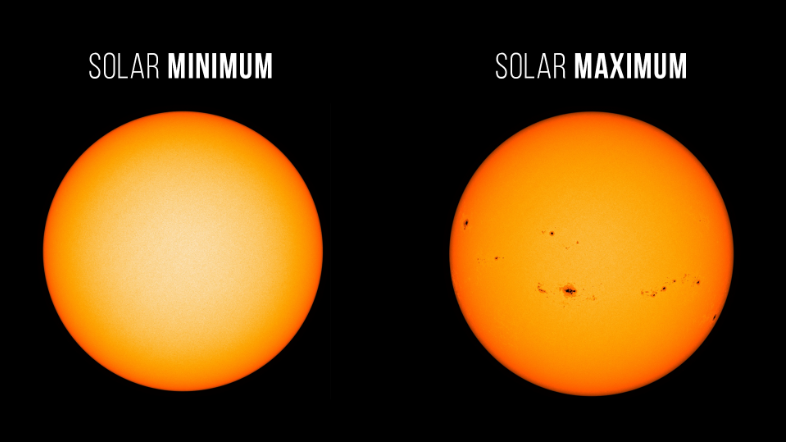
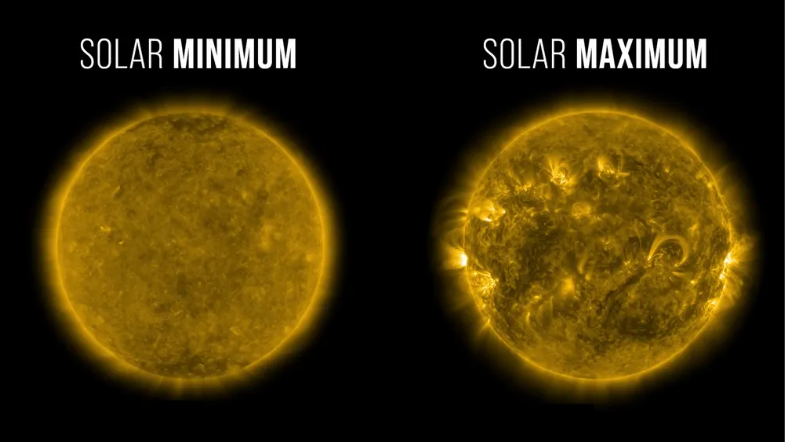
Images from NASA’s Solar Dynamics Observatory highlight the appearance of the Sun at solar minimum (left, December 2019) versus solar maximum (right, May 2024). These images are in the 171-angstrom wavelength of extreme ultraviolet light, which reveals the active regions on the Sun that are more common during solar maximum.
NASA and NOAA track sunspots to determine and predict the progress of the solar cycle — and ultimately, solar activity. Sunspots are cooler regions on the Sun caused by a concentration of magnetic field lines. Sunspots are the visible component of active regions, areas of intense and complex magnetic fields on the Sun that are the source of solar eruptions.
“During solar maximum, the number of sunspots, and therefore, the amount of solar activity, increases,” said Jamie Favors, director, Space Weather Program at NASA Headquarters in Washington. “This increase in activity provides an exciting opportunity to learn about our closest star — but also causes real effects at Earth and throughout our solar system.”
The Sun is stirring from its latest slumber. As sunspots and flares bubble from the Sun’s surface, representatives from NASA, the National Oceanic and Atmospheric Agency (NOAA), and the Solar Cycle Prediction Panel have announced the Sun has reached its solar maximum period.
The solar cycle is the natural cycle of the Sun as it transitions between low and high activity. During the most active part of the cycle, known as solar maximum, the Sun can unleash immense explosions of light, energy, and solar radiation — all of which create conditions known as space weather. Space weather can affect satellites and astronauts in space, as well as communications systems — such as radio and GPS — and power grids on Earth.
Music Credit: “Society News Bed Instrumental” by Jean-Francois Berger [SACEM] via Universal Production Music
Video credit: NASA’s Goddard Space Flight Center
Producer: Beth Anthony (eMITS)
This video can be freely shared and downloaded at https://svs.gsfc.nasa.gov/14685 While the video in its entirety can be shared without permission, the music and some individual imagery may have been obtained through permission and may not be excised or remixed in other products. Specific details on such imagery may be found here:
https://svs.gsfc.nasa.gov/14685
For more information on NASA’s media guidelines, visit
https://www.nasa.gov/nasa-brand-center/images-and-media/.
If you liked this video, subscribe to the NASA Goddard YouTube channel: https://www.youtube.com/NASAGoddard
Follow NASA’s Goddard Space Flight Center
· Instagram: http://www.instagram.com/nasagoddard
· X: http://twitter.com/NASAGoddard
· Facebook: http://www.facebook.com/NASAGoddard
· Flickr: http://www.flickr.com/photos/gsfc
The solar cycle is the natural cycle of the Sun as it transitions between low and high activity. During the most active part of the cycle, known as solar maximum, the Sun can unleash immense explosions of light, energy, and solar radiation — all of which create conditions known as space weather. Space weather can affect satellites and astronauts in space, as well as communications systems — such as radio and GPS — and power grids on Earth.
Credits: Beth Anthony/NASA
Solar activity strongly influences conditions in space known as space weather. This can affect satellites and astronauts in space, as well as communications and navigation systems — such as radio and GPS — and power grids on Earth. When the Sun is most active, space weather events become more frequent. Solar activity has led to increased aurora visibility and impacts on satellites and infrastructure in recent months.
During May 2024, a barrage of large solar flares and coronal mass ejections (CMEs) launched clouds of charged particles and magnetic fields toward Earth, creating the strongest geomagnetic storm at Earth in two decades — and possibly among the strongest displays of auroras on record in the past 500 years.
From May 3 through May 9, 2024, NASA’s Solar Dynamics Observatory observed 82 notable solar flares. The flares came mainly from two active regions on the Sun called AR 13663 and AR 13664. This video highlights all flares classified at M5 or higher with nine categorized as X-class solar flares.
A solar flare is an intense burst of radiation, or light, on the Sun. Flares are our solar system’s most powerful explosive events. Light only takes about 8 minutes to travel from the Sun to Earth, so that’s how long it would take the energy from a flare to reach our planet.
Solar flares are rated into different classes based on their strength, or energy output, and the effect a flare will have on Earth depends on what class it is (B, C, M, and X classes, with X being the most intense). Earth’s atmosphere absorbs most of the Sun’s intense radiation, so flares are not directly harmful to humans on the ground. However, the radiation from a flare can be harmful to astronauts outside of Earth’s atmosphere, and it can affect the technology we rely on.
Stronger solar flares — those rated class M5 or above — can have impacts on technology that depends on Earth’s ionosphere (our electrically charged upper atmosphere), like high-frequency radio used for navigation and GPS.
To see how such space weather may affect Earth, please visit NOAA’s Space Weather Prediction Center https://spaceweather.gov/, the U.S. government’s official source for space weather forecasts, watches, warnings, and alerts. NASA works as a research arm of the nation’s space weather effort. NASA observes the Sun and our space environment constantly with a fleet of spacecraft that study everything from the Sun’s activity to the solar atmosphere, and to the particles and magnetic fields in the space surrounding Earth.
Music Credit: “Halos” from the album Burning Clouds. Written and produced by Lars Leonhard. https://ultimae.bandcamp.com/track/halos
C&P 2014 Ultimae—Ultimae.com
Video credit: NASA’s Goddard Space Flight Center
Producer: Beth Anthony (eMITS)
Writer: Abbey A. Interrante (ADNET Systems, Inc.)
Writer: Joy Ng (National Institutes of Aerospace)
This video can be freely shared and downloaded at https://svs.gsfc.nasa.gov/14588 While the video in its entirety can be shared without permission, the music and some individual imagery may have been obtained through permission and may not be excised or remixed in other products. Specific details on such imagery may be found here:
https://svs.gsfc.nasa.gov/14588
For more information on NASA’s media guidelines, visit
https://www.nasa.gov/nasa-brand-center/images-and-media/.
If you liked this video, subscribe to the NASA Goddard YouTube channel: https://www.youtube.com/NASAGoddard
Follow NASA’s Goddard Space Flight Center
· Instagram: http://www.instagram.com/nasagoddard
· X: http://twitter.com/NASAGoddard
· Facebook: http://www.facebook.com/NASAGoddard
· Flickr: http://www.flickr.com/photos/gsfc
May 3–May 9, 2024, NASA’s Solar Dynamics Observatory observed 82 notable solar flares. The flares came mainly from two active regions on the Sun called AR 13663 and AR 13664. This video highlights all flares classified at M5 or higher with nine categorized as X-class solar flares.
Credit: NASA
“This announcement doesn’t mean that this is the peak of solar activity we’ll see this solar cycle,” said Elsayed Talaat, director of space weather operations at NOAA. “While the Sun has reached the solar maximum period, the month that solar activity peaks on the Sun will not be identified for months or years.”
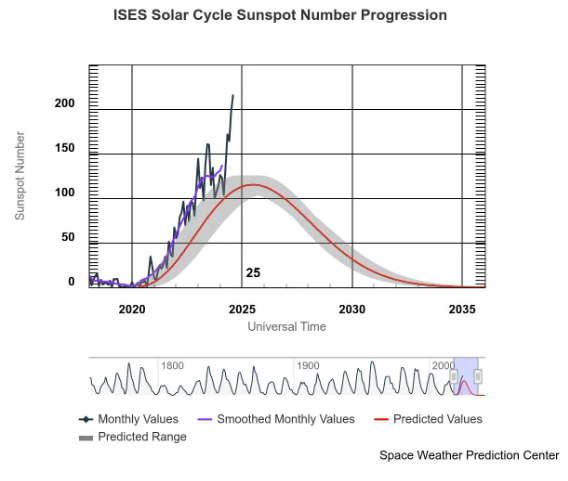
Scientists will not be able to determine the exact peak of this solar maximum period for many months because it’s only identifiable after they’ve tracked a consistent decline in solar activity after that peak. However, scientists have identified that the last two years on the Sun have been part of this active phase of the solar cycle, due to the consistently high number of sunspots during this period. Scientists anticipate that the maximum phase will last another year or so before the Sun enters the declining phase, which leads back to solar minimum. Since 1989, the Solar Cycle Prediction Panel — an international panel of experts sponsored by NASA and NOAA — has worked together to make their prediction for the next solar cycle.
Solar cycles have been tracked by astronomers since Galileo first observed sunspots in the 1600s. Each solar cycle is different — some cycles peak for larger and shorter amounts of time, and others have smaller peaks that last longer.
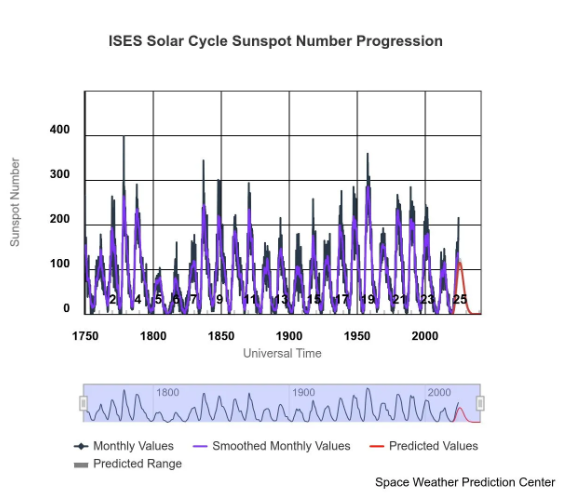
Sunspot number over the previous 24 solar cycles. Scientists use sunspots to track solar cycle progress; the dark spots are associated with solar activity, often as the origins for giant explosions — such as solar flares or coronal mass ejections — which can spew light, energy, and solar material out into space.
“Solar Cycle 25 sunspot activity has slightly exceeded expectations,” said Lisa Upton, co-chair of the Solar Cycle Prediction Panel and lead scientist at Southwest Research Institute in San Antonio, Texas. “However, despite seeing a few large storms, they aren’t larger than what we might expect during the maximum phase of the cycle.”
The most powerful flare of the solar cycle so far was an X9.0 on Oct. 3 (X-class denotes the most intense flares, while the number provides more information about its strength).
NOAA anticipates additional solar and geomagnetic storms during the current solar maximum period, leading to opportunities to spot auroras over the next several months, as well as potential technology impacts. Additionally, though less frequent, scientists often see fairly significant storms during the declining phase of the solar cycle.
NASA and NOAA are preparing for the future of space weather research and prediction. In December 2024, NASA’s Parker Solar Probe mission will make its closest-ever approach to the Sun, beating its own record of closest human-made object to the Sun. This will be the first of three planned approaches for Parker at this distance, helping researchers to understand space weather right at the source.
NASA is launching several missions over the next year that will help us better understand space weather and its impacts across the solar system.
Space weather predictions are critical for supporting the spacecraft and astronauts of NASA’s Artemis campaign. Surveying this space environment is a vital part of understanding and mitigating astronaut exposure to space radiation.
NASA works as a research arm of the nation’s space weather effort. To see how space weather can affect Earth, please visit NOAA’s Space Weather Prediction Center, the U.S. government’s official source for space weather forecasts, watches, warnings, and alerts.
By Abbey Interrante
NASA’s Goddard Space Flight Center, Greenbelt, Md.