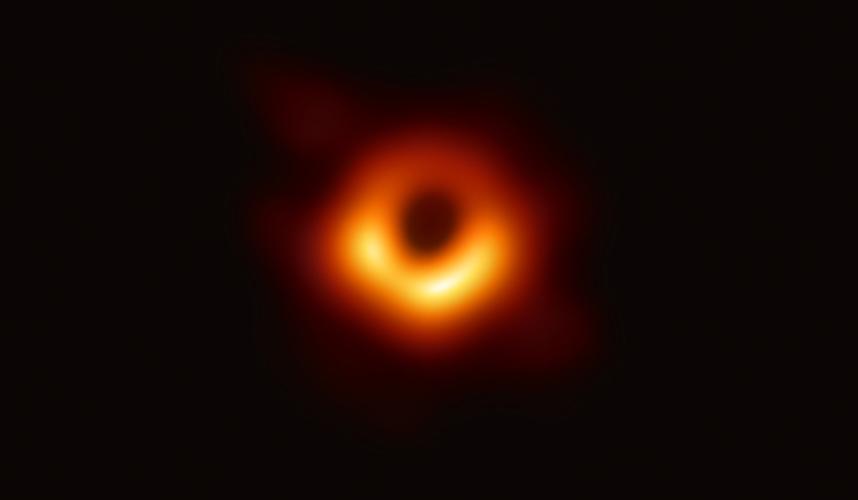
This image has never been captured before now. It shows a supermassive black hole and its shadow. These are nearly impossible to photograph because no light can escape from a black hole - it's too dense. According to a NASA press release on this topic, "Anything that comes within a black hole’s 'event horizon,' its point of no return, will be consumed, never to re-emerge, because of the black hole’s unimaginably strong gravity." (It's worth noting the "event horizon" of this particular black hole is roughly the size of our entire solar system) In reality we can only see the shadow of the black hole against the bright disk behind it; we can't actually see into the black hole itself.

Image Credit (also at top of page): Event Horizon Telescope collaboration et al.
This supermassive black hole is in the center of Messier 87 (M87), an elliptical galaxy roughly 55 million light-years away from us. Supermassive describes the size; according to the University of Cambridge "stellar mass" black holes are roughly 3-10 times the mass of our Sun while supermassive black holes are 100,000-10,000,000,000 time the mass of our Sun. This particular black hole is 6.5 billion times the mass of our Sun. It took eight telescopes on Earth, part of an international network of radio telescopes called the Event Horizon Telescope, to capture this image. That may not sound like a big deal, but those telescopes are on four different continents. The weather at each location had to be nearly perfect to allow the telescopes to look this far away without interference on Earth. Originally scientists thought they would have to build one incredible telescope to study black holes, but the EHT is doing that work now. Researchers are not done studying all the data that came from this event and expect more discoveries can be made from it.

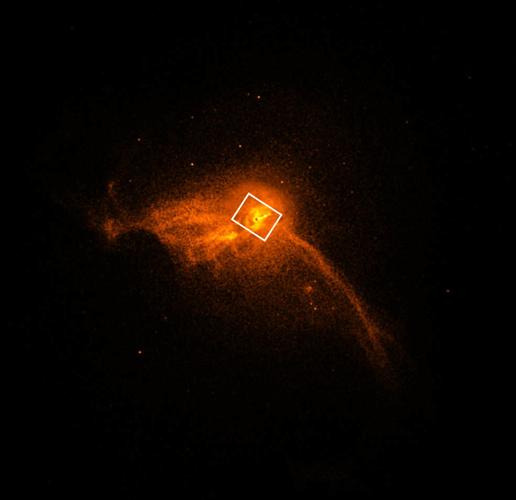
Image Credit: NASA/CXC/Villanova University/J.Neilsen
According to the Associated Press, "The measurements were taken at a wavelength the human eye cannot see, so the astronomers added color to the image, choosing gold and orange because the light and gas are so hot, heated to millions of degrees by the friction of gravity." Albert Einstein theorized about black holes more than one hundred years ago and scientists have been studying them for decades. Even so, the origin of the supermassive black hole remains a mystery in many regards. Smaller black holes can result from collapsed stars, but that does not explain their larger cousins. Until now we have only seen artists renditions of what a black hole may look like; now we see what it really is.


