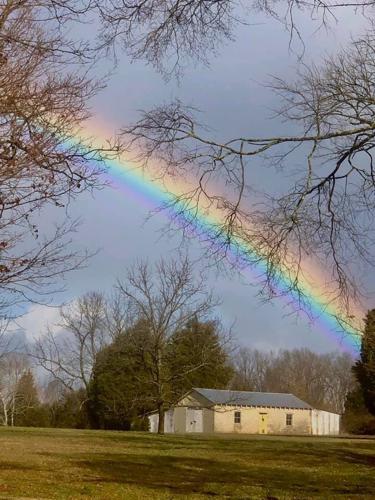

Supernumerary rainbows: trying saying that five times fast! It's pronounced just like it's spelled if you go through it slowly: super-noom-er-ar-y (here's the real phonetics from the dictionary: "so͞opərˈn(y)o͞oməˌrerē")
Until last week it's a word I (Hannah) had not heard before. When I heard Marc say "supernumerary rainbow" while showing the picture below sent in by one of our viewers, I started researching. That's what today's blog is: my research into this specific kind of rainbow.
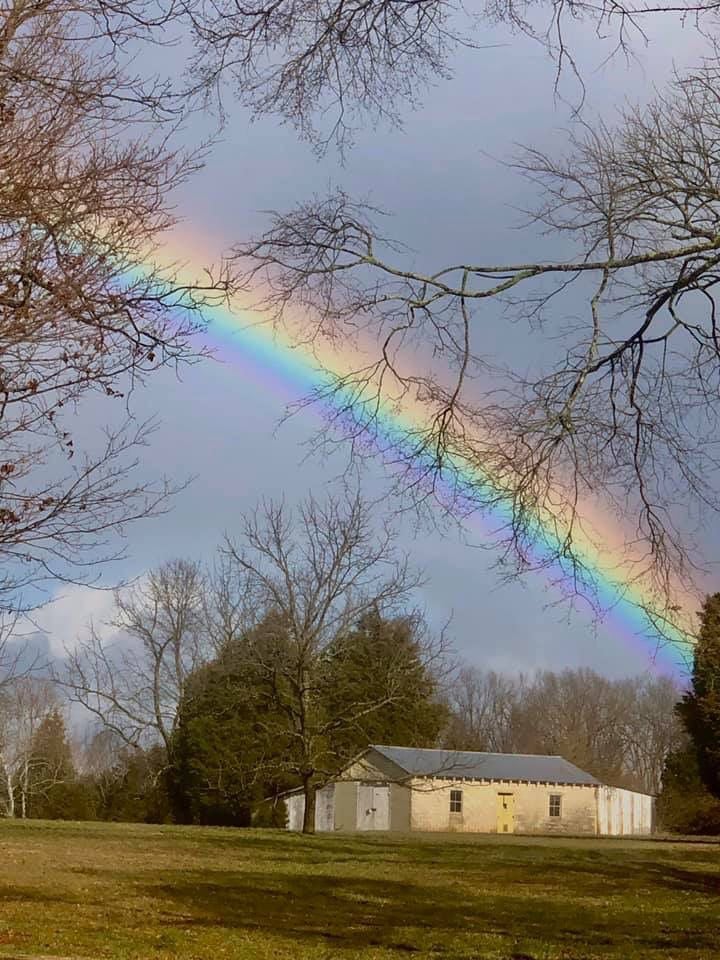
From this wide view you may not see anything weird about this rainbow, so let's zoom in.
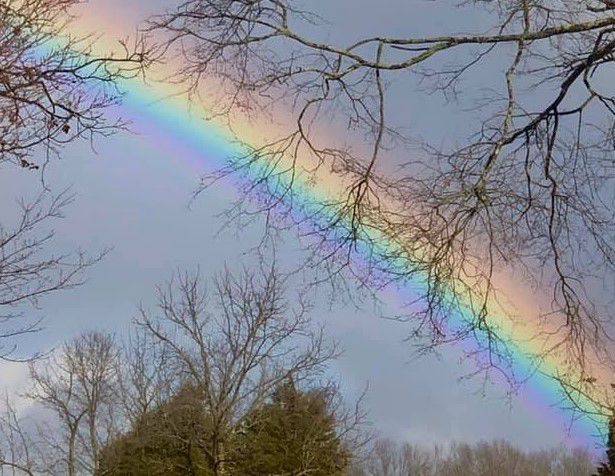
Can you see it yet? Let me show you where to focus.
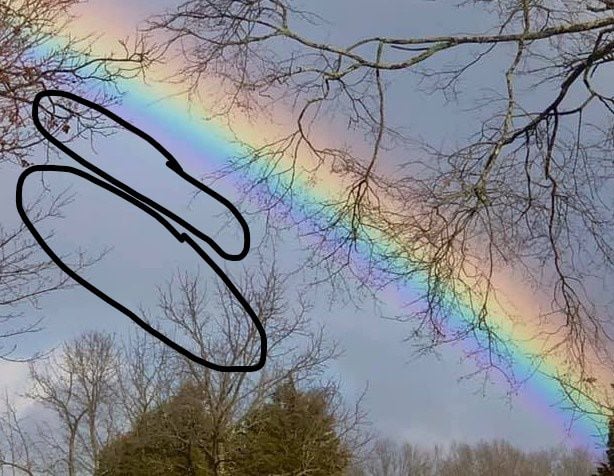
Now do you see the faint purples and greens in the circles? Let's zoom once more.
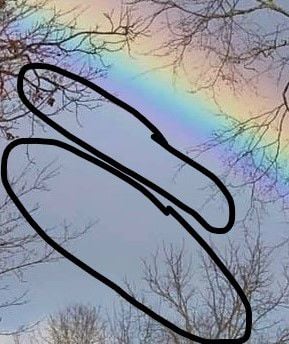
You are looking at supernumerary rainbows! But what is this? What are we actually seeing?
HOW DO THEY FORM?
Supernumeraries show up inside the inner edge (the purple side) of the primary bow. It's common to see these on a day with a visible double rainbow, so locate the primary (more vibrant) rainbow and look at it's inner edge. Look toward the peak of the primary rainbow, where it's highest in the sky, then follow the rainbow to where it becomes more vertically oriented than horizontally. That's where you are most likely to find the supernumerary.
You need lots of sunshine and lots of raindrops to get these. Ideally those raindrops would all be roughly the same size and less than a millimeter in diameter. Raindrops can be anywhere from 0.1 to 5.0 (or slightly larger) millimeters across, but 1-2 mm. is pretty average. It doesn't happen often that we have bright, unobstructed sunshine while heavy rain is falling, but that's what you need to see a supernumerary.
A "normal" rainbow is formed when sunlight passes through raindrops and is refracted. That refraction separates the sunlight into the colors of the rainbow and reflection in that drop and by other raindrops creates the longer bow instead of the tiny stripe of colors that show up when sunlight passes through your grandma's crystal lamp.
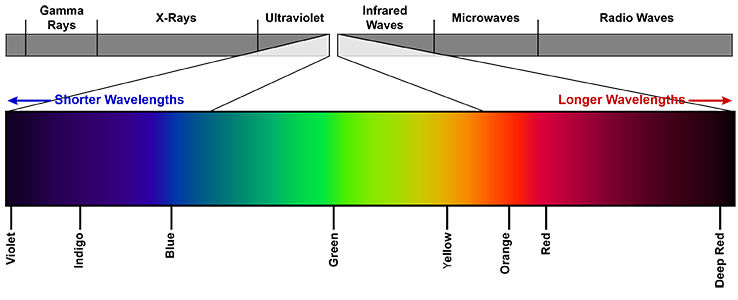
To understand how supernumeraries form, you need to understand that light behaves like a wave in a pond. Supernumerary rainbows actually helped prove the theory that light travels as a wave! In fact, the reason you are seeing different colors in a rainbow is *because* light has different wavelengths. The wavelength of red is longer than yellow which is longer than blue. When the light is refracted, it is separated into the different wavelengths shown in the image below from the National Weather Service.
That still happens for a supernumerary rainbow, but we add another layer to the equation. The light is refracted through raindrops and reflected by them; then you need interference. That's an optical term describing when waves of light overlap each other, seen in the image below from the Boston University Physics Department. The image looks like repeating ripples in a pond which is exactly what a supernumerary rainbow is - just the visible light form.
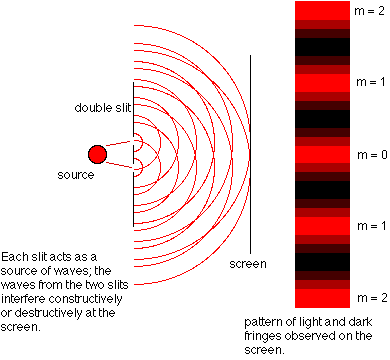
Because they are formed differently and by wave motion, you can pick up on noticeable changes in the supernumeraries minute to minute. The typical rainbows form by refraction and reflection don't change quite as much as quickly.
CAN I SEE THEM?
Yes! These can be tough to spot but are not terribly unusual. Like what we did in this blog, it may be easier to take a picture first, then try to zoom in to see it better if you think you may be looking at a supernumerary rainbow.