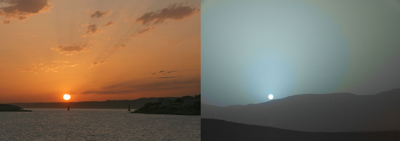
Check out these two images of the sun at sunset...One from Earth and one from Mars!
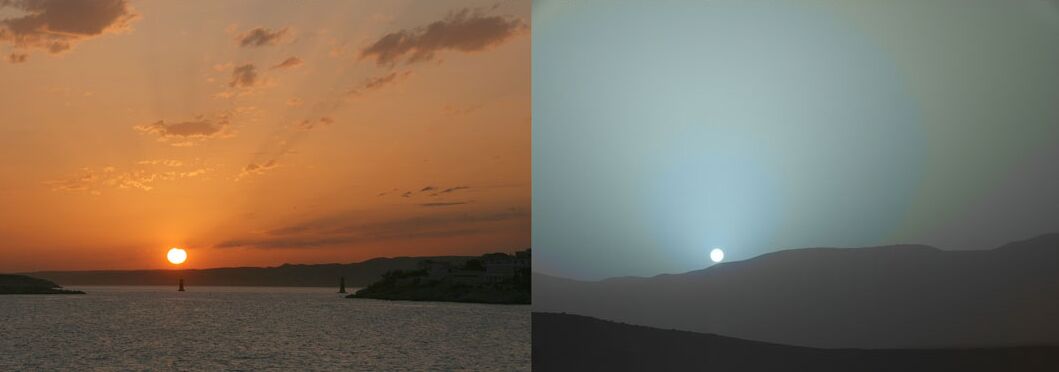
A quick inspection will reveal that the Sun appears slightly smaller from Mars than from Earth. This makes sense because Mars is 50% farther the Sun than Earth, the Sun appears only about two-thirds the size we see when we watch sunsets here on Earth. More striking, perhaps, is that Mar's sunset is noticeably bluer near the Sun than the typically orange colors near the setting Sun from Earth. The reason for the blue hues from Mars is not fully understood, but thought to be related to forward scattering properties of Martian dust. The terrestrial sunset was taken in 2012 March from Marseille, France, while the Martian sunset was captured last month by NASA's robotic Curiosity rover from Gale crater on Mars.
Science Behind the Scenery
These images are more than just beauty shots.
Martian sunset and twilight images help scientists determine how high into the atmosphere the martian dust extends, and allow them to look for dust or ice clouds.
Other images have shown that the twilight glow remains visible, but increasingly fainter, for up to two hours before sunrise or after sunset. The long martian twilight (compared to Earth's) is caused by sunlight scattered around to the night side of the planet by abundant high altitude dust.
Similar long twilights or extra-colorful sunrises and sunsets sometimes occur on Earth when tiny dust grains that are erupted from powerful volcanoes scatter light high in the atmosphere.
Why is Mars Red? Why Are Some Images Blue?
Mars is known as the Red Planet because of iron oxide (like rust) in its soil. The planet's distinctive reddish hue is visible from Earth even without the aid of a telescope. The ancient Romans named it for their God of War (Ares in Greek mythology).
So what's with the blue twilight?
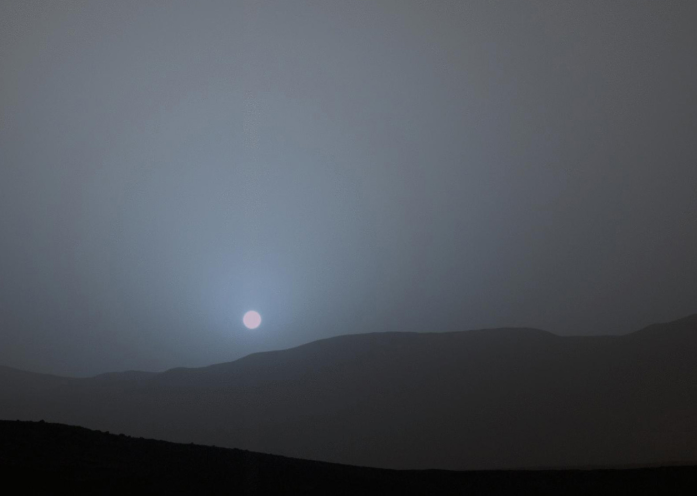
Just as colors are made more dramatic in sunsets on Earth, Martian sunsets would appear bluish to human observers watching from the red planet. Fine dust makes the blue near the Sun's part of the sky much more prominent, while normal daylight makes the Red Planet's familiar rusty dust color more prominent.
"The colors come from the fact that the very fine dust is the right size so that blue light penetrates the atmosphere slightly more efficiently," said Mark Lemmon of Texas A&M University, College Station, a science team member of the Curiosity rover mission. "When the blue light scatters off the dust, it stays closer to the direction of the Sun than light of other colors does. The rest of the sky is yellow to orange, as yellow and red light scatter all over the sky instead of being absorbed or staying close to the Sun."


