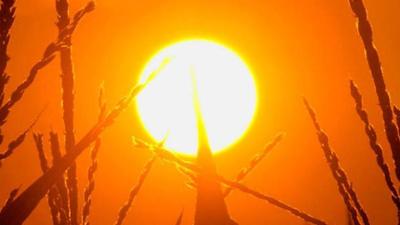
Summer officially arrives at the end of this week during the summer solstice, so it's that time of year to start talking about hazards of hot weather. One we have already started showing you this season is the UV Index, but why is it important and what is it telling you? I'm so glad you asked :)
WHAT IS UV INDEX
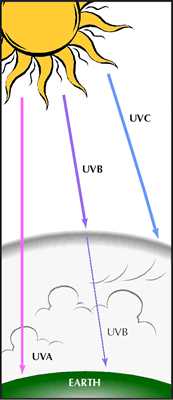
The sun emits energy over a broad spectrum of wavelengths: visible light that you see, infrared radiation that you feel as heat, and ultraviolet (UV) radiation that you can't see or feel. UV radiation has a shorter wavelength and higher energy than visible light. It affects human health, both positively and negatively. Short exposure to UV radiation generates vitamin D, but can also lead to sunburn. Fortunately for life on Earth, our atmosphere's ozone layer shields us from most of the dangerous UV radiation wavelengths. However, what does get through the ozone layer can still cause serious health problems. The sunny days when temperatures aren't terribly hot can be some of the most problematic days because you don't always think about needing to protect yourself from the sun when temperatures are lower. But you still need to.
WHAT DO THE NUMBERS MEAN
Believe it or not, forecasts play a big part in the numbers. The National Weather Service has an equation to determine the UV Index that factors in surface elevation, forecasted cloud cover and stratospheric ozone concentration. That stratospheric ozone is what blocks out the majority of the harmful UV radiation.
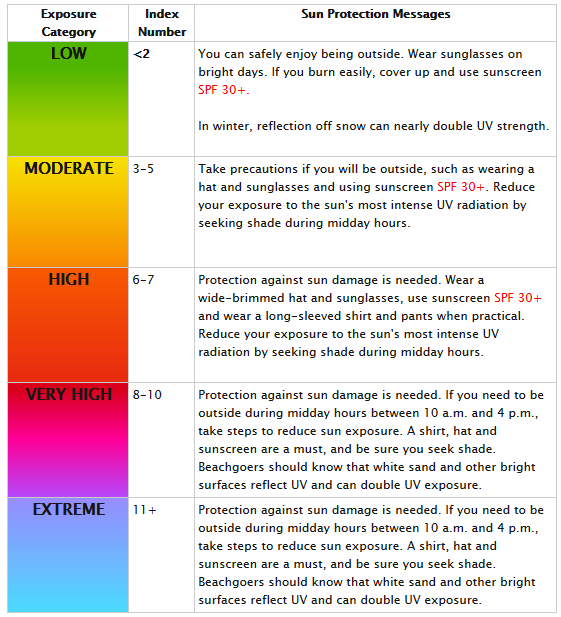
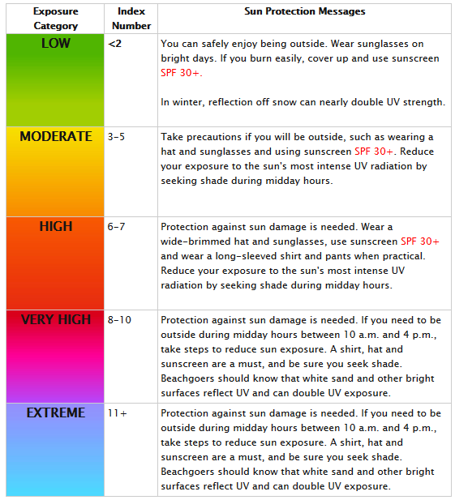
They make their calculations which yield a result on a scale from less than 2 up to 11+. The image above from the Environmental Protection Agency explains each different category and the risks that much UV radiation poses to you.
WHY IS THIS IMPORTANT
As mentioned above UV exposure can be beneficial in small amounts, but overexposure can lead to:
- Skin cancer (melanoma and nonmelanoma)
- Premature aging of the skin and other skin problems
- Cataracts and other eye damage
- Immune system suppression
Here's a good rule of thumb: if your shadow is taller than you, which happens in the early morning and late afternoon, your UV exposure will be lower. If your shadow is shorter than you, which happens around midday, you are being exposed to higher levels of UV radiation. Those are the times when you need to protect yourself. The Environmental Protection Agency recommends these actions:
- Limit your time in the sun between 10:00 a.m. and 4:00 p.m.
- Whenever possible, seek shade.
- Use a broad spectrum sunscreen with an Sun Protection Factor (SPF) of at least 30.
- Wear a wide-brimmed hat and if possible, tightly woven, full-length clothing.
- Wear UV-protective sunglasses.
- Avoid sunlamps and tanning salons.
- Watch for the UV Index daily.


