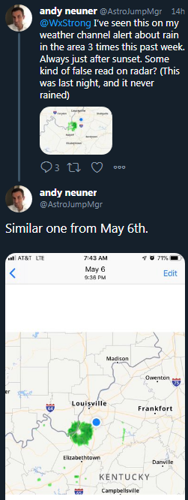
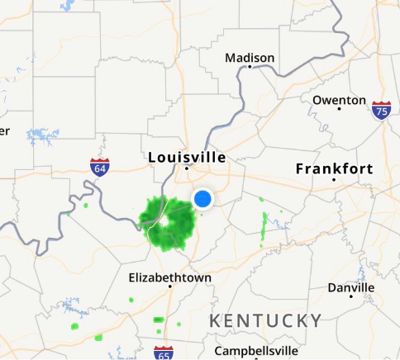
Sometimes if you look at radar late in the evening, it may show colors even when there is no rain in the area. Andy reached out on Twitter asking what is causing this. He said the weather app he was using even alerted him that rain was in his area even though there was no rain - just this strange circle around the radar site.

This phenomenon is called "ground clutter." To discuss this it's important to understand how radar works. The radar sends out a beam of energy. If that beam hits an object, it gets bounced back to the radar and shows up on the display. Radar is not a camera that can see the difference visually between rain, snow, hail, bugs, etc. With recent radar data upgrades (dual-polarization), depending on how the beam gets bounced back we can tell a subtle difference between the shape of objects and make inferences about what they might be.
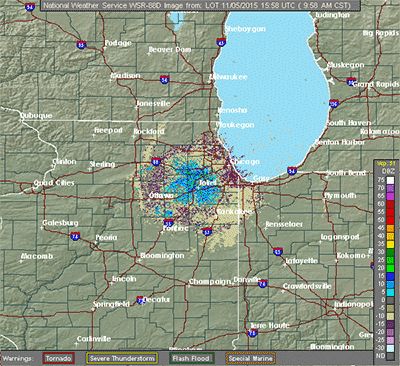
Image from NWS
Ground clutter happens when the radar beam has hit something and bounced. It doesn't just randomly start showing colors where nothing exists. The problem is, since the radar can't visually see the difference between a rain drop and bugs or tree leaves, when it runs into these biological objects and gets bounced back, they look the same as rain on the display. The radar beam is closest to the ground at the radar site, which is why this shows up around the site of the radar every time instead of at some random location in the radar coverage area.
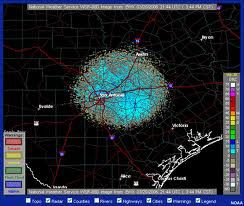
Image Credit: meted.ucar.edu
Now that we've established what you are actually seeing, let's address why this doesn't happen every day. Normally even right around the radar site, the beam is scanning about a hundred feet in the air. By the time gets to Louisville it is more than 1000 feet in the air. In order to scan trees/bugs/hills, the beam would have to bend down when it normally bends up. Under an inversion, this is possible. An inversion is basically when the lower atmosphere is backwards. Instead of temperatures dropping as you go up higher into the sky (as they normally do), under an inversion temperatures rise with height because there is a layer of warmer air above the relatively cool air at the surface. Because the temperature affects the relative density of the air, it will bend the radar beam downward. This is called Superrefraction.
Another way to recognize ground clutter is the radar will be in Clear Air mode. The radar is placed in to Precipitation mode by the National Weather Service when there is rain/snow in the area, so if the radar is in Clear Air mode and you see a ring around the radar site, you are probably seeing ground clutter. You can also compare the 0.5º scan to the top-level scan you have (some times 4º, sometimes 6º). If the echo is showing up on reflectivity at both levels, it is probably raining. If it only shows up in the lowest scan and not the top one, it is likely ground clutter. Finally, ground clutter usually won't move. There might be small perturbations within the echo, but it will not travel like rain does.


