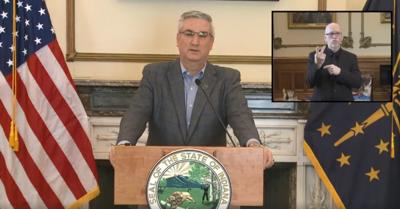
LOUISVILLE, Ky. (WDRB) -- Bracing for COVID-19 cases to spike in Indiana in the coming weeks, state health officials said Monday they're working to create new hospital beds and give health care workers more protective gear.
Based on models that predict cases of the respiratory illness, Hoosiers should expect a "peak surge" in mid-April to mid-May, said Dr. Jennifer Sullivan, secretary of the Indiana Family and Social Services Administration.
State leaders are working with hospitals in different parts of the state to handle high volumes of COVID-19 patients in each region.
“Indiana already has hospitals that can turn every bed they have into critical care beds, and we have identified those sites as possible surge hospitals for each region," Sullivan said at a briefing in Indianapolis.
To aid planning efforts, Gov. Eric Holcomb signed an executive order Monday that waives licensing requirements for temporary medical facilities and lets retired doctors and nurses, medical students and other health care workers get short-term credentials.
Thus far, state officials said more than 5,400 clinicians have volunteered to help out if they're needed as patients with coronavirus illnesses flood hospitals.
Indiana hospitals now have 1,940 intensive-care beds available, a 35 percent increase from the "baseline" inventory before the COVID-19 outbreak, Sullivan said. Health officials plan to double that capacity by converting other beds, using operating suites and taking over space in facilities like elective surgery centers.
In particular, she noted plans call for moving "less critical patients" to medical clinics, unopened floors of state-owned hospitals in Indianapolis and Richmond.
If needed, Sullivan said, recently closed hospitals in Michigan City and St. Joseph County could handle patients, while a new rehabilitation center in Clark County also could provide "step down beds for non-critically ill patients."
To add even more beds, she said Indiana is working with the state's National Guard and the Federal Emergency Management Agency to set up temporary field hospitals in as little as 72 hours.
State officials also are seeking to increase the 1,177 ventilators across the state. Holcomb's office says hospitals have located 750 more that can be used for critical patients and secure more by adding ventilators from operating rooms, ambulatory care centers and emergency management operations, as well as from the National Guard.
Indiana University Health, for example, is repurposing anesthesia machines into ventilators. By tracking every ventilator, it can provide them to a facility that runs low, said Dr. Chris Weaver, a health system senior vice president.
"We can transfer and get the right amount of ventilators to their site at any time," he said.
Indiana reported 273 new cases of COVID-19 on Monday morning, bringing the state's total confirmed infections to 1,786. Statewide, 35 people have died, including three new deaths.
State health commissioner Dr. Kristina Box cited new data that shows 86 percent of Hoosiers who have died from COVID-19 were over 60 and 40 percent were older than 80. Two-thirds of those deaths were men.
“We believe that this really reflects the fact that men have higher percentages of cardiac disease, diabetes and are oftentimes a higher rate of smoking than women here in the state of Indiana,” she said.
A surge in COVID-19 patients would put a strain on nurses, doctors and other first responders who need face shields, masks, gowns and other protective gear. Indiana, like other states, has a shortage of the personal protective equipment, or PPE.
Indiana recently received its third and final shipment from a national PPE stockpile and has also received gear from companies, Indiana-based vendors and citizens, said Dr. Lindsay Weaver, the state health department's chief medical officer.
She said the supplies received thus far have been "limited," but have been distributed to 285 hospitals, long-term care facilities, local health departments and EMS workers.
“We won’t be able to get everything we want," she said, "but we are working to get everything we need.”
Reach reporter Marcus Green at 502-585-0825, mgreen@wdrb.com, on Twitter or on Facebook. Copyright 2020 WDRB Media. All rights reserved.


