


LOUISVILLE, Ky. (WDRB) – The interim president and CEO of the West End Opportunity Partnership says she is interested in the job permanently.
Laura Douglas, who has held the temporary position with the public investment agency for nearly two years, made the remarks during an interview with WDRB News outside a closed session of the board Monday evening.
“Yes, I am, because I'm dedicated to the work and I love west Louisville,” she said. “This has been a long process, but I guess I am a glutton for punishment. I think that it's going to work in the long run.”
Her comments come as the partnership board, which will decide how to spend public tax revenue on projects in nine western Louisville neighborhoods, plans to form a committee to lead the search for the organization’s top staff position.
The partnership’s board chair, Mary Milliner, announced the committee makeup at Monday’s meeting, but she later tabled the plan after some on the board raised concerns about how those committee members were chosen. She asked anyone interested in serving on the panel to email her.
The Kentucky General Assembly created the partnership in 2021, when it also authorized a sweeping tax increment financing (TIF) district across Louisville’s west end. That district will funnel a portion of some state and city tax dollars generated there to the partnership to spend on revitalization and investment efforts in the neighborhoods.
Douglas is a former general counsel of the Louisville Water Company and Metropolitan Sewer District who also served as a vice president of corporate responsibility and community affairs for LG&E and Kentucky Utilities.
In her retirement she also has taken on roles as interim co-executive director of TARC and interim president and CEO of the Muhammad Ali Center.
Douglas clashed with several board members and the Louisville NAACP earlier this year over a bill she pushed in the state legislature to give the partnership the power to strip board seats from some institutions that don’t follow new bylaws.

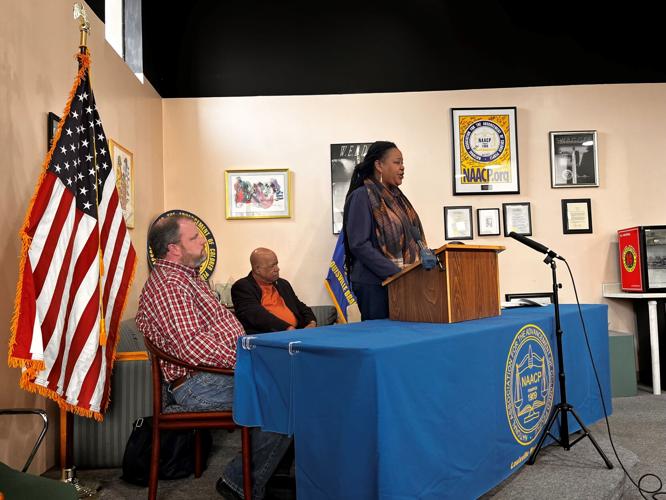
Jeana Dunlap (right), the NAACP of Louisville's board representative on the West End Opportunity Partnership, speaks at a March 7, 2024 press conference at NAACP offices. Raoul Cunningham (center), president of the Louisville NAACP, and Mike Neagle (left), Portland representative on the partnership board, look on (WDRB photo).
That legislation ultimately passed, prompting the NAACP to vacate its seat earlier this month.
Douglas alluded to some of the tensions that have followed the partnership’s early work, telling WDRB it “represents a big change. It also means a change in how decisions are made, a change in who gets to make the decision.”
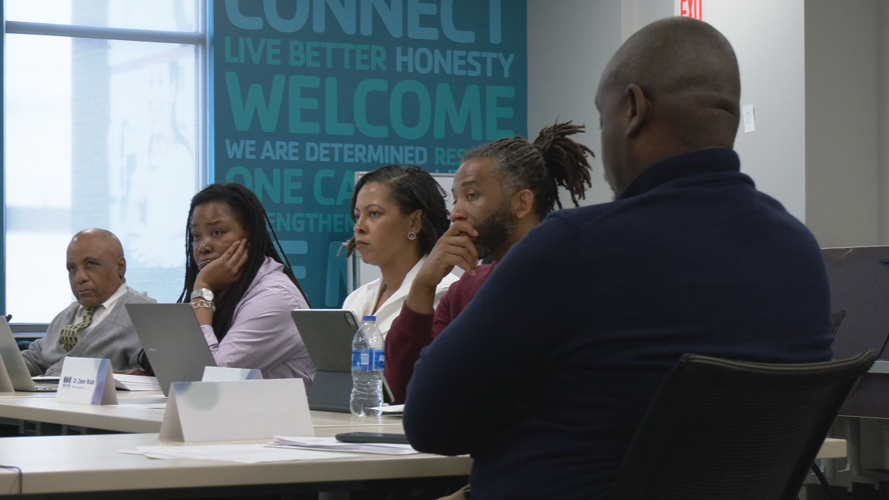
The partnership board went into the closed session Monday to discuss a personnel issue. Douglas was not part of that session.
She told WDRB in a phone call Friday morning that she hopes to have the "interim" title removed and hopes to hold the position no more than the next 24 months.
TIF ‘baseline’ taking shape
The partnership’s initial $30 million funding includes $10 million in private investment and $10 million each from Metro government and Kentucky state government. But the organization plans to rely on the TIF district to generate the main revenue stream for its work.
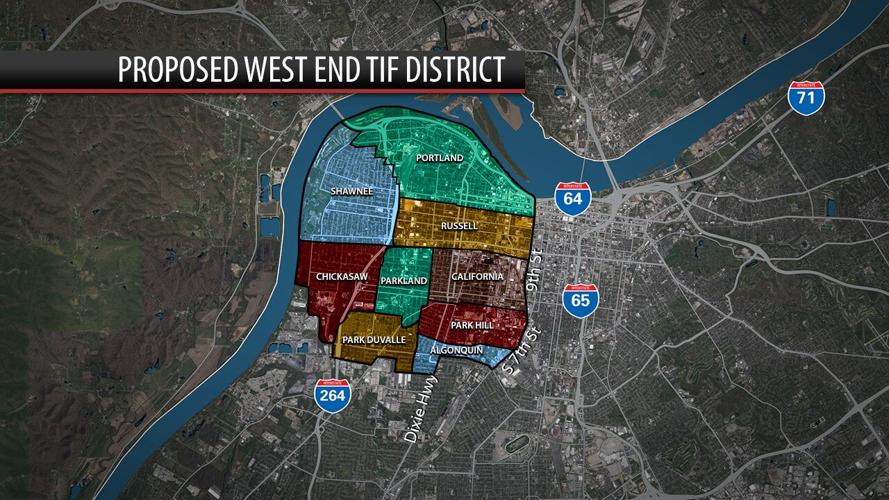
The western Louisville TIF area takes in more than 12 square miles west of 9th Street and covers the neighborhoods of Parkland, Shawnee, Park Duvalle, Russell, Portland, California, Chickasaw, Park Hill and Algonquin.
As WDRB previously reported, the TIF district would be the largest in Kentucky and won’t face the scrutiny of similar publicly subsidized areas. But the basic approach is in line with other TIF plans.

The tax increment financing district in Louisville's West End covers more than 12 square miles, making it the largest in Kentucky.
It will be based on the total amount of five streams of tax revenue produced in that area in 2022 -- local property and occupational taxes, and state property, income and sales taxes. Then, when the annual collections exceed that “baseline” amount, 80 percent of the money would go to the partnership for a 20-year period.
It’s not yet known how much those taxes generated in 2022, or how much the partnership expects to get each year. But in recent months, the board has received data on the state portion of the tax base.
In 2022, according to the Kentucky Department of Revenue, just under $38 million was generated in the area. Withholding taxes made up the biggest share, at $21.1 million, followed by sales taxes at $15.2 million and property taxes at $1.7 million.
The Metro Louisville tax amounts haven’t been determined.
Funding criteria discussed
State lawmakers gave the partnership wide latitude to invest the TIF and other revenues in the area. The legislation calls for spending on things ranging from neighborhood-led initiatives to loaning money to businesses. It also must guarantee that all housing developments have affordable aspects.
For the first time this week, the partnership board got a look at how the funds might be distributed. A draft report from consultant Cornerstone Engineering Inc. lays out the criteria for small and large companies, as well as nonprofit entities.
Ultimately, according to the report, funds would be awarded based on a 100 point scale: 35 points for “organizational info,” 35 points for a “project plan,” 20 points for “community impact” and 10 points for “narrative.”
The partnership declined to provide a copy of the report to two reporters in attendance. Instead, it was shown on a projection screen at the meeting.
The report envisions that small businesses would have to submit general information about their operations – such as their borrowing history and timeline for repaying the loan – plans to hire west end residents, community benefits and whether there will be a “community give-back program.” Larger companies or projects would have to answer similar questions.
Any entity getting funds would have to show a “comprehensive outline of the forecasted execution of the project,” as well as a feasibility statement with information about a project’s objectives, profitability and other highlights.
A “community impact” requirement includes contracting set asides for minority-, women-owned and disabled-owned businesses modeled after a similar program run by the Louisville Metro Housing Authority.
Other parts of the draft report reference contracting methods used by MSD, the U.S. Small Business Administration and other local governments. The 100-point scoring criteria for projects, for instance, is based on a U.S. Department of Defense method.
“We didn't recreate the wheel,” Travis Foxx, Cornerstone’s business development director, told the partnership board. “These references are from entities that are in place.”

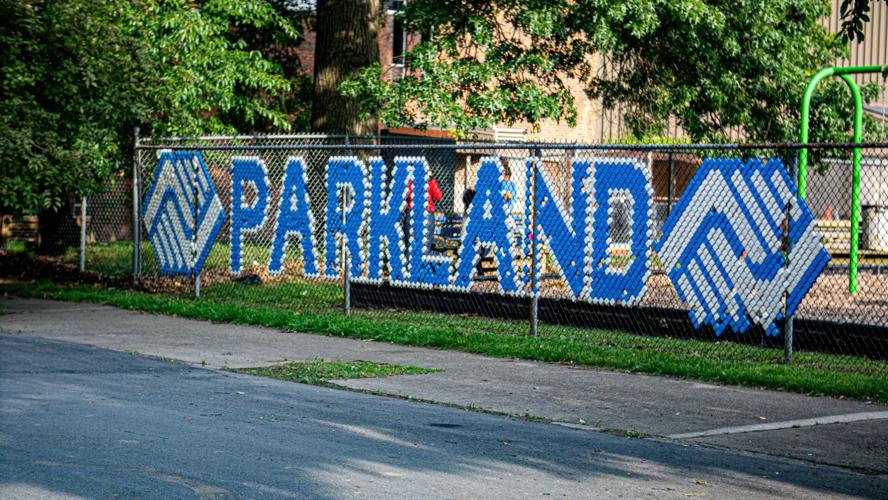
Louisville's Parkland is one of nine neighborhoods required to have a seat on the West End Opportunity Partnership board.
Douglas said she believes the partnership will need a dedicated project manager and an engineering or other professional services firm to help sift through the proposals, which she said ultimately would need board approval.
The partnership board remains open to changes to the Cornerstone report and the funding criteria. Board member Lyndon Pryor, the president and CEO of the Louisville Urban League, said there needs to be a “separate conversation” about the grant approval process.
“What I don't hear in there is where, if anywhere, there is an opportunity for the community to weigh in on what proposals might be feasible or, what projects they might like to see,” he said, noting that some proposals could represent projects with “huge impacts on the community.”
Cornerstone was selected without a competitive bidding process because the cost fell below the partnership’s $50,000 spending threshold for such work, Douglas said. She told WDRB that the company was chosen because “they have done work in the community with folks that we regard as partners.”
In particular, she said, Cornerstone has worked with MSD and one of its employees used to work at OneWest, a nonprofit economic development organization with a seat on the partnership board.
Douglas said Cornerstone’s work has cost less than $10,000 and is largely based on feedback from people who attended recent public meetings in the nine west end neighborhoods.
“They developed this outline based on those back-and-forth discussions,” she said. “But none of this is cast in stone, yet. The board still is going to have to review it, then have its input before it adopts it.”
The board could consider revisions as early as its July 22 board meeting.
Copyright 2024 WDRB Media. All rights reserved.


