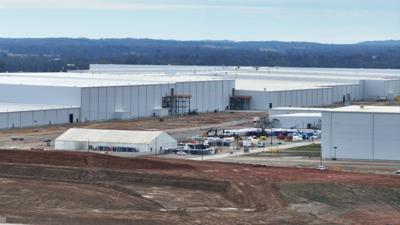


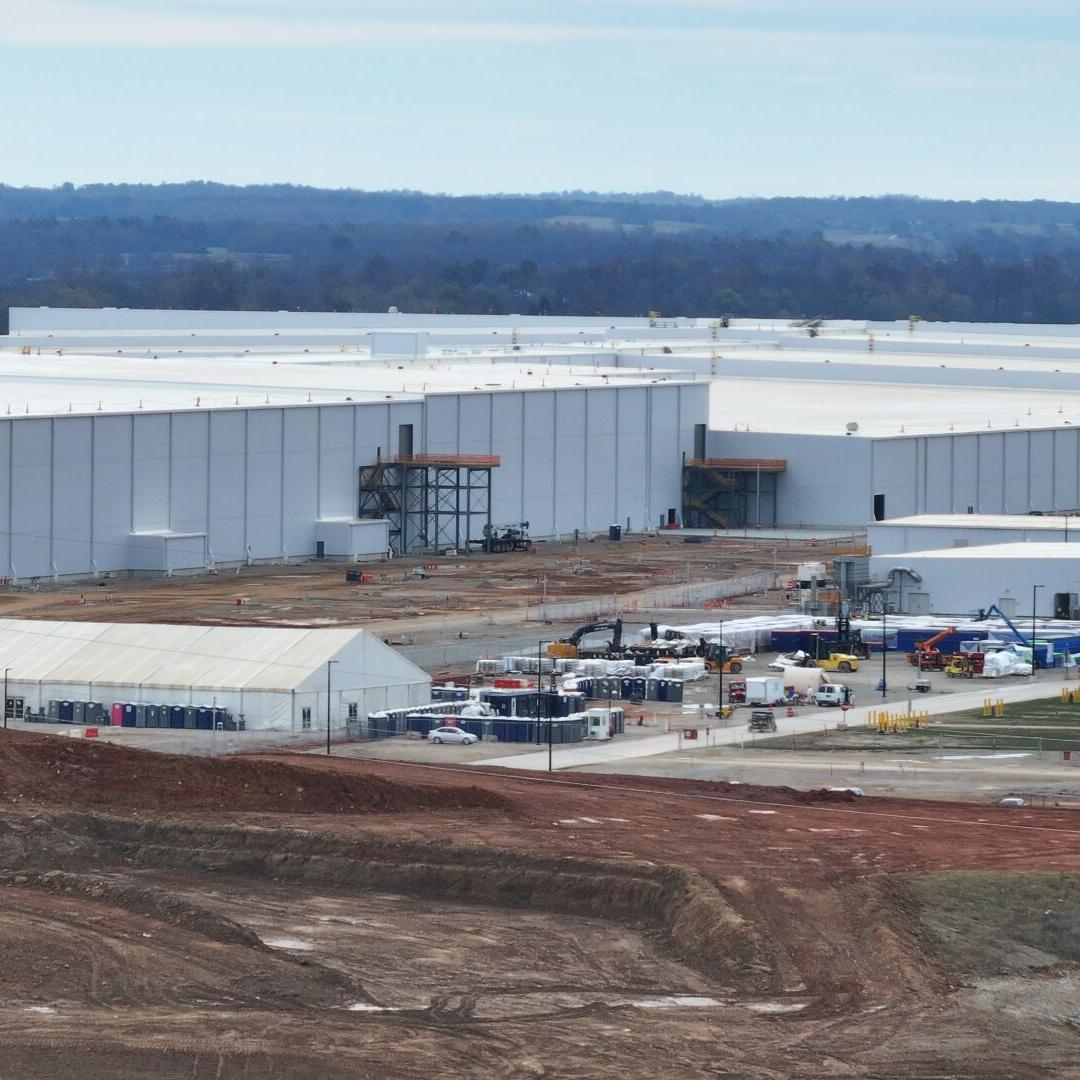
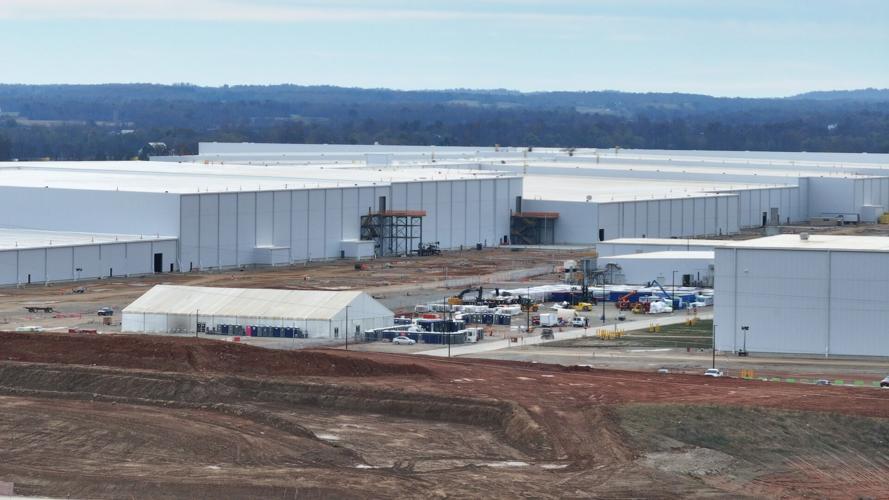
LOUISVILLE, Ky. (WDRB) -- All 1,600 employees of the brand new electric vehicle battery plant in Kentucky will be laid off before Ford converts it to manufacture batteries for data centers and other utilities.
Ford will turn the Glendale factory into a battery-storage business for customers such as utilities, wind- and solar-power developers, and massive data centers that train artificial intelligence, the Wall Street Journal reported Monday. And Ford announced Monday it plans to begin shipping the battery energy storage systems from its Kentucky and Michigan plants in Late 2027, a shift to "higher-return opportunities." In total, the company said it'll take a $19.5 billion hit to its profit as it transitions away from the EV business.
"Instead of plowing billions into the future knowing these large EVs will never make money, we are pivoting," Ford Chief Executive Jim Farley said in an interview with the WSJ.
In a video statement sent to employees Monday, Michael Adams, CEO of BlueOval SK — the original joint venture between Ford and SK On — said this shift would lead to "the end of all BlueOval SK Positions in Kentucky." Adams didn't give a timeframe for those layoffs, though he said employees will have access to benefits and continue to receive paychecks for the next 60 days.
Ford plans to hire 2,100 employees for the new iteration of the Glendale plant, and a company spokesperson said Monday that all those laid off will have the "opportunity to apply" for those new jobs.
"This is a customer-driven shift to create a stronger, more resilient and more profitable Ford," Farley said in a news release Monday. "The operating reality has changed, and we are redeploying capital into higher-return growth opportunities: Ford Pro, our market-leading trucks and vans, hybrids and high-margin opportunities like our new battery energy storage business."
In an interview with WDRB News in June, Adams said they were prepared to pivot away from their original business if the demand for EVs proved to not meet their production."
"We are actually allowed to bring other customers' business into this facility," Adams said. "So primarily, yes, as Ford is our parent, we want to fill this plant with Ford business. But, at the same time, under that scenario, we're also able to go out and work with other OEMers."
Kentucky Gov. Andy Beshear said through a spokesperson Monday that the state will remain the "EV battery capital of the U.S. ... despite the President's shortsighted attacks on the industry." Beshear said he's in direct contact with Ford leadership on a restructured future project.
"Right now, our primary focus is helping the affected BlueOval employees find new jobs," he said. "Team Kentucky is coordinating with company and community leaders to directly support these employees, in addition to planning job fairs and creating a website offering resources."
Beshear's office said the terms of the incentive agreement are being renegotiated.
"We are talking with Ford about it right now," Beshear said during an event in Louisville Monday evening.
According to the Wall Street Journal, Ford has lost $13 billion on its EV business since 2023.
Wall Street Journal automotive reporter Chris Otts, who covered Ford extensively for years at WDRB, said not all batteries are created equally.
"They built the wrong kind of battery and the wrong chemistry for that here in Kentucky, so they have to change the entire plant to make a different product," Otts said. "That's why you're seeing this long lead time and this mass layoff of all the employees here."
Lack of EV demand
The entire Hardin County project — originally marketed as a $5.8 billion investment in the burgeoning future of Ford's EV infrastructure — has taken a turn in response to lacking consumer demand. Farley has recently said they planned for too much EV capacity and needed to pull back in response to rollbacks of strict emission rules by President Donald Trump's administration.
The first battery to be sold out of the plants rolled off the assembly line in August of this year, made to power the all-electric Ford F-150 Lightning. But Ford canceled production on that truck in announcement Monday.
And progress on the second plant next door was put on pause, with equipment yet to be installed inside. Earlier this year, the WSJ said it's possible that second plant could be used to supply Nissan with batteries for its EV fleet.
Last week, Ford and SK On announced an end to their partnership that sparked the massive Hardin County plants in the first place. Ford agreed to take full ownership of the plants moving forward through a subsidiary. And SK On will assume ownership of a nearly finished Tennessee plant and produce batteries for similar utility needs as the plant in Glendale.
Reps. Samara Heavrin and Steve Bratcher, Republican Kentucky House members who represent Hardin County, said in a written statement Monday that they remain focused on those men and women who could lose their jobs.
"We are optimistic about Ford Motor Company's decision to take over the Glendale facility and transition the project toward energy storage, particularly as initial plans for the project have faced significant challenges from the outset," Heavrin and Bratcher said. "At the same time, optimism must be matched with both caution and accountability, and we will be watching closely to ensure commitments are met and honored."
The Wall Street Journal reported Monday that Ford's new plan for the Glendale plants calls for using just 23% of the site's original capacity when the new batteries begin production in 2027.
This story will be updated.
Top Stories:
Gov. Andy Beshear announces $42M battery facility coming to Louisville, bringing 110 jobs
Rob Reiner's son Nick arrested after the director and his wife were found dead at their home
Body camera shows southern Indiana officer rescuing couple from burning home
Copyright 2025 WDRB Media. All Rights Reserved.


