


LOUISVILLE, Ky. (WDRB) -- As Louisville's elected officials consider a subsidy worth up to $114 million for the ambitious One Park development, a powerful narrative has taken hold.
It goes like this: That $114 million that Metro government would give to developer Kevin Cogan's group over 30 years is not really costing the taxpayers anything.
Instead, it's just a partial rebate of a boatload of new tax revenue that Cogan's project will deliver to the city — and, therefore, taxpayers can give much of it back and still come out ahead. Everyone wins.
"We are getting tax revenue that has not existed — and will not exist — if something like this doesn't go there," Metro Council member Anthony Piagentini said last week when the One Park subsidy took its first step forward.
As Markus Winkler, the president of the Metro Council, put it: "I, for one, would like to have 20% of something than 100% of nothing."
This reassurance may well power Metro Council to give the final OK on the One Park deal at its meeting Thursday night.
Yet, as with all so-called tax-increment financing — or "TIF" — subsidies, the narrative about the developer and the taxpayers mutually benefitting from the One Park deal rests on a foundation of assumptions.
Change those assumptions, and the deal may not be such a slam dunk.
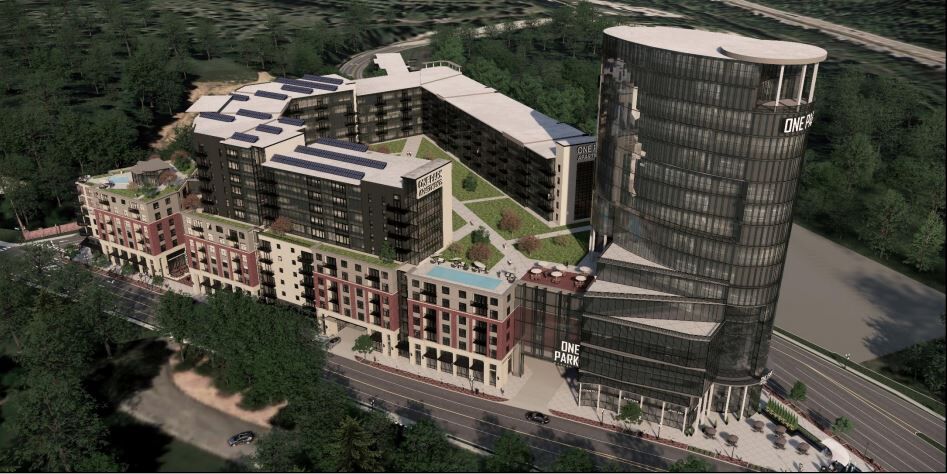
First, a brief explanation of the deal: Cogan would build his $554 million mix of hotel rooms, offices, stores and apartments across from Cherokee Park. And then, little by little over 30 years, Metro government will pay Cogan's group back for up to $114 million in costs that would otherwise be Cogan's responsibility in building the project.
Louisville has a long history of these sort of subsidies. One previous deal looms particularly large over the current debate.
In 2015, then-Mayor Greg Fischer and the council borrowed and fronted more than $100 million of the $300 million Omni Hotel downtown.
Today, Omni is renting apartments on the hotel's upper floors for more than $7,000 per month — apartments that Metro taxpayers helped pay for despite the city's acute shortage of affordable housing and growing homelessness crisis.
City officials are quick to point out that the One Park deal is not nearly as generous to Cogan as the 2015 deal was to Omni. One Park will at least have some affordable housing. And, crucially, taxpayers will not take the risk of fronting the money for One Park, as we did for the Omni and with the KFC Yum! Center downtown arena before that.
"There's no upfront cash," Jeff O'Brien, director of Mayor Craig Greenberg's economic development department, told me earlier this month. "This is a reimbursement and it's going to require performance — not just construction, but economic performance — from the project."
Foundation of assumptions
The lack of upfront money means Cogan and his investors — not taxpayers — will be on the hook if One Park doesn't do all it promises to do over 30 years.
Still, the $114 million that Cogan could receive in annual checks from Metro over 30 years is not nothing — and whether taxpayers really come out ahead is a separate question.
That's where those assumptions come in. Two particularly big ones are at work here:
The first is that all the economic activity at One Park (hotel stays, restaurant meals, office worker paychecks) is truly new to Louisville and not simply shifted from other parts of town into the 7-acre boundaries of the One Park.
The second is that One Park — and all the businesses and residents who locate within in it — would not materialize at all without this massive subsidy.
Cogan's group has commissioned an "economic and fiscal impact analysis," which predicts that, over 30 years, One Park will provide $415 million more in state and local tax revenue than the hodge-podge of businesses that currently occupy the corner of Grinstead Drive and Lexington Road.
$114 million doesn't look like a steep price to pay for that sort of boon.
Yet, the last page of the report includes a glaring caveat: "It should be understood that numbers shown in this analysis do not necessarily account for transfer activity that may occur within the Project from elsewhere within Jefferson County or the Commonwealth of Kentucky."
"Transfer activity" meaning a store, restaurant or corporate office that's already in Louisville — already "generating" taxes — and may move into One Park. If One Park is simply enticing local businesses to relocate, that destroys the narrative about a bunch of "new" tax revenue.
"It could be a wash with them (One Park) winning — another part of town losing," said Thomas Lambert, a University of Louisville economist who studies economic impacts. "There's probably really no net gain, unless you're bringing people from outside the region."
Commonwealth Economics, the consulting firm that produced the One Park study, did not respond to my question about the disclaimer.
Louisville Metro officials are surely aware of the possibility of "transfer activity" occurring at One Park. You can see that in the deal they negotiated with Cogan, which contains a special protection meant to ensure One Park doesn't make the already huge glut of office space in downtown Louisville even bigger.
The deal essentially says Cogan's group will get no subsidies for luring any office tenant away from the Central Business District.
"Given the proximity (of One Park to downtown), we wanted to be real clear that we want to protect the office space in downtown Louisville," O'Brien said. "We want to protect the office space all over Jefferson County. ... but the proximity was the real driver (for) adding that provision."
To be sure, another provision assures that if already-local company moves into One Park from some place other than downtown, only the job growth that occurs at One Park counts. (That still leaves a question about whether that local company would have grown in Louisville anyway without One Park).
Then there's the second big assumption — one which city officials seem to have little trouble accepting: that One Park would not be built at all without the subsidy Metro Council may approve Thursday night.
Cogan testified to this last week, telling council members that One Park would not be profitable for him without the taxpayer assistance.
After the meeting, I asked Cogan why he's spent a decade and countless millions pursuing a project that can't succeed without public subsidies, over which he has no control.
"Very fair question," he said. "But I truly believe it goes back to a commitment to our city."

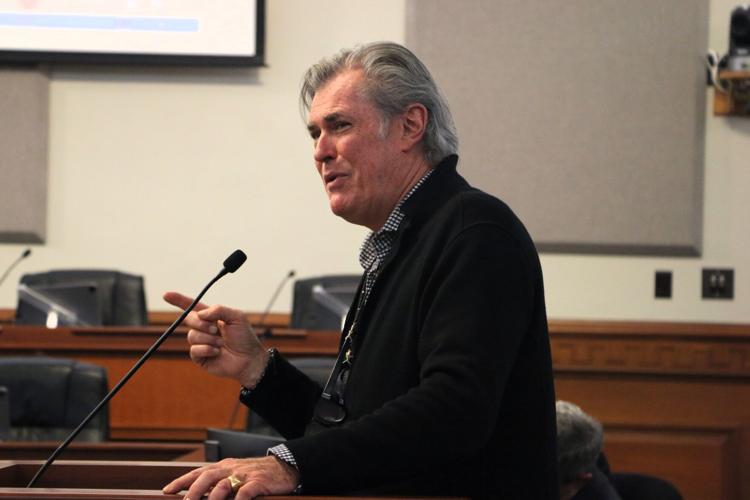
Louisville developer Kevin Cogan, CEO of Jefferson Development Group, at a Metro Council committee meeting Dec. 5, 2023. Chris Otts, WDRB News
Cogan, whose group now owns all the property at Grinstead Drive and Lexington Road, wouldn't reveal his "Plan B" for the site, though he told the council it would be easy to backfill with a Starbucks, a Panera Bread and a Thorntons gas station.
One school of thought is that all the hair-splitting I am doing in this piece misses the bigger picture. If Louisville wants the chic, urban-friendly trappings of a fast-growing city, it has to pony up. Because Louisville is not a fast-growing city, as the mayor's new economic development plan acknowledges.
"We're the '16th-largest' city in the country and we're 20 years behind in development," Metro Council member Khalil Batshon said at last week's meeting. "And I think we need to grow."
Pat Mulloy, Greenberg's deputy mayor for economic development, has no qualms taking Cogan at his word that One Park requires public assistance.
"Do you see cranes all over this town? I don't," Mulloy told me earlier this month. "This town needs growth. It needs new housing products. It needs infill sites, where people can come back into the city."
Finally, there's a practical argument in favor of the One Park deal — an argument that also underpinned the Omni and Yum! Center deals.
If the council signs off on One Park, Cogan's next step will be to ask state government to also participate in the tax-increment deal at an additional cost of up to $218 million for Kentuckians as a whole.
Louisville officials have long suspected that the state's largest city doesn't get its fair share of investment from state dollars. To get $218 million for a luxury development in Louisville would be dead on arrival in the state legislature, but TIFs need only administrative approval.
As Winkler said last week, "This is a great way for us to bring tax revenue back from Frankfort — back into Jefferson County."


