


LOUISVILLE, Ky. (WDRB) — The debate over changing the clocks twice a year is back in the national spotlight after Congress approved legislation to make Daylight Saving Time permanent.
And the vote came just months after Kentucky lawmakers filed a similar proposal with the General Assembly. State Rep. T.J. Roberts, R-Burlington, co-sponsored legislation with Rep. Steven Doan, R-Erlanger, during the 2026 session that would have placed Kentucky on permanent standard time. While that state proposal differed from the federal bill, Roberts said his primary goal is ending the biannual time change.
"I'm frankly ecstatic that this issue is being kept up with at the national level," he said. "It's an important matter to consider, especially when we look at the health implications that we have from the time switch."
State lawmakers argued in January that data shows standard time is better for humans' circadian rhythm. However, there are other arguments in favor of daylight saving time. Research shows improved sleep patterns and increased exercise. Because the switch means more sunlight, studies show the permanent change would result in a boost for the economy and lower crime rates.
"There really isn't a good health argument against either getting rid of daylight saving time or making daylight saving time permanent," Roberts said.
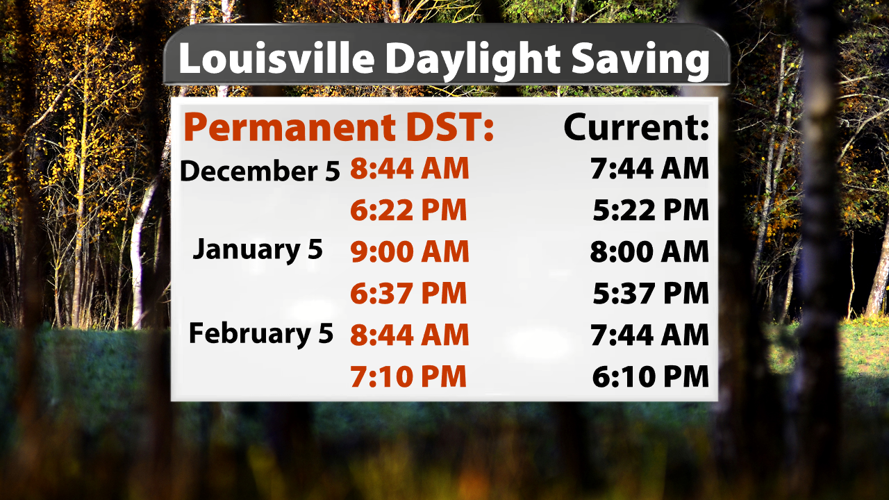
In Louisville, on March 8, the first day of daylight saving time in 2026, the sun rose at 8:04 a.m. and set at 7:38 p.m. On Nov. 1, daylight saving time ends, so the sun will rise in Louisville at 6:28 a.m. and set at 5:44 p.m. unless the bill designed to end the changing of the clocks actually becomes a law.
If that happens, the sun will rise Nov. 1 at 7:28 a.m. and set at 6:44 p.m. Here's a look at how it will affect other the sunrise and sunset times of other dates for Louisville during the winter months:

The federal measure now heads to the Senate. President Donald Trump, who has called for ending the time changes, is expected to sign the bill if it passes.
Back to 1974
While people may not like making the change, history shows they also don't like living with even less morning light in the winter months, when daylight hours are shorter than in summer.
In 1973, Congress passed a law instituting permanent daylight saving time for what was supposed to be a trial period from January 1974 to April 1975. It lasted until October, when it was repealed after public outcry. Among the concerns was worry that schoolchildren would have to start the school day without daylight. These days, some school starting times have started to shift later.
Kevin Birth, a professor of anthropology at Queens College whose research focuses on cultural concepts of time, was in elementary school in Syracuse, New York, at the time and remembers it vividly. "I had to get up for school and it was like it was midnight," he said. "It was just pitch black and it remained pitch black into the school day."
If the U.S. decides to try it again, he said, more has to change than just the clocks. The time zones across the country would need to be adapted as well. The current four zones wouldn't be adequate - they cover so much ground that sunrise comes at different times in western and eastern parts of each zone.
Republican South Dakota Sen. Mike Rounds is concerned about that. He said that it would be dark past 9:30 a.m. in some areas of his state. "You'd be sending kids to school in the dark," he said.
Copyright 2026 WDRB Media. The Associated Press contributed to this report. All Rights Reserved.


