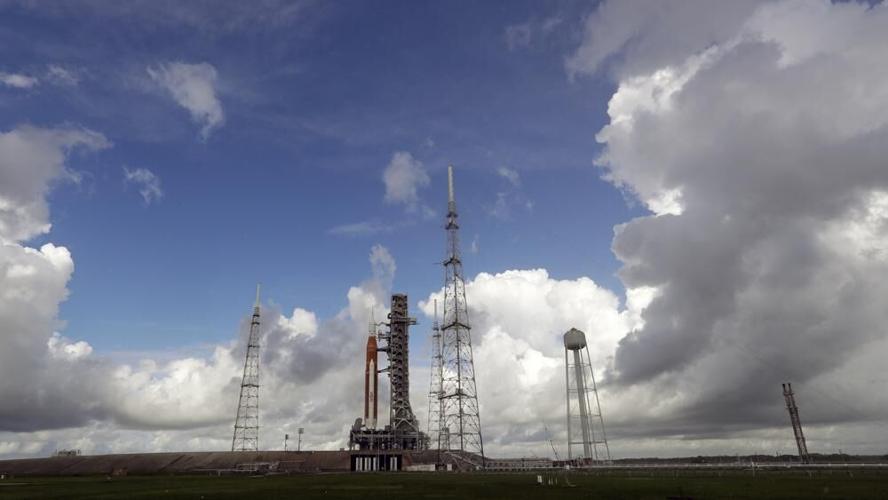
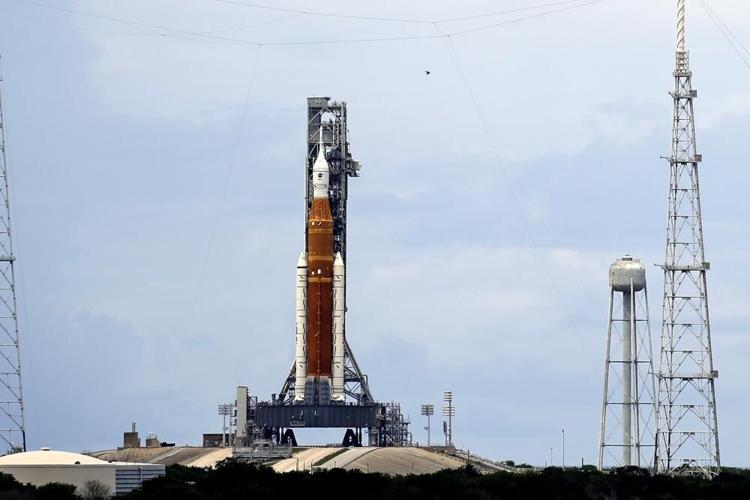


LOUISVILLE, Ky. (WDRB) -- NASA has bumped back its schedule for a planned launch attempt of its Artemis I mega moon rocket.
According to he space agency, the earliest launch attempt has been bumped back four days from Friday, Sept. 23, to its new launch date of Tuesday, Sept. 27, at 11:37 a.m. EST.
This would put the expected splashdown of the unmanned Orion capsule on Nov. 5.
A possible backup launch date of Monday, Oct. 9, at 2:52 p.m. is under review. If that launch window is used, the scheduled splashdown would take place on Nov. 11.
This flight is NASA's attempt to send a crew capsule into lunar orbit with test dummies, using the agency's 322-foot (98 meter) Space Launch System rocket -- the most powerful built by NASA.
Alora Mazarakis, a UofL Speed School graduate who grew up in Shelbyville, Kentucky, and now works as a flight communications and tracking engineer on the Artemis I launch team, says everyone will hear the launch when it happens.
"It's gonna be louder than the Saturn V rocket, which actually shattered many windows in Titusville, so hopefully everybody has replaced their windows since the 60s," she laughed.
She said three minutes after launch, the rocket's solid rocket boosters will separate. Three minutes after that, the core stage will separate and fall away from the interim cryogenic propulsion stage (ICPS), the second-stage liquid engine that will fire and insert the rocket into low-earth orbit.
"We have cameras on all the stages -- you'll see all this," she said.
After orbiting the earth, the ICPS will be jettisoned and the Orion crew module will head to the moon. For this launch, the capsule will contain dummies but will hopefully one day contain human passengers.
"For about five days, it won't be too notable, but you'll see the Earth getting a lot smaller," she said.
The final propulsion system will push it into what's called "trans-lunar injection."

Alora Mazarakis grew up in Shelbyville, Kentucky and credits the UofL Speed School of Engineering and the River City Rocket Club for preparing her for a career as a flight communications and tracking engineer for NASA's Artemis I program. (Image provided by Alora Mazarakis)
"We will do a near-lunar orbit," she said. "And I believe that we get about 60 miles from the lunar surface, so we'll get a really cool view of the moon, I think."
From there, she said the capsule will be put into what's called a "distant-retrograde orbit," which is a very high orbit, roughly 64,000 miles above the surface of the moon.
"We're going to test that orbit, and I will mention that the purpose of that is to put as much stress on the crew module as possible, because for Artemis II, we'll have actual astronauts in there," she said. "And the Artemis II mission is only 10-12 days long. It’s not very long. So you might ask, 'Why are we doing a 42-day mission if our crew mission is only 10-12 days?' It’s because we want to test everything about our crew module. We want to put it under the harshest conditions – the harshest solar conditions, the furthest orbits, the most stresses and strains. We want to make sure that it can handle absolutely everything."
After that, the Orion crew module will head back home to Earth - test dummies and all.
"And once we go to recover the Orion module, we have a big ship that’s gonna come in with a big mouth that opens up, and it’s gonna scoop it up," Mazarakis said. "And then we’ll see it inside the ship, and we’ll evaluate everything about it.”
The total mission will last anywhere from 38-42 days, Mazarakis said.
Fuel and hydrogen leaks have forced launch controllers to scrub two previous launch attempts in recent weeks. After the latest setback, mission managers decided to haul the rocket off the pad and back to the hangar for further repairs and system updates.
NASA Administrator Bill Nelson stressed that safety is the top priority, especially on a test flight like this where everyone wants to verify the rocket's systems “before we put four humans up on the top of it.”
"Just remember: We’re not going to launch until it’s right," he said, according to the Associated Press.
Related stories:
Copyright 2022 by WDRB Media. All rights reserved.