

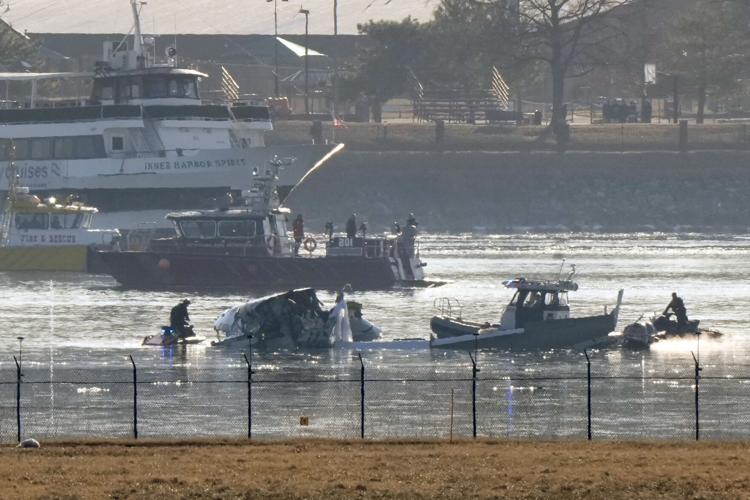
LOUISVILLE, Ky. (WDRB) -- Officials in Washington, D.C., are still working to determine what went wrong when an Army helicopter and a passenger plane collided over the Potomac River near Reagan National Airport.
The crash Wednesday claimed the lives of 67 people. Friday, dive teams continued their recovery efforts, retrieving evidence and bodies from the water.
Southern Indiana pilot Daniel Paden, a former Army Black Hawk helicopter pilot who now flies commercial airliners, has extensive knowledge of the airspace surrounding Reagan National Airport and is familiar with both types of aircraft involved in the crash.
“I was saddened by the fact that it’s 2025, and something like this could still happen today,” Paden said.
Reagan National Airport operates within one of the most tightly controlled airspaces in the country, located just three miles south of the White House and the U.S. Capitol. Pilots must adhere to strict procedures, including designated altitudes and reporting points for helicopter traffic.
“That particular airspace has certain procedures that must be followed,” Paden said. “On paper, this never should have happened, but here we are.”
Navigating the congested airspace at night poses additional challenges. Pilots must contend with hundreds of commercial and military aircraft, restricted areas, and various environmental factors such as reflections off the water.
“When you’re flying at night over water in an already busy airspace, your head is on a swivel, you're looking all around you,” Paden said. “Each pilot that was in each aircraft, they are doing their specific job and they are counting on the other person to be doing their jobs, and in a perfect world, everything works great.”
Federal authorities and aviation experts have long expressed concerns about near-miss incidents, with reports indicating as many as 30 occurrences at Reagan National since 1987. Investigators are now examining whether the aircrafts’ Traffic Collision Avoidance System (TCAS) malfunctioned, contributing to the tragedy.
Paden emphasized that TCAS is designed to provide a crucial margin of error, alerting pilots to potential collisions and allowing them time to react.
“There's certain things that TCAS from the airplane you're flying and the airplane that it's communicating with gives different signals and what they're doing, so it will give you several seconds for even the pilot, the human factor, the pilot, to hear the alarm, determine what needs to be done, and then respond to that," he said.
Despite the crash, Paden remains confident that air travel is safe, noting that pilots undergo rigorous training multiple times a year. He also believes that this crash will prompt significant changes within the aviation industry to prevent future incidents.
It has sparked concerns about air traffic controller staffing. Last year, the FAA said it had exceeded its goal of hiring 1,800 air traffic controllers after a report that controllers were forced to work 10-hour days 6 days a week.
At SDF in Louisville, there are 46 air traffic controllers employed which is the goal, but experts said 52 is the optimal number to effectively manage air traffic.
Top Stories:
- Business application under review for retail store in Louisville's Portland neighborhood
- Louisville officially hires Dan Meske as new volleyball coach, confident he can carry on success
- Metro Council president excited to find common ground in new balance of power
Copyright 2025 WDRB Media. All Rights Reserved.