LOUISVILLE, Ky. (WDRB) -- One of Kentucky's top law enforcement officers is transitioning back into civilian life this week.
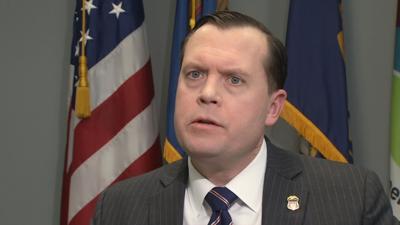
As Russell Coleman's tenure as Kentucky's chief federal law enforcement officer ends, he's more interested in highlighting the mission rather than his legacy. Coleman, a U.S. attorney and federal appointee, made the announcement Monday morning, days before President Donald Trump's administration prepares to leave to make way for the incoming administration of President-Elect Joe Biden.
Coleman said partnerships with other law enforcement agencies helped take hundreds of illegal weapons and criminals off the streets and created crime-fighting initiatives that will continue, even after he leaves office.
"We're trying new things," he said. "The Group Violence Intervention, I'm incredibly enthusiastic about. We've increased federal firearms prosecutions. The FBI is doing some great work in targeting the gangs."
Coleman was nominated by Trump, unanimously confirmed by the U.S. Senate and sworn-in as U.S. Attorney in September 2017. From the beginning, reducing violent crime has been a top priority.
"You can't look at the numbers," Coleman said. "You can't look at the history and not feel that you need to tackle this with a degree of passion."
But there's also an element Coleman did not expect to tackle: systemic racism.
"We have to be willing to have these conversations, as uncomfortable as they are," he said. "For us to move forward as a city, we have to have these difficult conversations."
Coleman said that means delving into the root causes of some of the violence.
"It's just convicting to be in this job when you look at the number of (homicide) victims," he said. "Those 173 from last year ... the majority of them were young, black men. And when you learn the history of Louisville, you see that there are deep-seeded structural challenges for people in the very same neighborhoods that we are losing to violent crime that have been present for 100 years."
For the past several years, some of the tension between police and certain communities has been palpable, but Coleman doesn't believe it has to stay that way.
"We have to exist in an environment where someone can say I am pro-police, I think law enforcement are some extraordinary heroes and pro-reforming police," Coleman said. "We have to be able to say that we have to do a better job policing and building relationships and neighborhoods where folks look more like you than they look like me, neighborhoods where we have structurally laid-down barriers and not treated people not only as equals. We have not treated people with appropriate respect as human beings, traditionally."
Coleman said after delving into the history of Louisville, he felt led to address the subject.
"The very same neighborhoods where those red dots appear — where we are losing our sons and daughters — are those very same neighborhoods where we have limited opportunity in an overt way for over 100 years."
He also leaves office with a few regrets, including the unsolved murders of Crystal Rogers and Bardstown Police Officer Jason Ellis.
"I looked Jason Ellis' widow in the eye, and I looked one of her sons in the face," Coleman said. "'We won't stop remembering your father and we will bring you justice.'"
Rogers has been missing since July 2015.
"I have not successfully been able to tell Crystal Rogers' family where she is or what happened to her and that's a failure, and I own that," he said.
Coleman also takes responsibility for the spike in violent crime.
"When you sit in this chair, you should take the responsibility," he said. "I should be the one that's mitigating those. When I pack out and leave on the 20th, I'll carry a great deal of sadness with me that I didn't resolve those matters."
Coleman said he's confident the Louisville Metro Police Homicide Unit will solve the cases, but he hopes the community will be patient.
"We have some hard chargers in the homicide unit being led by Lt. Burbrink," said Coleman, referring to veteran LMPD Lt. Donnie Burbrink, who leads the homicide unit. "They're out there trying to work these cases, but they cannot do it in a vacuum."
Coleman is a Kentucky native had hoped to continue the mission but submitted his resignation shortly after the election.
"Elections have consequences, and I respect the system, and I stand ready to assist my successor," he said.
Meanwhile, in addition to fighting violent crime, Coleman’s tenure ended with some new challenges.
"My job and that of federal law enforcement was to protect the protesters and law enforcement," he said.
The U.S. Attorney's office was not involved in the Breonna Taylor case but acted when outsiders infiltrated peaceful protests that followed Taylor's death.
"We indicted a number of individuals, charged them federally for crossing that line way beyond first amendment protected activity."
Coleman believes that despite ongoing tension between police and protesters, there's hope.
"We have a great city, filled with kindness," he said. "Some wear badges, some live in the west end, some live in the south end. We have wonderful people in this community ... if we could stop screaming at each other for five minutes."
Coleman was also watching when the U.S. Capitol was under attack on Jan. 6, saying he was "nauseated" by what he saw. Before he became a U.S. attorney, Coleman spent several years working in the Capitol as Sen. Mitch McConnell's legal counsel.
"I have very close friends that serve in that building, not only wearing suits like this but also wearing the badges of the United States Capitol Police," he said.
After the attacks, Coleman spent the next few days checking on Capitol Police and praising the actions of one. Officer Eugene Goodman appeared to be retreating from the mob, but Coleman said, there's more to the story.
"You saw him delaying the mob that continued getting in his face," he said. "What hasn't been widely discussed is how he delayed the mob and actually brought them in a direction that was away from essentially an open door to the Senate floor. That man's a hero."
Coleman said the attacks not only damaged the Capitol but also the men and women who protect the building.
"They are a broken agency," he said. "They lost one of their own to suicide, who was so overwhelmed that they couldn't do that mission in protecting that building and took his own life. They lost an officer to the mob."
Officer Brian Sicknick died shortly after a physical confrontation with rioters, and Officer Howard Liebengood took his own life days after the mob breached the Capitol.
"The officer that took his life, I spoke to frequently," he said. "He was assigned to the Senate and so, both outside the chamber and outside the building, I saw him often."
Coleman said he has also had conversations with McConnell.
"He is very focused on moving forward," Coleman said.
Once Biden takes the oath of office, Coleman's tenure officially ends, but he still provided a lot of praise for some of the new administration's nominations.
"I am excited about the leadership of the Justice Department in the new administration," he said. "Lisa Monaco, the deputy attorney general nominee, is a friend of mine. She is a rock-solid prosecutor. I am enthusiastic for my colleagues here at the Justice Department that they'll be led by some talented people of integrity."
When Coleman leaves, the office will be led by an interim U.S. attorney until the new administration nominates someone for the position.
Coleman will return to private practice.
Copyright 2021 WDRB Media. All Rights Reserved.