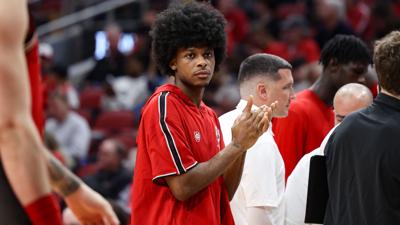

LOUISVILLE, Ky. (WDRB) -- When Louisville basketball signed London Johnson, it didn't just land a transfer. It landed a new category.
Johnson is coming to college basketball after three years in the NBA's G League development ecosystem, and the NCAA cleared him. Around the same time, Alabama tried to bring back former Tide big man Charles Bediako after his own pro stint in the G League, and the NCAA said no.
At first glance, it feels like the NCAA is contradicting itself: How can one "pro" be eligible and another not? That's the confusion your average fan is having, and it's fair.
The cleanest way to understand it is this: the NCAA isn't really drawing the line at "G League." It's drawing the line at when you went pro and what kind of pro step you took.
Louisville | Kentucky | Indiana | Eric Crawford
Johnson fits the emerging "pro-before-college" lane. Bediako ran into the lane the NCAA is still guarding like it's the last possession of the game: college → pro contract → return to college.
That "undo button" concept isn't just a soundbite advanced by NCAA president Charlie Baker. It's the heart of what the court addressed when it denied Bediako's motion for a preliminary injunction, ending his Alabama eligibility for this season while the case continues.
Q&A: What's going on here, in plain English?
Q: Is the NCAA suddenly allowing pro players to come back to college?
A: Not across the board. What's happening is more specific: some athletes who went into professional development settings before ever playing college basketball are now finding a path into the NCAA. That's a meaningful shift from the old "pro once, pro forever" mindset, but it's not a blanket rule.
Q: Then why was London Johnson eligible?
A: Because Johnson's situation is being treated as a pro-development path before initial college enrollment, not as a former college player trying to return after turning professional.
In other words: he's coming to college as a first-time college player, just with professional experience on his résumé.
(And yes, that's weird. But it's increasingly part of the landscape.)
Johnson also comes from the now-defunct G League Ignite pipeline, a program the NBA created as a professional alternative to college for elite high school prospects. Ignite blurred the old amateur/pro line on purpose: it paid players, trained them like pros, and tried to fast-track them to the draft. That background helps explain why the NCAA now treats some of these "pro-before-college" cases differently than "college-to-pro-to-college" returns.
Johnson spent two years with the Ignite, then went to Maine in the G League draft before being waived, but he never declared for the NBA Draft.
Q: So why is Bediako different?
A: Bediako is the tougher fact pattern for the NCAA: he played college basketball first, then left, then signed a professional contract and played professionally, then tried to come back.
In the filings, Bediako describes leaving Alabama after 2023, going undrafted, and then signing a two-way contract (the classic "this is a professional contract" marker) that placed him in the NBA/G League system.
That sequence — college → pro → college — is the sequence the NCAA has been the most resistant to allowing.
Q: Didn't a judge initially let Bediako play?
A: Temporarily, yes. The court issued a temporary restraining order (TRO) that prevented the NCAA from enforcing its bylaws to keep him out, and it also restrained the NCAA from threatening or implying penalties against Alabama for using him while the TRO was in effect.
That TRO window is why Bediako played in games. But a TRO is the quick, emergency version of relief.
Q: Why is he not eligible now?
A: Because the judge later denied the motion for a preliminary injunction, which is the first real "pause button" decision after both sides have been heard. The order explains that the TRO was entered before the NCAA had the chance to respond, and that the preliminary injunction requires a higher showing (irreparable harm, no adequate remedy, reasonable chance of success, balance of hardship).
The judge found Bediako didn't meet those standards, especially on "irreparable harm." The order says lost financial opportunities are quantifiable (and therefore not irreparable). In legal terms, if you can calculate damages in dollars, a court can award money later, so you don't need emergency intervention now.
The judge even notes that Bediako had been playing pro basketball recently, making the case less about whether he can be paid to play and more about who he can be paid to play for.
Q: What "rule" did the judge say the NCAA is enforcing?
A: The order describes a core NCAA line: an athlete can't leave college, play professionally, and then return to college athletics. Bediako's side couldn't point to cases where the NCAA had let someone return after going college → pro → college, and even conceded that this rule had been consistently enforced.
That's the "line of demarcation" the NCAA wants protected.
Q: But Bediako argues the NCAA is being inconsistent, right?
A: Yes. That's a major theme of the lawsuit. Bediako's complaint argues that the NCAA has recently reinstated other players with significant pro experience and is applying its rules selectively.
And the complaint points directly at the NCAA's own bylaw language that, before initial full-time college enrollment, an athlete may compete on a professional team if they don't receive more than actual and necessary expenses, then argues it's arbitrary to treat "pro-before-college" differently than "college-then-pro-then-back."
Bediako's lawyers argue that the NCAA is creating a new disadvantage for players who tried college first. In his view, players like Johnson who skip college initially can return later with pro experience, while players who gave college a shot and went undrafted are permanently locked out, even though both groups played professionally and neither was paid huge sums. The argument is that this punishes players for trying the college route first, which seems backward if the NCAA claims to value the college pathway.
Whether that argument wins later is a different question. The court just said it didn't justify keeping him eligible right now.
Q: What does Charlie Baker mean by the "undo button"?
A: It's the NCAA's public framing of exactly what the court order is describing: if you leave college to go pro, you shouldn't be able to reverse that decision and reclaim a roster spot later.
Baker's statement makes it moral ("college sports are for students"), practical ("crowd out the next generation"), and political ("Congress needs to act").
Q: What should fans actually remember from all this?
A: Think of it as two buckets:
1. Pro-before-college (Johnson-type cases): the NCAA is finding ways, via waivers and interpretation, to let some of these players in.
2. College → pro contract → return (Bediako-type cases): the NCAA is fighting these hard, and for now it got a court win on the emergency injunction stage.
The confusion comes from calling both of these "a G League player." Generally, that’s true. But they don’t have the same story.
Copyright 2026 WDRB Media. All Rights Reserved.


