

LOUISVILLE, Ky. (WDRB) -- I’m not sure if the offense Kenny Payne will run with his first University of Louisville men’s basketball team will tilt more toward the pick-and-roll or spacing shooters on the perimeter.
Zone or man-to-man? I’ll predict man.
But there is one Kenny Payne prediction I can make with absolute certainty:
The culture of his program will matter as much as the strategy the Cards employ. He is determined his U of L players understand that job one for every member of Payne’s staff will be helping them succeed.
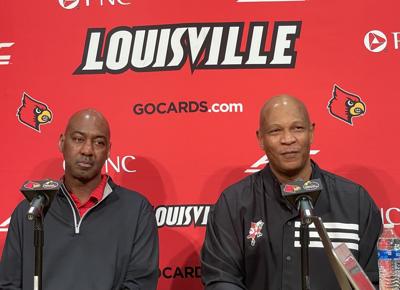
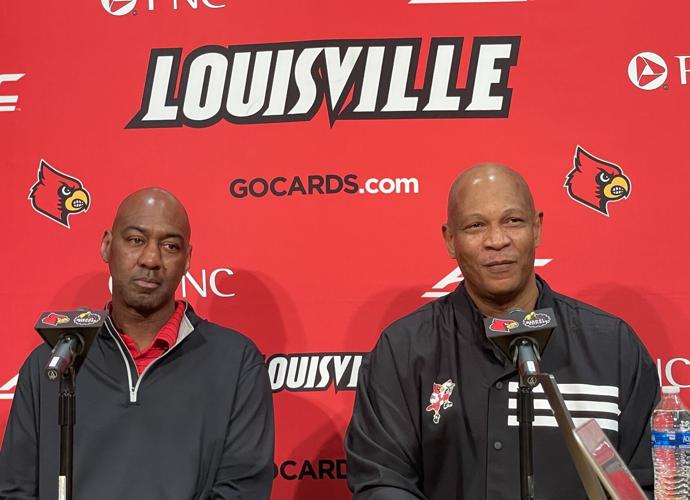
It’s the reason he hired Nolan Smith from Duke as the first assistant on his staff and then backed it up by recruiting veteran head coach Danny Manning as his second assistant Friday.
They’re listeners, not screamers, men who understand how to relate to young players.
Payne has known Smith since he was a toddler. Smith’s father, Derek, mentored Payne when he played at Louisville.
Smith and Manning shared an agent, Ron Grinker, who was based in Cincinnati. Smith, Manning and Payne worked out with each other during NBA off seasons. This staff has been connected for years.
“I go back to culture,” Payne said. “I’ve been fortunate to (win a title) on a team as player (U of L in 1986) and as a coach (Kentucky assistant in 2012).
“Danny is similar (Kansas player 1988; assistant 2008). Nolan the same (Duke player 2010).
“What better culture than to have coaches who have done what you’re trying to do, to build a championship culture, to build a championship team, to have guys that have done it and can talk about the sacrifices it takes until we get there.”
Know this about Manning:
His name is on a tiny list with guys like Kareem Abdul-Jabbar, Magic Johnson, Anthony Davis and a few others as players who won the NCAA title in their final season of college and then were taken first months later in the NBA Draft.
Manning achieved almost everything that can be achieved on a basketball court, leading Kansas to the 1988 NCAA title and then scoring more than 12,000 points over 15 NBA seasons (on knees that usually gave him trouble).
According to Basketball Reference, Manning earned nearly $60 million as a pro player before moving to the coaching world. He worked nine seasons as a head coach, including the time he spent as the interim leader of Maryland last season after six seasons at Wake Forest and two at Tulsa.
That’s a long-winded way of saying that Manning, who will turn 56 next month, did not need an assistant coaching job at this point on his basketball journey.
You can certainly debate his head coaching record, which included six losing seasons and an overall record of 126 wins and 154 losses. You cannot debate his desire to team with Payne, his history in the Atlantic Coast Conference or his knowledge of the demands on a head coach.
When he learned that Louisville hired Payne to fix the proud tradition of Cardinal basketball, Manning was immediately interested. Why return to the grind of assistant coaching after everything Manning has achieved?
“Kenny,” Manning said, while pausing for that answer to resonate through the press conference.
“That was an easy decision ... this job is 24/7. It really helps to be a lot more enjoyable to be around people that you love and care for with everybody moving in the same direction.”
What started as a congratulatory text grew into a heart-to-heart discussion about how Payne will run this program.
Manning was hooked. So was Payne, who has received more than 400 inquiries for the three coaching spots on his staff, which still has one on-the-court vacancy.
Expect Payne to maintain his insistence on productive communication and chemistry as he builds out his staff and roster. Payne has worked at strengthening his relationships with returning Louisville players as relentlessly as anything over his four weeks on the job.
Six guys (Sydney Curry; El Ellis; Jae’Lyn Withers; J.J. Traynor; Mike James and Roosevelt Wheeler) are currently expected to return. Payne asked his players not to make a decision until they’d had multiple conversations about their basketball and life goals.
Payne said that he has been encouraged by individual workouts he has directed with two guys: Curry and Ellis.
He put Curry through a 40-minute workout the other morning that put the player on his knees in exhaustion before the final whistle. Payne said he was impressed by the improvement Ellis showed over three days.
“Just his attention to detail,” Payne said. “Not letting go of the rope.
“Keeping the ball in the right position even when fatigue takes over. Remembering the proper footwork. All the basic stuff that I’ve always used in drills. Just getting the details right.”
Communicating about everything honestly afterward also helped. In Manning, Payne has a guy who can help him do that.
Manning was the best player in college basketball in 1988. He was the first pick in the 1988 NBA Draft.
Injuries limited him to 26 games during his rookie season. Manning got healthy and made back to back NBA All-Star teams in 1993 and 1994. His knees made greatness difficult again.
But Manning kept playing until he retired in 2003. He was with the Pistons when Payne was driving from Louisville to Detroit, trying to learn the coaching profession from Larry Brown.
“He’s a man that was on top of the hill, and then something happened,” Payne said. “He had a knee injury.
“He had to get back up and get on top of that. Maybe a couple times. What better example for young people to know than this man?”
Copyright 2022 WDRB Media. All Rights Reserved.


