
LOUISVILLE, Ky. (WDRB) -- For so long, everybody thought Wesley Cox was moody, inconsistent, somehow disappointing, even. So many newspaper stories extolled the abilities of Cox, who died Saturday at the age of 69 after a lengthy battle with various ailments, but also questioned his demeanor.
So much armchair analysis.
"To some University of Louisville fans," George Rorrer wrote for the Sunday Courier-Journal and Times before Cox's senior season, "Wesley Cox is a disappointment. They expected the world, and so far he has given them only a couple of continents."
It was only before that season that everyone knew how much he'd been giving. Doctors diagnosed his particular form of exercise-induced asthma and prescribed him medication that allowed him, for the first time in his life, to play without becoming run down.
And the kid who won Kentucky's Mr. Basketball and became a Parade All-American for Male High School while playing with one lung tied behind his back soared to an All-American season as a senior.
"It's the first time he's ever played without having to hold himself back," Louisville coach Denny Crum said during that same season.
Cox could've gone anywhere out of high school but said he stayed in Louisville because his parents asked him to and because he thought Crum, who had been an assistant to John Wooden at UCLA, "had to know what he was doing."
He might have wondered when Crum came up to him in the gym where he was shooting around before his freshman season. The coach told him he had a good story and a bad story. Cox asked for the bad. Crum told him he had failed to land a 7-foot center to play alongside him.
What was the good? Crum told him, "Freshmen are eligible to play. Now, can you play center?"
Cox paused before answering Crum, "Can you coach?"
Cox believed he could do anything on a basketball court, and he wasn't far from the truth. He averaged 16.5 points and eight rebounds per game as a senior, and scored 1,575 points in his career. In all that time, he battled centers six or seven inches taller, without giving an inch.
He helped lead Louisville to the 1975 Final Four as a freshman, averaging 14.2 points and 8.2 rebounds per game.
It was Cox's success at Louisville that helped another high school phenom from Male, Darrell Griffith, realize that he could achieve his All-American and NCAA championship goals at Louisville.
I was just a 7-year-old in Fern Creek when Cox began playing for Louisville. He was probably the first player that I pretended to be. Once, on my first youth league team, I grabbed the ball when it went through the net and flung it, one-handed, like a football, to the first teammate I could see, who of course wasn't watching and couldn't have caught it even if he had been.
What was that? They asked me. Well, that's how Wesley Cox did it. It was kindly suggested that maybe I just inbound the ball and not try to be like Cox, dazzling the crowd with a long pass up the court to Junior Bridgeman or Phil Bond.
After his U of L career, Cox was taken by the Golden State Warriors with the 18th pick of the first round. But his medical condition curtailed his NBA career, and he came back to Louisville, where he went to work for Metro Parks and in the city's economic development office. He took classes at night to get a city job in a legal support capacity.
Cox was not well-understood during his playing days. Reporters seemed to think he was stand-offish. Asked once, later during his Louisville career, what that had been about, Cox said, "Reporters were always wanting to talk to me and I felt bad coming back to the locker room and looking at all these guys on my team. I wouldn't have been anything without them. I felt like somebody needed to talk to them."
But even late in life, when a lot of young fans probably didn't remember what Cox meant to Louisville's basketball development and its program, we probably all needed to hear from Cox more.
The more Cox played, the harder he worked on the court, the worse his asthma would become. He learned through trial and error just how hard he could go to preserve himself to play as long as he possibly could. Sometimes, that was interpreted as a lack of effort. In reality, Cox was putting forth more effort than anyone knew.
"I always had the determination to finish because my father always told me if you still had some, you need to finish it," Cox said. "I had asthma. But I didn't know that, you know, to deter me, because he said, 'Once you get out there, you can't find no excuses. You have to do just what everybody else does. If they have to have to run 4 miles, you have to run 6 to compensate. So that's just what I did."
After coaching against him, Marquette's famed coach Al McGuire called him, "Superman."
No, Cox was just doing what his dad had instructed him to do.
"You keep going," he said his dad told him. "Until your heart stops beating, you keep going."
And Cox did exactly that.
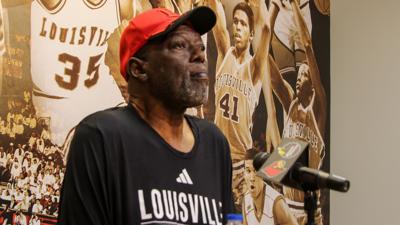
Last year, after losing his legs because of diabetes and a circulation issue, Cox was adjusting to his new reality. He was on dialysis and awaiting prosthetics. He knew his life had changed forever. He was sitting in a wheelchair, with a picture of his younger self just over his sholder.
I asked him if he ever was tempted to say, "Why me?"
"No," he said, "I didn't. Because that's a part of being defeated."
If Cox was misunderstood at times as a young man, we should not misunderstand this now that he is gone: He left undefeated.
Louisville will pause to remember Cox with a moment of silence before Tuesday's home game against Bellarmine.
Copyright 2024 WDRB Media. All Rights Reserved.