


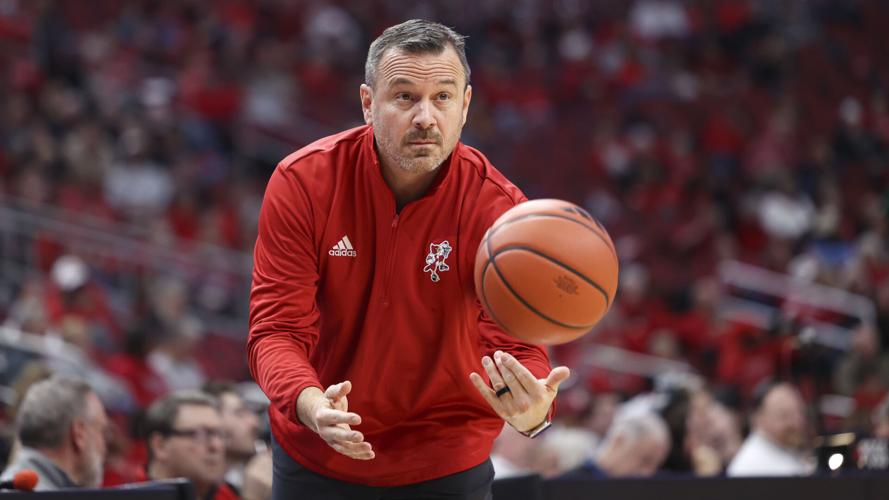
LOUISVILLE, Ky. (WDRB) -- Jeff Walz has spent 19 years building one of the premier programs in women's college basketball. He's coached Final Fours and first-rounders. Managed rosters. Trained pros. Recruited internationally.
And now? He's working a spreadsheet.
He talks about it as easily as he used to talk about recruiting a scorer or breaking a press. These days, building a winning team isn't just about drawing up plays. It's about plugging in numbers.
I went to an offseason news conference Wednesday, and a microeconomics lecture broke out.
"You only have so much money to pay your players," Walz said. "Eventually, I'm hoping to get down to maybe 10 to 12 players." (The roster limit is 15.) "Some are just happy to be on scholarship — which sounds crazy, anymore — but, you know, Asia Durr was just on a scholarship. Dana Evans was just on a scholarship. There are kids at this university that would die to not have to borrow money. But you've got a certain amount you can pay. So, if you get down to 10 or 11, the amount you can offer is a little higher."
Louisville | Kentucky | Indiana | Eric Crawford
That's not just coaching. That's cap management.
And it's not a conversation reserved for mid-major men's programs anymore. Louisville aspires to play with the nation's best. But in this new world, the competition comes with decimal points.
The Cards will open their season on Nov. 4 at Ramstein Air Force Base in Germany against UConn, a program whose payroll may well be three times larger.
When Louisville plays host to Kentucky — a team it beat six straight times before last year's overtime loss in Lexington — it will face a roster built with roughly twice the payroll. And when South Carolina visits the Yum Center on Dec. 4, the salary math won't be pretty.
This is Year 19 for Walz at Louisville — one shy of 20, and about 15 more than most coaches last anywhere.
He's been a master of adaptation. Two national championship games. Four Final Fours. A hand in 16 WNBA picks. But nothing — not even UConn — has forced an adjustment quite like this.
Now he's budgeting like a GM, scouting like a customs agent and coaching like a man trying to win in three currencies at once.
The economy even shapes the strategy.
If you've got $80,000 to spend, and another school is offering $140,000, do you stay in the race because the player keeps saying "it's not all about the money"? Or do you believe what every coach already knows? It's always about the money.
"You can't fault the players," Walz said.
Then he looked toward the bank of TV cameras at the back of the room.
"If somebody called and offered you three times the money to switch stations, I've got a feeling you might switch," he said. "I might see a different logo on your camera next time."
He's not wrong.
"We're all just trying to figure this recruiting thing," he said. "… What does a starting point guard make in the SEC? What does a starting point guard make in the ACC? What's a starting post player make? We don't have that yet. I think we're all trying to figure out: What are the numbers?"
If only all the players would wear QR codes.
Walz, of course, still coaches the game. Still loves the game. Still teaches it like he's got Angel McCoughtry in one ear and Myisha Hines-Allen in the other. But now he's teaching players to recognize the hot hand — and the market value.
This is the college basketball art of the deal.
In a game where dollars dictate decisions, how do you build a team that still plays like it's about the game first?
"I like our team. I really do," he said. "They're a great group of people. They seem to get along extremely well. … They will work hard."
That's all you can ask. Well, that and maybe a few more donors.
This is what happens when college athletics becomes a line item. One year, you're charting rebounds. The next, you're forecasting buyouts.
But give Walz credit for adjusting. He's got the receipts to prove it.
He's embraced international recruiting. He's coached overseas. He's learned that when a player hits two shots in a row, the smart thing is to get her the ball again.
"Simple," he said. "But not always easy."
Kind of like college basketball these days.
Walz knows he's not the only one navigating this new world. But few talk about it as plainly — or as well. He's part coach, part economist. Part Pat Summitt, part Paul Krugman. A little Freakonomics, a little full-court pressure.
There was a time that would sound like a strange combination. Now, it's just roster management.
It's not just who can shoot. It's who you can afford.
"Do I put six figures into an incoming freshman?" Walz asked. "Or do I wait for the portal, and go get a kid I know has done it?"
So Walz keeps doing it. Building teams. Balancing books. Coaching with heart. Recruiting with a highlighter.
And he knows — it's not just coaches feeling the pressure anymore. There's more on players, too.
"I feel for them," Walz said. "You know, the days when I played at Northern Kentucky, of going up to Skyline and maybe having a few too many to drink at the little local establishment on the top of the hill…"
(He pauses.)
"Now? You might be sitting there at a bar next to someone who's like, 'I gave $100,000, and you're drinking?'"
He smiled.
"I'm not saying you're supposed to drink in college," he said. "But let's not be naïve."
Walz certainly isn't.
After 19 years, he's still evolving. Still competing. Still figuring it out — one spreadsheet cell at a time.
Louisville Sports Coverage:
CRAWFORD | Louisville's first practice was more sweat than sizzle — and designed that way
Coffee with Crawford | Yes, Virginia, Indiana ghosted Louisville first — and nobody blinked
CRAWFORD | For Louisville at ACC Kickoff -- no buzzwords, no branding, just Brohm
Copyright 2025 WDRB Media. All Rights Reserved.


