
LOUISVILLE, Ky. (WDRB) — For as long as Jose Ortiz has been riding, he has been following his brother.
Following him to the racetrack. Following him into the starting gate. Following him up the standings, through the sport, into the biggest races it has to offer.
On Saturday evening at Churchill Downs, in the final yards of the Kentucky Derby, he followed him one more time.
And then, in a golden moment, he went by him.
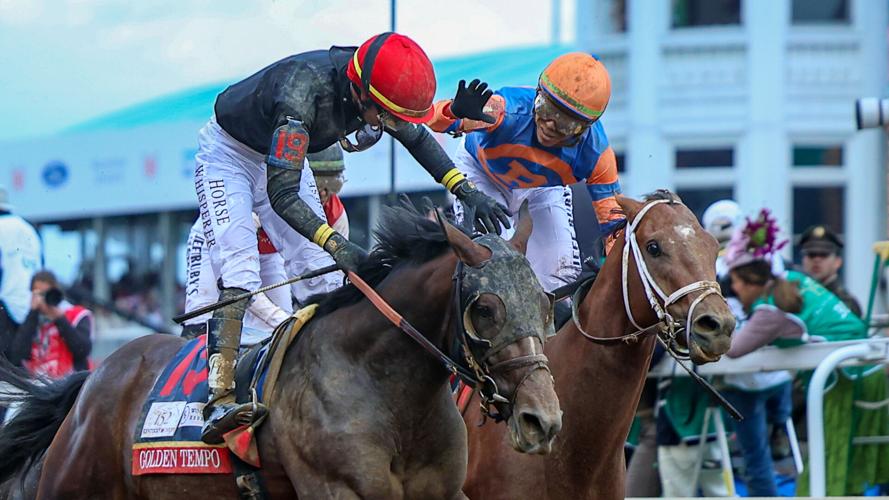
Jose Ortiz rode Golden Tempo past his older brother, Irad Ortiz Jr., and his mount Renegade in the final strides to win the 152nd Kentucky Derby. It was a clean, professional ride — patient early, decisive late — the kind of ride that wins this race.
It was also something more.
"I was following Irad," Jose said afterward. "I felt like he was the horse to beat."
Of course he was.
He always had been.
The story of the Ortiz brothers begins, as so many racing stories do, with family and a track and the kind of dream that doesn't need to be explained to the people who live around it.
They grew up in Puerto Rico, in a racing family. Their grandfather rode. Their uncle rode. Their father, if he didn't ride, made sure his sons understood the rhythm of it.
Multi-Eclipse Award-winning writer Ryan Goldberg reported this detail in his 2013 Daily Racing Form piece on the brothers: On race days, he would put them on a bed with a pillow for a saddle, helmets on their heads, and have them ride out the races they were watching on television — side by side, competing before they were old enough to understand what competition really meant.
Irad was first.
He was older by 18 months. First to riding school. First to success. First to make a name in the United States, arriving in New York and quickly becoming one of the sport's most aggressive and accomplished riders.
Jose followed.
"I want to do what he does," he said once, years ago, certainly not the first brother to express the sentiment.
That part never really changes.
There are stories told about them now that sound like folklore, the kind racing passes along from one generation to the next.
Also from Goldberg: a story from their boyhood when visiting New York with their grandfather. A backstretch fixture named Efraim "Pito" Rosa put them on an Equicizer — a mechanical horse used for training — and watched them balance, watched their hands, watched the way they carried themselves.
"These kids are naturals," Rosa said, in his recollection to Goldberg.
Another story from that piece is simpler, and maybe better.
They were too young to be let into the racetrack in Puerto Rico. So they hid in the trunk of a car, rode in that darkness until someone stopped near the track, and climbed out just in time to hear the horses coming.
"When I heard the breeze of the horses flying past," Irad told Goldberg, "I got a great feeling — like, wow, I want that."
They have been chasing that sound ever since.

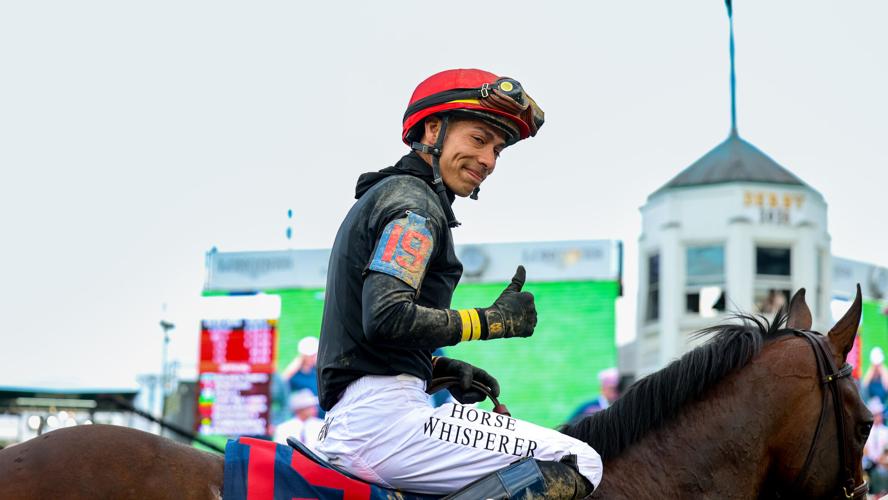
Jose Ortiz flashes a thumbs up after winning the 2026 Kentucky Derby aboard Golden Tempo.
They chased it together, and they chased each other.
By the time they arrived in New York — Irad in 2011, Jose soon after — they were no longer just brothers with a shared dream. They were competitors. They rode against each other every day. Won races off each other. Learned each other's tendencies the way great athletes learn their rivals.
There is a line they have used over the years, one that sounds harsh until you understand it.
There is no brotherhood on the track.
But there is no bitterness, either.
Saturday gave them both a chance at something neither had yet achieved.
For all their success — the stakes wins, the titles, the millions in purses — the Kentucky Derby had eluded them. It is the race every jockey grows up imagining, the one that sits above all the others.
Jose knew where he needed to be.
Behind Irad.
"I felt like he (Renegade) wasn't a closer," Jose said. "So I knew he was going to drop back a little bit. I was expecting him to run a very good race… maybe win it. So it was one of my targets to follow. And I did."
The race unfolded the way so many races between them have.
Irad, forward, assertive, placing his horse where it could win. Jose, patient, settling, waiting, trusting what he felt beneath him.
He has always had that feel. Other riders talk about it, the way he seems to arrive in the right spot without forcing his way there, the way he saves something for the end.
"I knew the point that I had to make my move," he said. "I think I timed it right."
In the stretch, with the crowd rising and the field thinning, the race came down to the two of them.
For a moment, it was exactly what it had always been: Irad in front, Jose chasing.
Then it wasn't.
Jose angled out. Asked his horse for more. And Golden Tempo responded.
Stride by stride, he closed the space that had always been there.
And then he erased it.
What happened next lasted only a second, maybe less.
As they crossed the finish line, Irad looked over.
Jose looked back.
There was no celebration yet, no disappointment fully formed. Just recognition.
Irad reached out his hand.
Jose, still riding out his mount, met his eye.
It was not the fist bump that would come later, not the replay that would make its way across television and social media.
It was quieter than that.
Two brothers, in the biggest race of their lives, finding each other at the end of it.
After her historic win in the Derby, in the rush of questions, Golden Tempo's trainer Cherie DeVaux stopped and said she wanted to add something.
"I have known Jose since he was a kid; him and Irad since they were babies," she said. "And it's been such a pleasure to watch. They're both extraordinary human beings. They are hard workers. And I watched Jose develop, and we've done a lot together. But just to know him from the very beginning to now, it's a complete honor."
The morning after, Jose stood outside Golden Tempo's barn, and he was asked about that moment, after the race.
"Very special," he said. "Obviously we both want to win. This is a long-time dream for us. We grew up in the sport. My grandpa rode. My uncle rode. The Kentucky Derby is the biggest race in the world. Very happy for me, and I hope he gets his win."
He will, probably. Riders like Irad Ortiz Jr. usually do.
But on this day, the race belonged to the one who had spent a lifetime chasing him.
The one who followed.
Until he didn't.
Copyright 2026 WDRB Media. All Rights Reserved.


