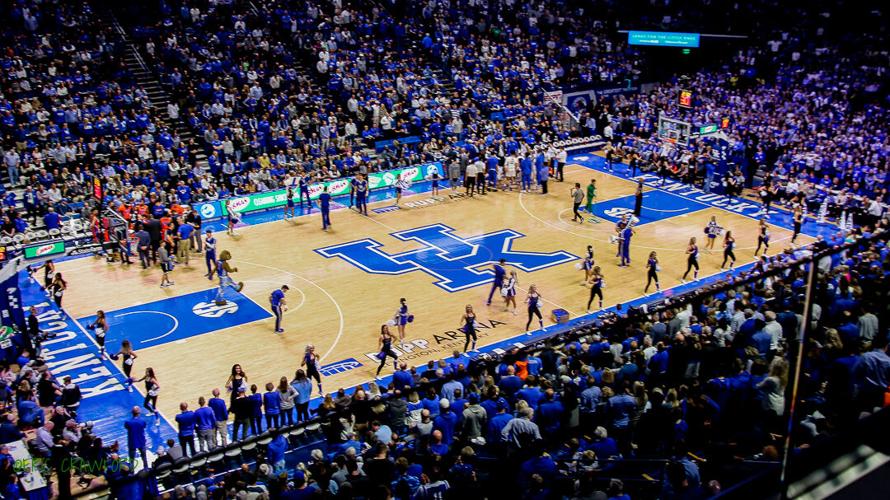
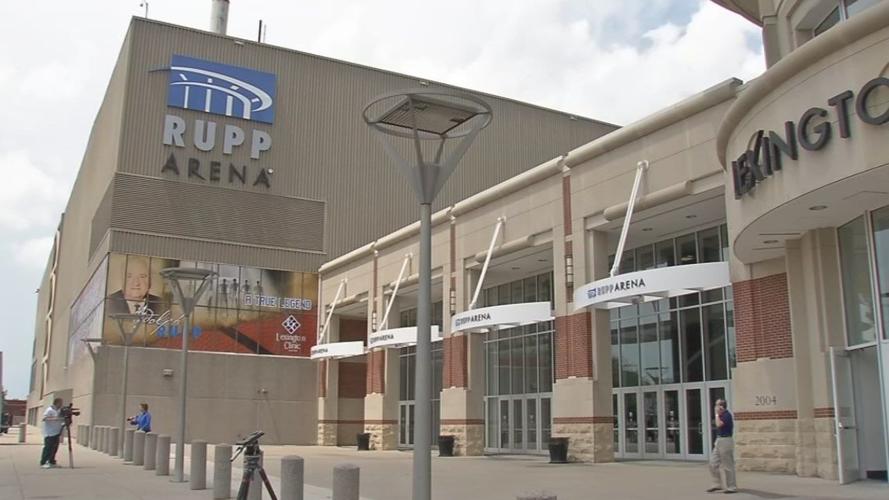



LOUISVILLE, Ky. (WDRB) – Adolph Rupp was a racist who resisted integrating the University of Kentucky basketball program. Adolph Rupp integrated the UK program after years of trying and has been made a symbol of racist attitudes in college basketball during his era. Adolph Rupp was a product of his time. Adolph Rupp made Kentucky basketball what it is. Adolph Rupp is not what Kentucky basketball should be going forward.
It would appear the time for this conversation has come. Which of those statements, or combination of statements, best reflects the truth? And depending on which you wind up believing, does his name deserve to adorn the University of Kentucky’s basketball arena? Can more than one of them be true? Does any one of them being true disqualify him from having his name on Kentucky’s arena.
We are brought to this place by the appropriate group – a collection of professors in UK’s African-American and Africana Studies department, which has asked UK to rename Rupp Arena, as part of a larger set of racial equity initiatives.
Why do I say appropriate? Because what happens to Rupp Arena’s name now will be a product of a discussion between the university and its faculty and staff; between the university and its basketball program and its basketball alumni; and between the university and its supporters around the state and nation.
I can’t make an exception for Rupp when it comes to my view in all these instances: If the memorial is offensive to and does real harm to entire races or large groups of people, why hang onto it? Whatever I think on whether a statue should stay or go, if a significant number of people or society in general would benefit from a memorial being removed, why should I insist on keeping it? People are more important than memorials or statues.
I can’t say anything different about Rupp Arena.
But I am a 52-year-old white male. The fate of Rupp Arena’s name does not belong with me, nor should it. I often think, when writing columns like this, what others who have been in this position might have done.
Dave Kindred, former Courier-Journal sports editor and one of the great columnists to roll through this city, is one I think of often. He knew Rupp and covered him. I reached out to him and he, quite candidly, told me that he lived through the turbulent 1960s and covered coaches, "who nearly universally were authoritarian products of a racist society."
Kindred's feeling was that he’d leave the name on Rupp Arena. He said he didn’t see Rupp as a George Wallace kind of figure any more than he’d see him as a Martin Luther King figure. But he did note, "I yield to the truth of lives shaped by new times and offended by reminders of times now gone."
It always ticks me off when guys can reel off in a few minutes lines I wish I’d written.
I have studied history my whole life. Perhaps the most significant thing I’ve learned: Everybody is flawed. The "greater" the person, often, the greater the flaw. There are exceptions. Not many. If you really study history, and do it with an honest heart and mind, you don’t put anyone on a pedestal.
And that, in the end, is our problem. We want to glorify people. We want them to enhance our narratives, whether as a nation or a state or a basketball program.
That gets dicey when it is contrasted with real life. An example: I am writing this from Jefferson County, Kentucky, in the municipality of Jeffersontown, in fact. Thomas Jefferson wrote into being the words, "We hold these truths to be self-evident that all men are created equal." But he owned slaves, and with one of them, Sally Hemings, he fathered six children. We all know what we would call that today.
Those words Jefferson wrote in the Declaration of Independence put an internal compass into everyone in this country – rich, poor, slave, free, no matter what race, ethnicity, country of origin, natural citizen or undocumented immigrant – a needle that points toward freedom.
And we will not have peace in this nation until every last group gets there. You can count on it.
Jefferson was brilliant. But he failed in this area, like most of the Founding Fathers. Benjamin Banneker was a former slave who taught himself mathematics and astronomy and was one of the city planners of Washington, D.C. His correspondence with Jefferson, which pleads for an end to slavery in general and Jefferson’s personal participation in it, can underscore only one conclusion: Jefferson looked full into the face of this evil, and turned away from confronting it.
I drove home on the Watterson Expressway. Henry Watterson volunteered for the Confederate Army. He helped raise money for the now-removed Confederate Memorial near the University of Louisville campus. On a vast scale of civil rights between Jefferson (whose name was chosen for the county where I live), and Watterson (street where I drive), and Muhammad Ali (street where I work) and Martin Luther King, Rupp is somewhere in the middle, residing with a great number of people with racist views by our standards who might not have held those views in a different time, in a different society.
The problem is, we want that different time to commence now. And we need that different society to have begun yesterday, and to take serious steps, symbolic and substantive, right now.
These names of streets and places and buildings, I live without thinking too much about. Would I do that if they were memorials to oppression of my race and ancestors? I hear a great many white commentators say that Blacks in America need to move on from the evils of slavery. I wonder if they even realize how many reminders are all around all of us, beyond the systemic and economic real-life obstacles. None of this is about erasing history. Nor is it a binary debate. It is about solving a problem.
A great many of us who don’t have the inborn outrage of hundreds of years of historic discrimination and mistreatment nonetheless have developed a weariness of decades of the same struggles in the Black community. We want to see change on its behalf, and will support those who promote it.
If you’re UK, there aren’t many public changes that would make a bigger statement than retiring the name of Adolph Rupp on the basketball arena.
Rupp’s name isn’t on that arena because he was a great person. It’s on there because he was a great basketball coach. It’s on there because, without what he did, the University of Kentucky wouldn’t be what it is today.
None of that is in question. The real question is this: What does the University of Kentucky want to be tomorrow?
Related Stories:
Copyright 2020 WDRB Media. All Rights Reserved.


