
LOUISVILLE, Ky. (WDRB) — The final whistle had barely blown before America put its youth soccer system on trial.
The U.S. had just been run off the pitch by Belgium, 4-1, ending an exhilarating World Cup run and igniting a debate that had apparently been waiting for permission to explode.
Landon Donovan blamed a youth system that charges families thousands of dollars, burns kids out and prioritizes winning over development. Sebastian Salazar, on his podcast, argued American soccer follows affluent suburbs instead of talent. ESPN's Dan Wetzel, in a column for the network, called the developmental pipeline "more business than development."
Others questioned whether America's best athletes still choose other sports. Whether Christian Pulisic had done enough. He was paired opposite Lionel Messi in a Michelob Ultra commercial, but Messi has eight World Cup goals. Pulisic scored only one, and did not put in a full 90-minute shift in any game.
Some former US players wondered aloud whether current American players simply lacked the toughness and resilience to compete with the world's elite. Carli Lloyd, on Fox Sports, said they looked "tentative" and "scared." Still others blamed helicopter parents, travel soccer, MLS, U.S. Soccer and a culture that continues to ask soccer to compete with football, basketball and baseball for the country's best athletes.
Somewhere in there, everyone seemed to agree on one thing.
The system is broken.
George Davis IV, a former LouCity FC captain, watched the same game everyone else did.
"It was disappointing," he said.
But he watched it differently.
"With some of the controversy that was going on around the suspension, and the president getting involved, now you start to create layers of pressure where you're not just playing against Belgium," Davis said. "It was really us against the world."
That's not an excuse. It's a different lens than the one most of the discourse chose.
But he didn’t dismiss the discourse. Davis sees many of the same problems everyone else does.
For Davis, now the executive director of the LouCity and Racing Foundation, this isn't an internet argument. It's his job description. He's spent years trying to build the game from the ground up in Louisville's neighborhoods, one player, one team and one opportunity at a time.
"I don't know that the system is the complete blame," Davis said this week.
"If you look at the rest of the world, you have a very clear pathway from the big clubs down through the youth systems," he said. "The benefit of youth development is those players pay minimal costs, and it's covered by the pro clubs."
America took a different path.
"All of our youth are forced to pay large costs and large costs of travel in order to play at high levels and receive high-level coaching."
That creates more than just a problem of access, with lower income kids boxed out of expensive developmental experiences, Davis said.
"When you pay for your kid to participate," he said, "then you have an expectation. If your kid's not playing, it's, 'Why aren't you playing? I'm paying for this. Do I need to call the coach?'"
Davis isn't criticizing parents. He's describing incentives. When families become customers, clubs begin acting like businesses.
Davis thinks that's where some of the pressure Landon Donovan talked about begins.
"I think parents put a different type of pressure on kids as it relates to the pay-to-play model," he said. "We're in a society where we put so much weight on being a professional athlete or getting a college scholarship that sometimes we lose sight of why sports is so important and why we all love it — it's fun, it's enjoyable and it's competition."
Nor does Davis dismiss Donovan's concern that youth sports too often reward winning before development. He just thinks that's a symptom of the pay-to-play model, not its cause.

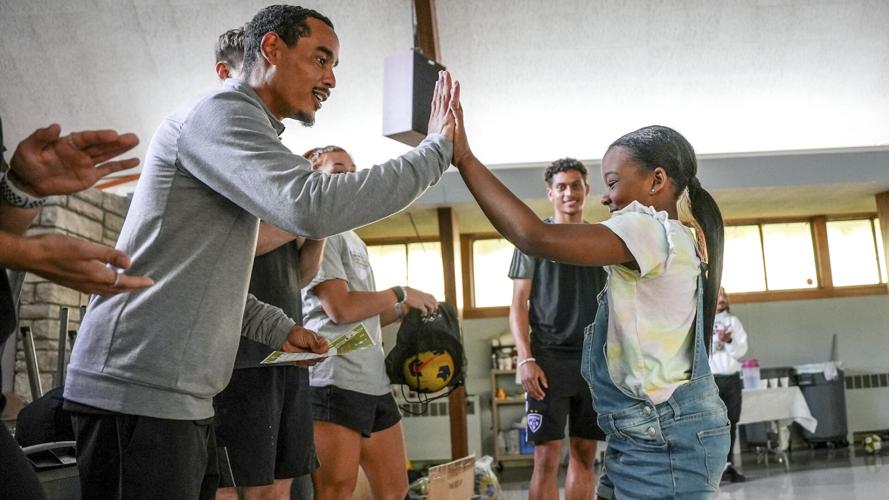
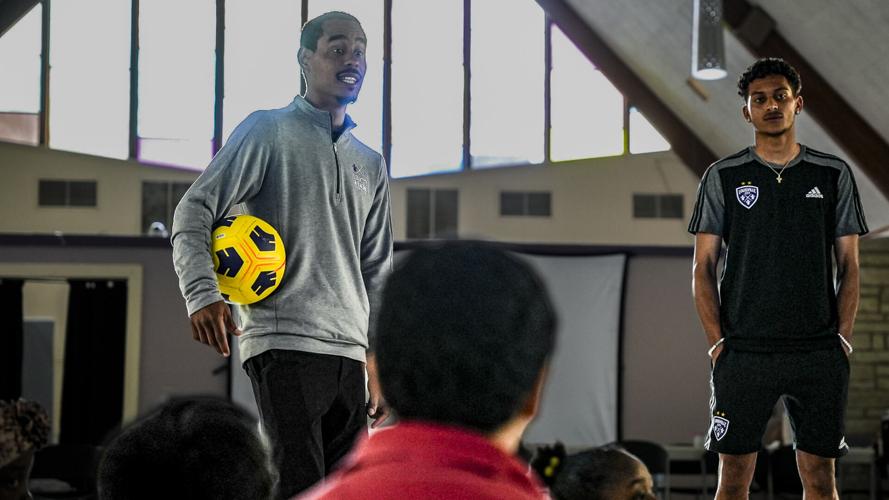
George Davis IV, executive director of the LouCity and Racing Foundation, works to develop opportunities for kids in soccer.
Those are harder problems to solve than simply building another field.
If America wants different results, Davis argues, it needs a different environment.
"If you look at our foundation, it's exactly what we're trying to do," he said. "Can kids play in their backyard? Can kids have access to quality soccer fields and mini-pitches so they can just go out, and it's part of their neighborhood game?"
Then Davis asks another question.
"What type of recreational leagues are available, even within the school systems, that they don't have to pay a bunch of money?"
And another.
"How do we get those kids out of the recreational environment and into competitive environments without paying thousands and thousands of dollars?"
That's the progression. Not one silver bullet. A pathway.
That's what Davis has spent years trying to build in Louisville.
He has seen results.
A few years ago, the JCPS Parks and Recreation League fielded just 17 teams. Today, it has nearly 50. Not because Louisville suddenly discovered soccer. Because somebody supplied coaches, equipment and organization.
"There is no lack of interest from the student-athletes," Davis said. "They just don't always have someone who can facilitate the opportunity."
America keeps asking where the players are.
Davis says they're already here.
The question is whether someone is giving them a chance.
It's personal for him.
"I would have killed to have a professional team in my backyard," Davis said. "At 15, 16, 17 years old, had I had the opportunity to be around professionals and train in those environments ... where my career could have gone. I don't have any regrets. I just want to make sure kids now get those opportunities."
That memory drives something practical: exposure.
Kids believing they can play for Louisville City or Racing Louisville, that's step one, Davis said. Many have never been to a professional match. Never felt connected to it.
Davis has a phrase for that: “Belief points.”
"Just getting them a jersey, or giving them tickets to a game, letting them see it and be a part of it, maybe even walk down on the field, meet a player," he said. "Those are belief points. It's like, 'Wow, I met this guy, and he looks like me, and I can do that too.'"
It doesn't stop at the field. Davis wants kids to see the business behind it, too. Coaching, training, marketing, sales. A career in soccer doesn't require playing it.
Ask him what comes next, and Davis doesn't hesitate.
"We need more coaches," he said. "We need more people who are willing to help these kids get access to the game."
More referees. More parents who understand what youth sports are supposed to be. More fields.
West Louisville Soccer already has five teams and more than 100 players, kids showing up, wanting to play, turned away mostly for lack of transportation, not talent. The next step, Davis said, is pushing that same model beyond Louisville, into Oldham County, southwest Louisville, out toward Bardstown.
None of that goes viral.
Davis doesn't think there's a shortcut. He points to France: 99 players in this World Cup alone came out of the suburbs of Paris. "It's no coincidence they have one of the best teams in the world," he said. "It's embedded in their culture. It's embedded in who they are."
The NFL isn’t disappearing. March Madness isn’t going anywhere. American sports culture is not going to resemble France’s.
That doesn’t mean Louisville can’t build more pathways than it has today. Kids playing soccer in sandlots, in backyards, on rec teams with real coaches, until eventually it isn't a program anymore. It's just how the city grew up.
Finding something to blame is easy.
George Davis will spend tomorrow trying to find another coach. More game officials. Another field. Another team. Another teenager ready for the next step.
That's slower work than winning an argument on social media.
It may also be where the next World Cup team begins.
Copyright 2026 WDRB Media. All Rights Reserved.


