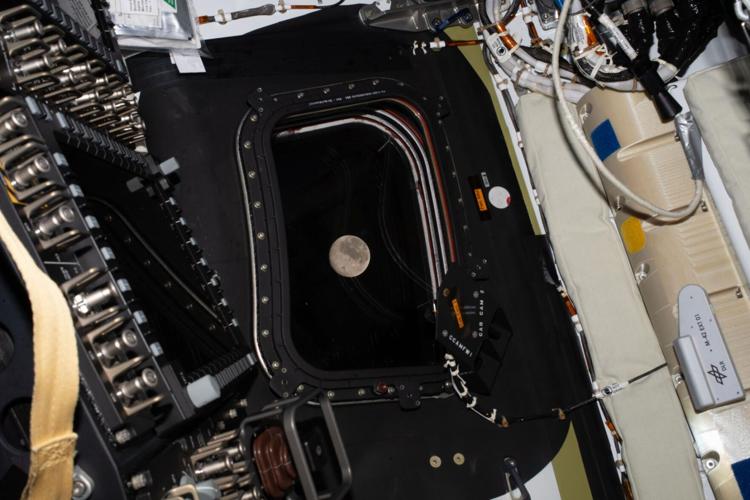


(April 6, 2026) – Before going to sleep on flight day 5, the Artemis II crew snapped one more photo of the Moon, as it drew close in the window of the Orion spacecraft. Orion and the four humans aboard entered the lunar sphere of influence at 12:37 a.m. EDT on April 6, at the tail end of the fifth day of their mission. That marked the point at which the Moon’s gravity had a stronger pull on the spacecraft than the Earth’s. Artemis II’s closet approach to the Moon will come on Flight Day 6, as they swing around the far side before beginning their journey back to Earth. About an hour after entering the lunar sphere of influence, Artemis II Mission Specialist Christina Koch said, “We are now falling to the Moon rather than rising away from Earth. It is an amazing milestone!”
Today's the day! The Artemis II mission crew launched this past Wednesday and they are set to fly around the moon TODAY! According to NASA, "at approximately 1:56 p.m. EDT, the spacecraft will break the record for the farthest distance from Earth traveled by any human, surpassing the mark set by Apollo 13 in April 1970, during its emergency return to Earth. The spacecraft will reach its maximum distance at 7:07 p.m., a total of 252,760 miles from Earth; Apollo 13 reached 248,655 miles from Earth.
The lunar observation is scheduled to begin at about 2:45 p.m. EDT. The roughly seven-hour flyby covers the period when their Orion spacecraft will be close enough to the Moon for the crew to make detailed observations of geologic features on the lunar surface."
Here is the schedule on when and where YOU can watch this take place today!
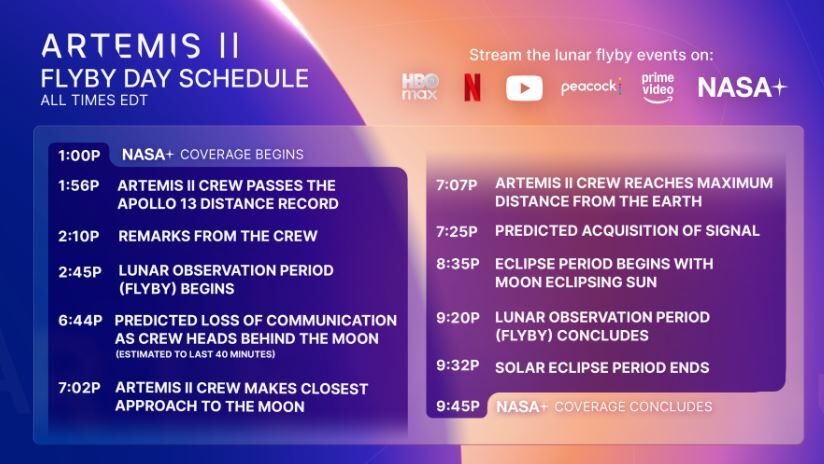
Image: NASA
Monday, April 6
- 1:30 p.m.: The science officer in the Mission Control Center at NASA’s Johnson Space Center in Houston will brief the crew on their science goals for the upcoming flyby.
- 1:56 p.m.: The Artemis II crew is expected to surpass the record previously set by the Apollo 13 crew in 1970 for the farthest humans have ever traveled from Earth.
- 2:45 p.m.: Lunar observations begin.
- 6:44 p.m.: Mission control expects to temporarily lose communication with the crew as the Orion spacecraft passes behind the Moon.
- 6:45 p.m.: During “Earthset,” Earth will glide behind the Moon from Orion’s perspective.
- 7:02 p.m.: Orion reaches its closest approach to the Moon at 4,070 miles above the surface.
- 7:07 p.m.: Crew reach their maximum distance from Earth during the mission (252,706 miles).
- 7:25 p.m.: “Earthrise” marks Earth coming back into view on the opposite edge of the Moon.
- 7:25 p.m.: Mission control will re-acquire communication with the astronauts.
- 8:35-9:32 p.m.: During a solar eclipse, the Sun will pass behind the Moon from the crew’s perspective.
- 9:20 p.m.: Lunar observations conclude.
Click here for a direct hyperlink to the NASA+ website to watch LIVE!
Coverage will include live views of the Moon from cameras mounted on Orion’s solar arrays. Image and view quality may vary throughout the lunar observation period due to distance from Earth, system limitations, and bandwidth across NASA’s communications network.
When Orion passes behind the Moon, starting at approximately 6:44 p.m., the mission will enter a planned communications blackout lasting about 40 minutes. During this period, the Moon blocks the radio signals needed for the Deep Space Network to maintain contact with the spacecraft. Shortly after loss of signal, Orion is expected to make its closest approach at about 7:02 p.m., when it will be just 4,070 miles above the surface.
Toward the end of their observation, starting at 8:35 p.m., the crew will witness a solar eclipse from space as Orion, the Moon, and the Sun align. The astronauts will see the Sun disappear behind the Moon for nearly an hour. During this period, they will view a mostly darkened Moon and will use the opportunity to analyze the solar corona — the Sun’s outermost atmosphere — as it appears around the edge of the Moon.


