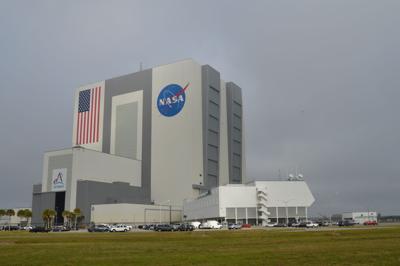
Monday morning NASA hopes to launch Artemis I from Kennedy Space Center in Florida, but the weather might interfere.

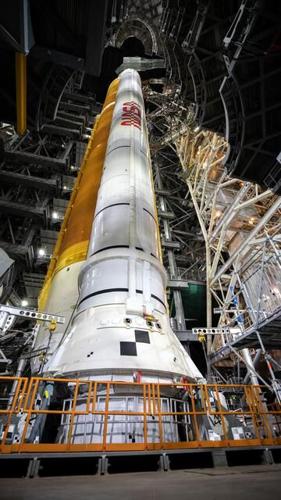
In this view looking up in High Bay 3 of the Vehicle Assembly Building at NASA’s Kennedy Space Center in Florida, all of the work platforms that surround the Artemis I Space Launch System (SLS) and Orion spacecraft are fully retracted on March 16, 2022. The Artemis I stack atop the mobile launcher will roll out to Launch Complex 39B atop the crawler-transporter 2 for a wet dress rehearsal ahead of launch. Artemis I will be the first integrated test of the SLS and Orion spacecraft. In later missions, NASA will land the first woman the first person of color on the surface of the Moon, paving the way for a long-term lunar presence and serving as a steppingstone on the way to Mars. (Credit: NASA)
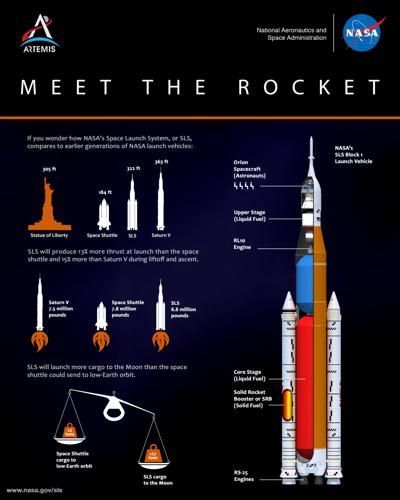
Artemis I is an un-crewed mission, meaning no humans will be launched into space. This "will be the first in a series of increasingly complex missions to build a long-term human presence at the Moon for decades to come. The primary goals for Artemis I are to demonstrate Orion’s systems in a spaceflight environment and ensure a safe re-entry, descent, splashdown, and recovery prior to the first flight with crew on Artemis II." Basically the goal for this launch is to make sure everything works before they send people up on Artemis II. Two of the main components being tested are the Orion heat shields and splashdown retrieval. Orion is the capsule where the astronauts will be, and the Space Launch System (SLS) is the vehicle. Check out the graphic below from NASA for a good explanation!

NASA’s Space Launch System (SLS), the most powerful and capable rocket NASA has ever built, will send missions farther and faster through space. SLS, along with NASA’s Orion spacecraft, the Gateway in lunar orbit and, the human landing system are the agency’s backbone for deep space exploration and the Artemis lunar program. SLS is the only launch vehicle that can send Orion, astronauts and supplies to the Moon in a single mission. For the first mission of SLS and Orion, Artemis I, the rocket is capable of sending more than 27 metric tons (59,000 pounds) to the Moon. As the SLS evolves, it will have even more power and will be capable of lofting even heavier payloads to orbit. (Credit: NASA/MSFC)
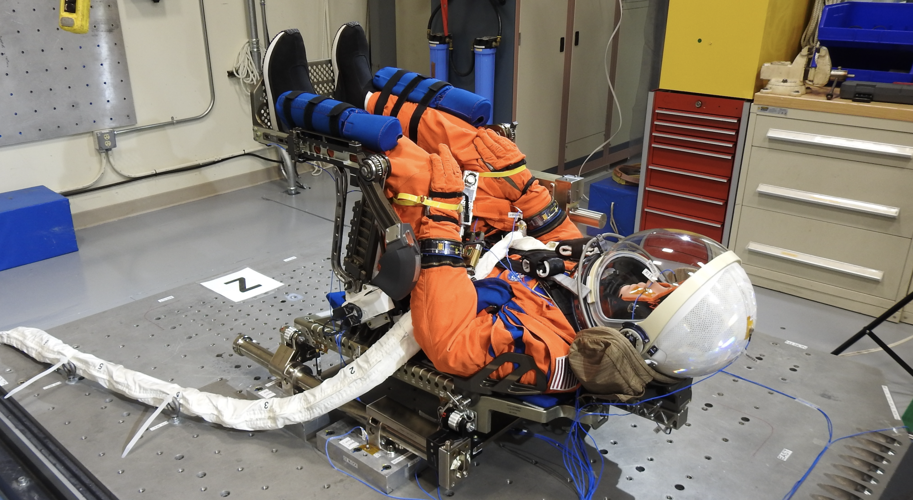
In addition to tons of equipment going up, there will be three manikins (Helga, Zohar, and Captain Moonikin Campos) outfitted to the gills with testing equipment riding in Orion. They will be collecting information on how the flight will affect a human body. This program will be the first time the United States sends people back to the moon since the Apollo program ended in the 70s. During the Artemis program, NASA will land the first woman and the first person of color on the Moon.

Three “passengers” will fly aboard Orion to test the spacecraft’s systems and collect data to inform future missions with astronauts. (Credit: NASA)
As mentioned above, weather has been threatening to derail the planned timing of this mission. Saturday afternoon "there were three lightning strikes to the lightning protection system towers at Launch Pad 39B – a strike to Tower 1, and two strikes to Tower 2." That meant overnight crews had to make sure no part of the spacecraft had been damaged by the lightning, which they confirmed Sunday morning.

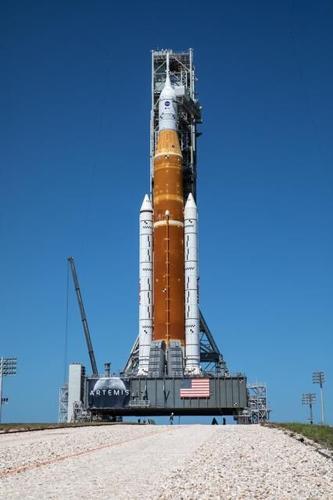
Standing atop the mobile launcher, NASA’s Space Launch System (SLS) rocket and Orion spacecraft can be seen at Launch Pad 39B at the agency’s Kennedy Space Center in Florida on March 18, 2022. The Artemis I stack was carried from the Vehicle Assembly Building to the pad – a 4.2-mile journey that took nearly 11 hours to complete – by the agency’s crawler-transporter 2 for a wet dress rehearsal ahead of the uncrewed launch. Artemis I will test SLS and Orion as an integrated system prior to crewed flights to the Moon. Through Artemis, NASA will land the first woman and the first person of color on the lunar surface, paving the way for a long-term lunar presence and serving as a steppingstone on the way to Mars. (Credit: NSAS)
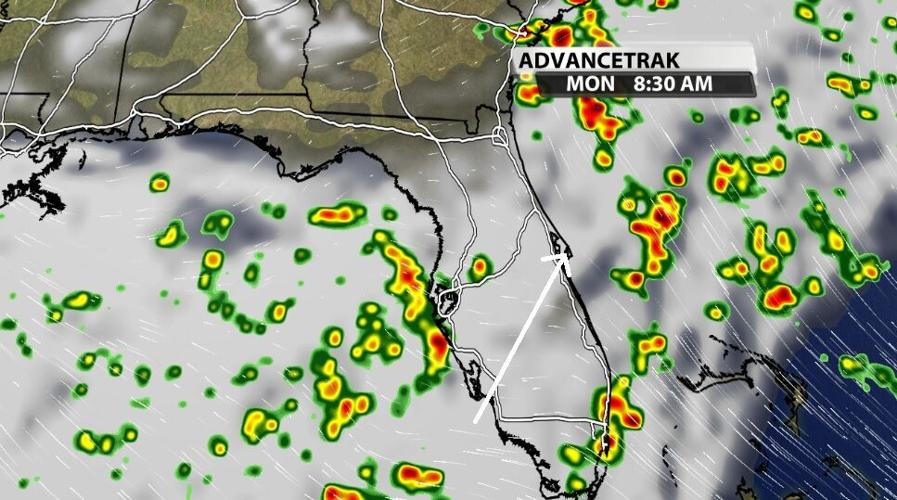
A team of meteorologists closely watch the weather before and during a launch, and there are specific weather criteria for temperatures, temperature changes, wind, precipitation, solar activity, lightning, and clouds. With all of those guidelines in mind, it does look like there will be rain and clouds in the area Monday morning that could affect the launch, but they only need a small window of time free from those limiting factors to be able to go through the launch sequence.

You can click here to watch NASA's live coverage - they will start the Artemis countdown at 6:30 AM. The launch window opens at 8:33 AM and is only open for two hours. If weather (or any other issue) prevents the launch within that window, it will be postponed to a later day/time. Between the time this post goes live and the opening of the launch window at 8:33 AM Monday, here's what will be happening at Kennedy Space Center:
L-15 hours and counting
- All non-essential personnel leave Launch Complex 39B (L-12H – L-10H)
- Ground Launch Sequencer (GLS) Activation (L-11H15M – 9H15M)
- Air-to-gaseous nitrogen (GN2) Changeover for vehicle cavity inerting (L-10H45M – Launch)
L-9 hours, 40 minutes and counting
- Built in countdown hold begins (L-9H40M – L-7H10M)
- Launch team conducts a weather and tanking briefing (L-9H40M – L-8H50M)
- Launch team decides if they are “go” or “no-go” to begin tanking the rocket (L-8H40M)
- Core Stage LO2 transfer line chilldown (L-8H15M – L-8H)
L-8 hours and counting
- Core stage LO2 main propulsion system (MPS) chilldown (L-8H – L-7H20M)
- Core stage LO2 slow fill (L-7H20M – L-7H5M)
- Core Stage LO2 fast fill (L-7H5M – L-4H15M)
- Core Stage LH2 chilldown (L-7H15M – L-7H5M)
- Core Stage LH2 slow fill start (L-7H5M – L-6H15M)
- Core Stage LH2 fast fill (L-6H15M – L-5H5M)
- Core Stage LH2 topping (L-5H5M – L-5H)
L-5 hours and counting
- Core Stage LH2 replenish (L-5H – Launch)
- ICPS LH2 ground support equipment (GSE) and tank chilldown (L-4H45M – L-4H30M)
- ICPS LH2 fast fill start (L-4H30M – L-3H30M)
- Orion communications system activated (RF to Mission Control) (L-4H20M – L-3H45M)
- Core stage LO2 topping (L-4H15M– L-3H55M)
- Core Stage LO2 replenish (L-3H55M – Launch)
- ICPS L02 MPS chilldown (L-3H55M– L-3H45M)
- ICPS L02 fast fill (L-3H45M– L-2H55M)
- ICPS LH2 validation and leak test (L-3H30M – L-3H15M)
- ICPS LH2 tank topping start (L-3H15M – L-2H55M)
L-3 hours and counting
- ICPS/Space Launch System (SLS) telemetry data verified with Mission Control and SLS Engineering Support Center (L-2H55M – L-2H45M)
- ICPS LO2 validation and leak test (L-2H55M – L-2H30M)
- ICPS LH2 replenish (L-2H50M – Launch)
- ICPS LO2 topping (L-2H30M – L-2H10M)
- ICPS LO2 replenish (L-2H10M – Launch)
L-50 minutes and counting
- Final NASA Test Director briefing is held (L-50M)
L-40 minutes and holding
- Built in 30-minute countdown hold begins (L-40M)
L-15 minutes and holding
- The launch director polls the team to ensure they are “go” for launch
T-10 minutes and counting
- Ground Launch Sequencer (GLS) initiates terminal count (T-10M)
- GLS go for core stage tank pressurization (T-6M)
- Orion ascent pyros are armed (T-6M)
- Orion set to internal power (T-6M)
- Core Stage LH2 terminate replenish (T-5M57S)
- GLS is go for flight termination system (FTS) arm (T-5M)
- GLS is go for LH2 high flow bleed check (T-4M40S)
- GLS is go for core stage auxiliary power unit (APU) start (T-4M)
- Core Stage APU starts (T-4M)
- Core stage L02 terminate replenish (T-4M)
- ICPS LO2 terminate replenish (T-3M30S)
- GLS is go for purge sequence 4 (T-3M10S)
- ICPS switches to internal battery power (T-1M56S)
- Core stage switches to internal power (T-1M30S)
- ICPS enters terminal countdown mode (T-1M20S)
- ICPS LH2 terminate replenish (T-50S)
- GLS sends “Go for automated launch sequencer” command (T-33S)
- Core stage flight computer to automated launching sequencer (T-30S)
- Hydrogen burn off igniters initiated (T-12S)
- GLS sends the command for core stage engine start (T-10S)
- RS-25 engines startup (T-6.36S)
T-0
- Booster ignition, umbilical separation, and liftoff

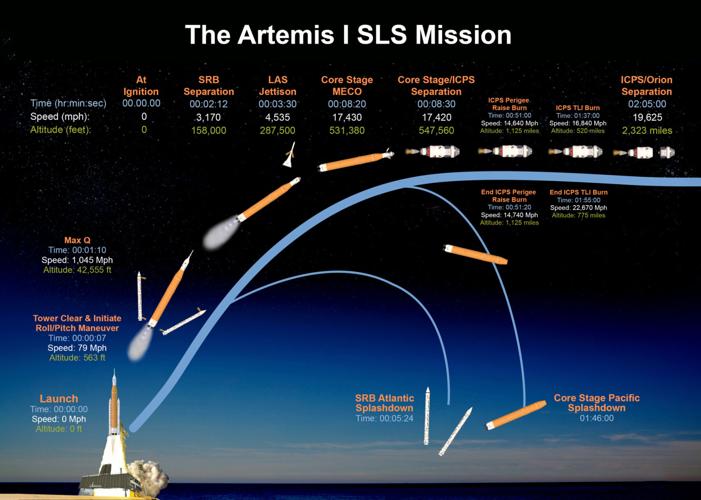
Artemis I Mission Launch sequence (Image Credit: NASA)
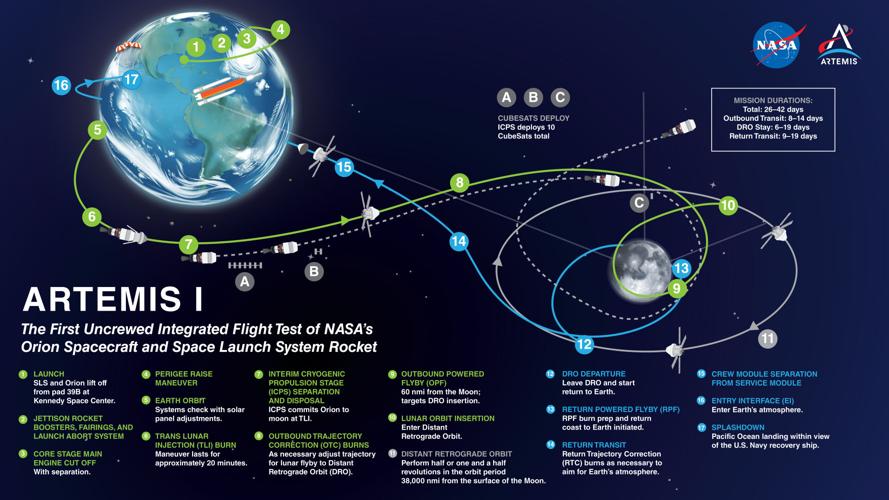
The graphic above shows what happens to get the craft off the ground, then the graphic below shows the planned flight. The craft is expected to return to Earth 42 days later.

(Image Credit: NASA)