
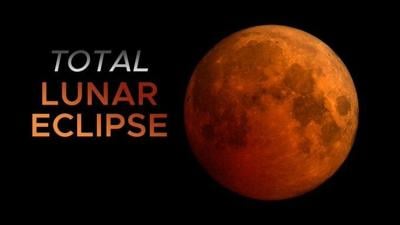

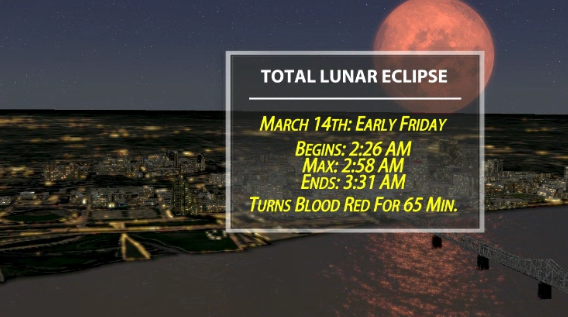
Are you willing to wake up around 3 AM early Friday to see a "Blood Moon" illuminate the night sky? If the answer is yes, then keep reading. A total lunar eclipse occurs when the Sun casts Earth's shadow onto the Moon. For this to happen, the Earth must be physically between the Sun and Moon with all three bodies lying on the same plane of orbit. Unlike solar eclipses, a total lunar eclipse lasts a few hours, with totality itself usually averaging anywhere from about 30 minutes to over an hour. This is due to the large relative size of Earth over the Moon (the Moon's diameter is only about 2150 miles), therefore casting a large umbral shadow on the Moon. Skies will be mostly clear and you don't need any special equiptment or glasses to view it!
What can I expect to observe?
Penumbral eclipse begins (11:57pm EDT ) The Moon enters the Earth’s penumbra, the outer part of the shadow. The Moon begins to dim, but the effect is quite subtle.
Partial eclipse begins ( 1:09am EDT ) The Moon begins to enter Earth’s umbra and the partial eclipse begins. To the naked eye, as the Moon moves into the umbra, it looks like a bite is being taken out of the lunar disk. The part of the Moon inside the umbra appears very dark.
Totality begins ( 2:26am EDT ) The entire Moon is now in the Earth’s umbra. The Moon is tinted a coppery red. Try binoculars or a telescope for a better view. If you want to take a photo, use a camera on a tripod with exposures of at least several seconds.
Totality ends ( 3:31am EDT ) As the Moon exits Earth’s umbra, the red color fades. It looks as if a bite is being taken out of the opposite side of the lunar disk from before.
Partial eclipse ends ( 4:47am EDT ) The whole Moon is in Earth’s penumbra, but again, the dimming is subtle.
Penumbral eclipse ends ( 6:00am EDT ) The eclipse is over.
Credit: NASA Video
Why does the Moon turn red during a lunar eclipse?
The same phenomenon that makes our sky blue and our sunsets red causes the Moon to turn reddish-orange during a lunar eclipse. Sunlight appears white, but it actually contains a rainbow of components—and different colors of light have different physical properties. Blue light scatters relatively easily as it passes through Earth’s atmosphere. Reddish light, on the other hand, travels more directly through the air.
When the Sun is high on a clear day, we see blue light scattered throughout the sky overhead. At sunrise and sunset, when the Sun is near the horizon, incoming sunlight travels a longer, low-angle path through Earth's atmosphere to observers on the ground. The bluer part of the sunlight scatters away in the distance (where it's still daytime), and only the yellow-to-red part of the spectrum reaches our eyes.
During a lunar eclipse, the Moon appears red or orange because any sunlight that's not blocked by our planet is filtered through a thick slice of Earth’s atmosphere on its way to the lunar surface. It’s as if all the world’s sunrises and sunsets are projected onto the Moon.

What else can I observe on the night of the eclipse?
Look to the western sky on the night of the eclipse for a glimpse of planets Jupiter and Mars. The Moon will be in the constellation Leo, under the lion's hind paw, at the beginning of the eclipse; soon afterward, it will cross into the constellation Virgo. As Earth's shadow dims the Moon's glow, constellations may be easier to spot than usual.


