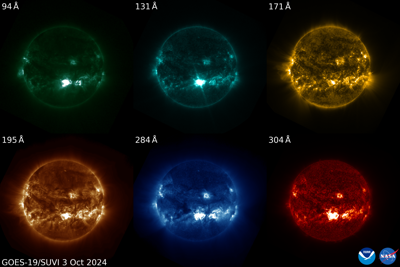

Space weather impacts numerous facets of everyday life, including power grids, communications, airline operations, global positioning systems (GPS), and satellites. In addition, there are a large variety of phenomena that are driven by the variability of the sun over periods ranging from hours to years.

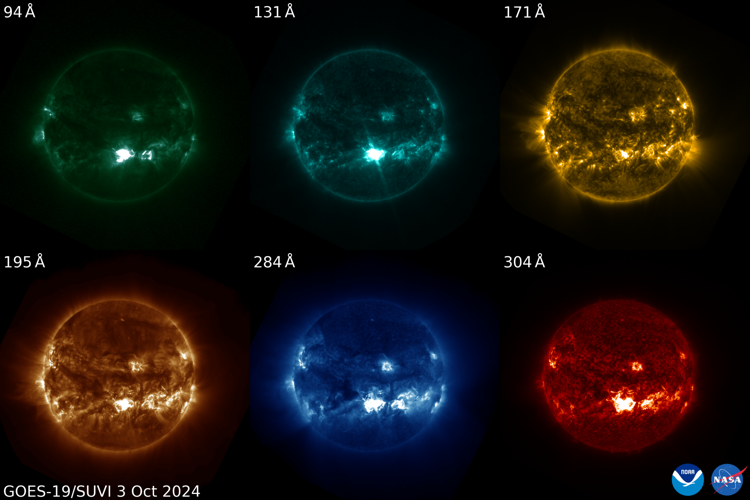
An X9 flare, which can be seen in the lower half of the sun, captured by GOES-19’s Solar Ultraviolet Imager (SUVI) instrument on Oct. 3, 2024. (Image credit: NOAA)
Solar flares are large eruptions of electromagnetic radiation from the sun. They can last minutes or hours and can cause increased ionization in the lower layers of the Earth’s ionosphere. Coronal mass ejections (CMEs) are large masses of plasma and strong magnetic fields that shoot out from the sun’s corona. CMEs are often associated with solar flares and can cause geomagnetic storms on Earth. Both solar flares and CMEs usually occur near sunspots, areas of particularly strong magnetic forces on the surface of the sun.
NOAA’s Space Weather Prediction Center and Office of Space Weather Observations, as well as earlier space weather observers, have seen some amazing solar events over the years. Here are some of the most memorable.
1. The Carrington Event on September 1, 1859

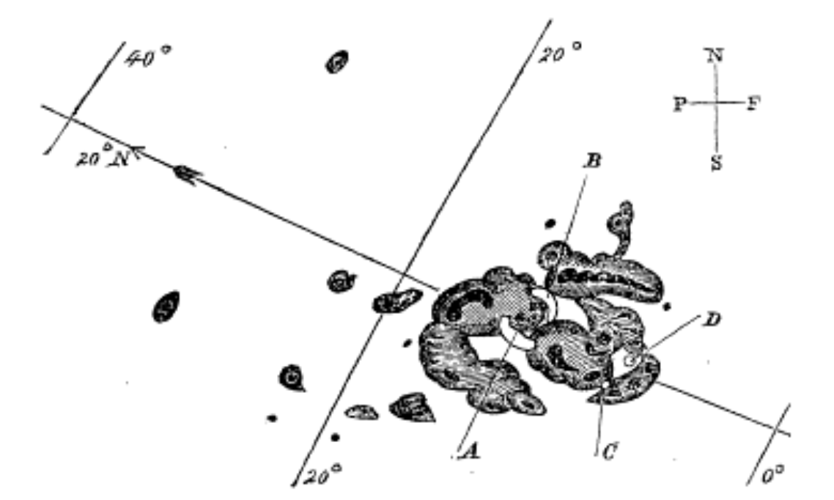
Illustration of sunspots by R.C. Carrington from Monthly Notices of the Royal Astronomical Society, Volume 20, Issue 1, November 1859. (Image credit: Public Domain)
The Carrington Event was observed by both R.C. Carrington and Richard Hodgson independently the day before the effects of this large solar flare hit Earth. The effects were astounding, causing the northern lights (aurora borealis) to be seen farther south than had ever been recorded before. Powerful electrical currents flowed through telegraph machine wires, causing them to shock their operators and igniting small fires in some offices because of the surge in electrical currents. Some even sent messages without being plugged in or received nonsensical messages that no one had sent. The Carrington Event set off the largest geomagnetic storm ever recorded.
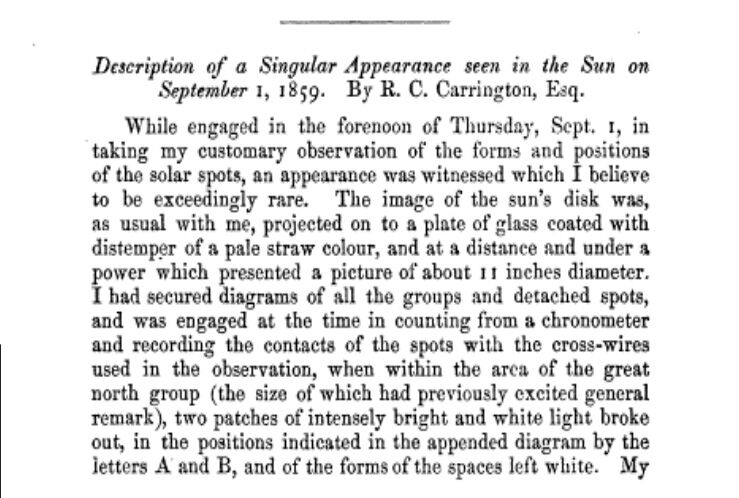
Excerpt from Monthly Notices of the Royal Astronomical Society, Volume 20, Issue 1, November 1859. (Image credit: Public Domain)
2. The solar storm on May 23, 1967
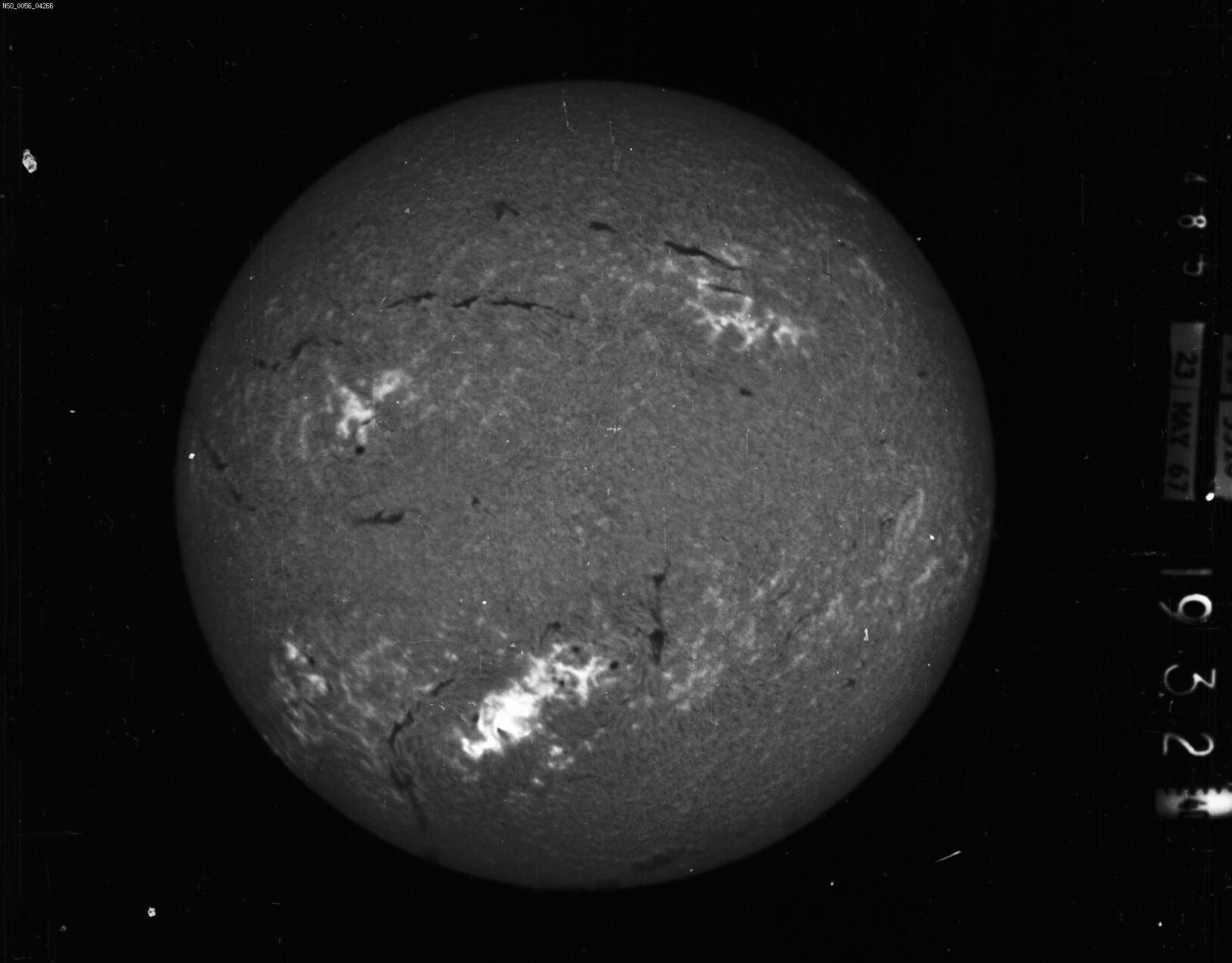
A view of the Sun on May 23, 1967, in a narrow visible wavelength of light called Hydrogen-alpha. The bright region in the top center region of brightness shows the area where the large flare occurred. (Image credit: Credit NSO/AURA/NSF)
In the middle of the cold war, a massive solar radio burst associated with a powerful solar flare jammed several U.S. and United Kingdom radar and radio communications systems in polar regions. The U.S. Air Force Strategic Air Command began readying their bombers, thinking that the Soviet Union had jammed our communications, but space weather forecasters in the U.S. Air Force’s Air Weather Service let them know that it was due to solar activity just in time.
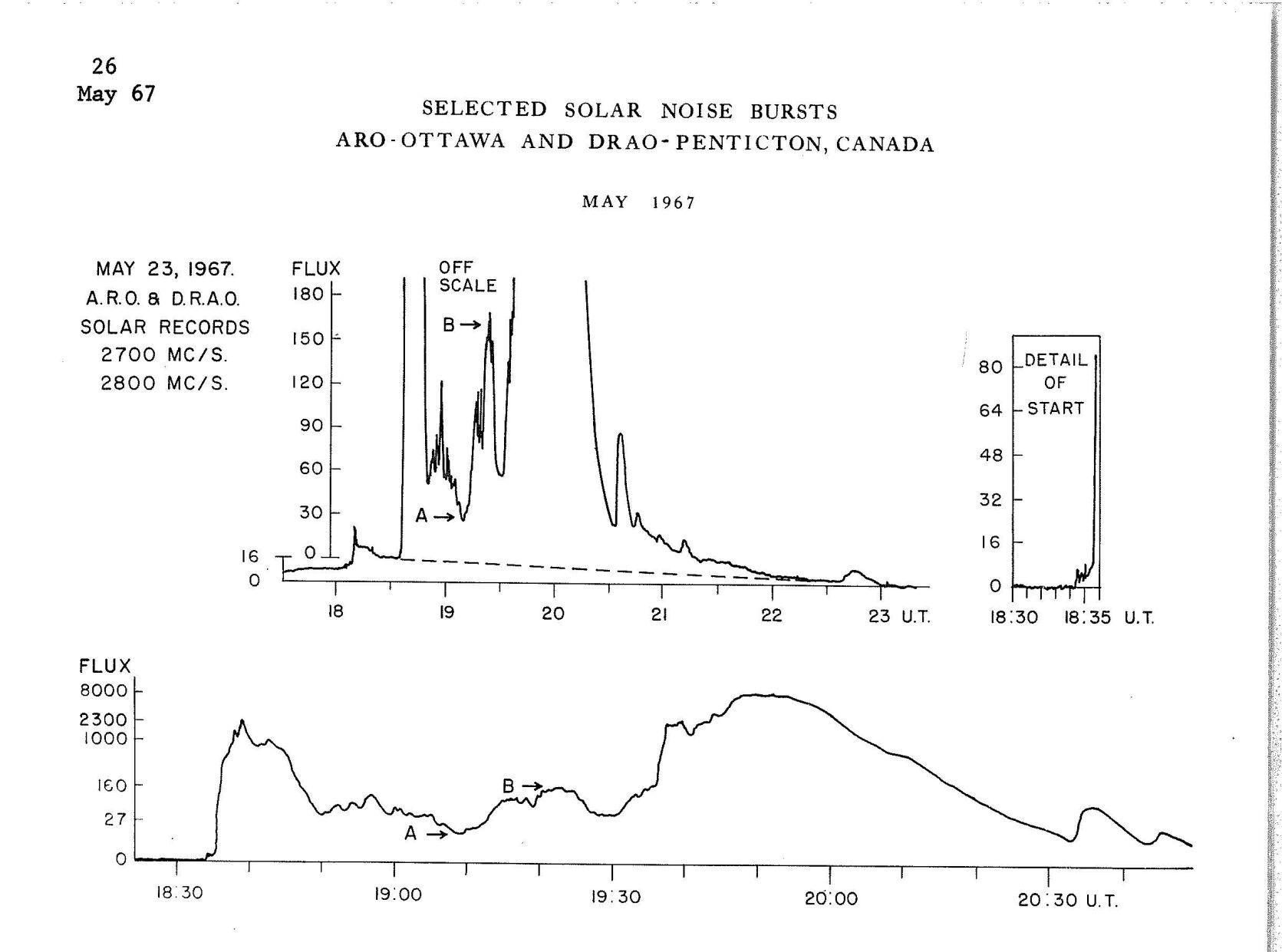
Excerpt from Solar-Geophysical Data, Number 274 showing plots of the radio burst accompanying the May 23, 1967 solar flare. (Image credit: NOAA)
3. The solar storm on August 2–4, 1972

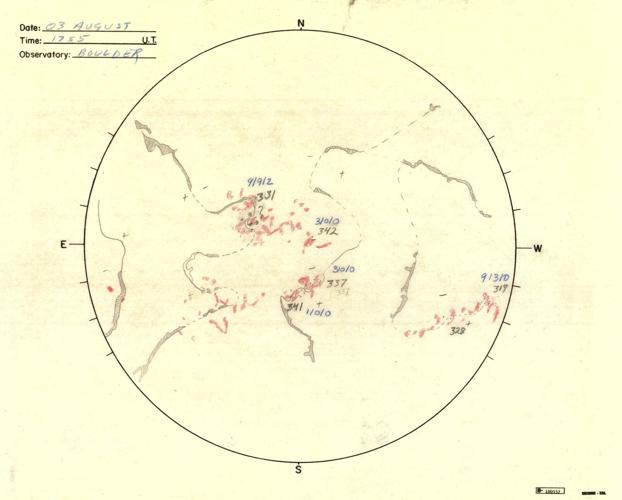
A solar synoptic solar analysis of the sun spots seen on August 3, 1972. (Image credit: Space Weather Prediction Center/NOAA)
These large solar flares and their associated CMEs eventually led to striking aurora borealis displays bright enough to cast shadows. They also caused radio blackouts and television broadcasts to break up. Some of the United States military’s nuclear detection devices falsely alerted to a nuclear bomb having been detonated on the planet. Despite that not being the case, the resultant geomagnetic storm did likely cause several magnetic sea mines off the coast of Vietnam to explode.
4. The Halloween Space Weather Storms of 2003
Imagery recorded from GOES-12 on October 31, 2003. (Credit: NOAA)
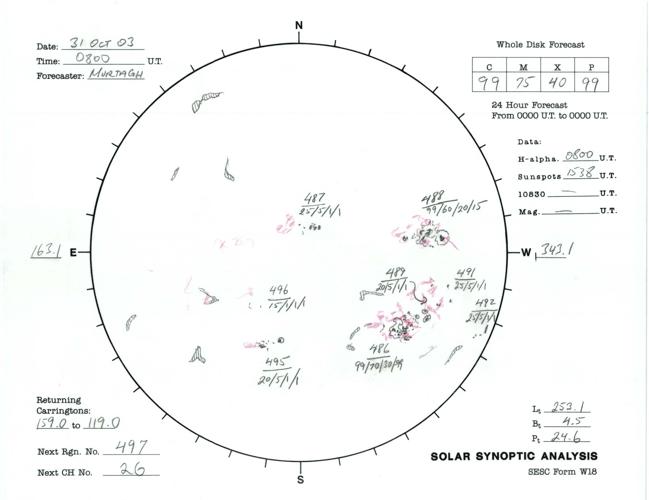
Three large intense sunspot regions produced 17 solar flares from October 19 to November 5, 2003. Because they were around Halloween, the event was named for the holiday. It was one of the most active and demanding solar activity epochs in years. Strong geomagnetic storms caused a blackout in Northern Europe. Airlines rerouted planes to avoid the high radiation levels and communication blackout areas. NASA ordered the ISS astronauts to take precautionary shelter and approximately 59% of deep space missions and satellites at all orbits experienced anomalies. It is even suspected that NASA’s ADEOS-2 spacecraft which carried the $150 million NASA SeaWinds instrument was lost due to these solar storms.

A solar synoptic solar analysis of the sun spots seen on October 31, 2003. (Image credit: Space Weather Prediction Center/NOAA)
5. The Gannon solar storm on May 8-11, 2024
Imagery recorded from GOES-18’s Solar Ultraviolet Imager (SUVI) instrument on May 8-14, 2024. (Credit: NOAA)
In early May of 2024, a highly active and complex sunspot cluster 17 times the diameter of Earth was observed by the Geostationary Operational Satellites (GOES) Solar Ultraviolet Imager (SUVI). At least eight Earth-directed coronal mass ejections (CMEs) erupted from this cluster between May 8-11. Several were Halo CMEs, which means that the ejections from the sun’s corona are directed toward the Earth, giving the appearance of a halo around the sun. The eruptions caused G5 geomagnetic storm conditions, the very top of the scale. Quite possibly the strongest geomagnetic storm recorded this century, its effects included the northern lights being seen farther south than usual around the world, as well as increased density at low Earth orbit altitudes which increased the drag on satellites, causing their orbits to decay and large numbers of satellites to maneuver at the same time, which resulted in one of the largest satellite migrations in history. The Gannon storm was considered to be a Carrington-class event, although the geomagnetic storm caused by it wasn’t quite as large as that of the Carrington Event.
The SUVI instruments carried onboard our current GOES satellites monitor the sun in the extreme ultraviolet wavelength range. SUVI’s detection of solar flares and eruptions can provide early warning of potential effects on Earth and in our near-Earth space environment.


