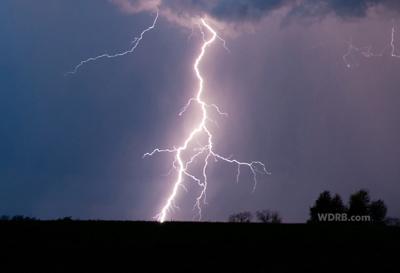
Lightning is a summertime phenomenon we take for granted around here. On a hot, humid summer day, seeing lightning or hearing thunder is not surprising. Think about the winter here, though. There's not nearly as much lightning, and weather people get excited for the chance of thunder with snow. That's because lightning in cold weather doesn't happen nearly as often.
With that in mind, more lightning is being detected during summer in the Arctic. That's strange because it's usually too cold to get much lightning that close to the north pole. In a recent study published in Geophysical Research Letters, more lightning is being connected to rising temperatures in that region. "If...the Earth has another 0.5°C global temperature increase, then the lightning stroke rate in the Arctic could increase by 100% from the 2020 stroke level."
Lightning forms when the tiny ice particles in a cloud bump into each other. In that collision, electrons are knocked off and start to collect in the cloud. Opposites attract so as the negative charges collect in the cloud, that causes positive charges to collect in a nearby cloud or on the ground (usually in a tree or tall structure). Lightning is the discharge of those charges so positives and negatives can be more regularly scattered instead of all bunched up together.
Since lightning depends on ice, you might think it would be easier to get lightning in a colder region or season. But lightning depends on having an energetic storm. You need warmer air for the storm to feed on to help it grow stronger. Then in the top part of the cloud (which has temperatures near or below freezing) tiny ice particles develop and bump into each other. There aren't many thunderstorms in the arctic because there isn't that temperature contrast between warmer and colder air to develop storms like that. This new study is interesting because it points to rising temperatures in the arctic as the cause for more lightning and more storms.


