

In the vast tapestry of the universe, most galaxies shine brightly across cosmic time and space. Yet a rare class of galaxies remains nearly invisible — low-surface-brightness galaxies dominated by dark matter and containing only a sparse scattering of faint stars.
One such elusive object, dubbed CDG-2, may be among the most heavily dark matter-dominated galaxies ever discovered. (Dark matter is an invisible form of matter that does not reflect, emit, or absorb light.) The science paper detailing this finding was published in The Astrophysical Journal Letters.
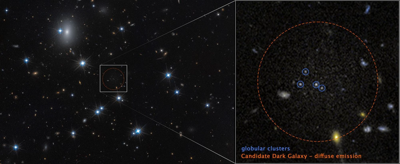
Detecting such faint galaxies is extraordinarily difficult. Using advanced statistical techniques, David Li of the University of Toronto, Canada, and his team identified 10 previously confirmed low-surface-brightness galaxies and two additional dark galaxy candidates by searching for tight groupings of globular clusters — compact, spherical star groups typically found orbiting normal galaxies. These clusters can signal the presence of a faint, hidden stellar population.
To confirm one of the dark galaxy candidates, astronomers employed a trio of observatories: NASA’s Hubble Space Telescope, ESA’s (European Space Agency) Euclid space observatory, and the ground-based Subaru Telescope in Hawaii. Hubble’s high-resolution imaging revealed a close collection of four globular clusters in the Perseus galaxy cluster, 300 million light-years away. Follow-up studies using Hubble, Euclid, and Subaru data then revealed a faint, diffuse glow surrounding the star clusters — strong evidence of an underlying galaxy.
“This is the first galaxy detected solely through its globular cluster population,” said Li. “Under conservative assumptions, the four clusters represent the entire globular cluster population of CDG-2.”
NASA's Hubble Space Telescope has revealed an exceptional discovery in the Perseus galaxy cluster: CDG-2, an ultra-low surface brightness galaxy composed of 99% dark matter.
This elusive galaxy remained hidden until astronomers detected a slight increase in globular cluster density, suggesting the presence of an underlying galactic structure.
Observations from Hubble, ESA's Euclid observatory, and the Subaru Telescope confirmed a faint halo of diffuse light surrounding these ancient star clusters.
Analysis indicates CDG-2 has the luminosity of approximately six million Sun-like stars, with the clusters comprising about 16% of its visible matter. The galaxy's normal matter was likely stripped away through gravitational interactions within the Perseus cluster.
This discovery provides a rare opportunity to study dark matter's fundamental properties and how it shapes galactic evolution across the universe.
For more information, visit science.nasa.gov/mission/hubble
Credit: NASA's Goddard Space Flight Center
Paul Morris: Lead Producer
Video Credits:
A simulation of the formation of dark matter structures from the early universe until today.
Ralf Kaehler/SLAC National Accelerator Laboratory, American Museum of Natural History
Image of the Subaru Telescope: NAOJ via ESA
Music Credit:
"Lost to Eternity" by Timothy James Cornick [PRS] via BBC Production Music [PRS] and Universal Production Music
This video can be freely shared and downloaded at https://svs.gsfc.nasa.gov/14924. While the video in its entirety can be shared without permission, the music and some individual imagery may have been obtained through permission and may not be excised or remixed in other products. Specific details on such imagery may be found here: https://svs.gsfc.nasa.gov/14924. For more information on NASA’s media guidelines, visit https://www.nasa.gov/multimedia/guidelines/index.html.
See more Hubble videos on YouTube: https://www.youtube.com/playlist?list=PLiuUQ9asub3Ta8mqP5LNiOhOygRzue8kN
Follow NASA's Hubble Space Telescope:
· Facebook: https://www.facebook.com/NASAHubble
· X: https://twitter.com/NASAHubble
· Instagram: https://www.instagram.com/NASAHubble
· Flickr: https://www.flickr.com/photos/nasahubble
---
If you liked this video, subscribe to the NASA Goddard YouTube channel:
https://www.youtube.com/NASAGoddard
Follow NASA’s Goddard Space Flight Center
· Instagram http://www.instagram.com/nasagoddard
· X http://twitter.com/NASAGoddard
· Facebook: http://www.facebook.com/NASAGoddard
· Flickr http://www.flickr.com/photos/gsfc
NASA's Goddard Space Flight Center; Lead Producer: Paul Morris
Preliminary analysis suggests CDG-2 has the luminosity of roughly 6 million Sun-like stars, with the globular clusters accounting for 16% of its visible content. Remarkably, 99% of its mass, which includes both visible matter and dark matter, appears to be dark matter. Much of its normal matter to enable star formation — primarily hydrogen gas — was likely stripped away by gravitational interactions with other galaxies inside the Perseus cluster.
Globular clusters possess immense stellar density and are gravitationally tightly bound. This makes the clusters more resistant to gravitational tidal disruption, and therefore reliable tracers of such ghostly galaxies.
As sky surveys expand with missions like Euclid, NASA’s upcoming Nancy Grace Roman Space Telescope, and the Vera C. Rubin Observatory, astronomers are increasingly turning to machine learning and statistical methods to sift through vast datasets.