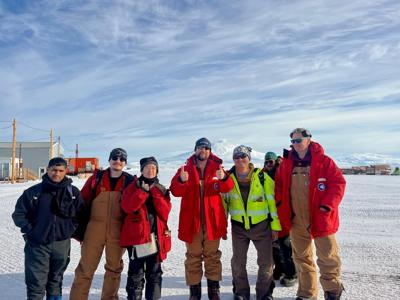


A photo of IceCube members, carpenters, and seismologists from Stoney Brook and USGS right before flight to the South Pole from McMurdo Station.
This winter, U.S. Geological Survey scientists are installing two new seismometers more than 8,000 feet beneath the South Pole icecap to help measure global earthquakes, support tsunami alerts and monitor nuclear testing. These seismometers will be the deepest seismometers ever deployed and expand the critical USGS Global Seismographic Network.
The advanced sensors will operate in one of the coldest and quietest environments on Earth, suspended deep within the Antarctic ice, allowing scientists to detect even the most subtle seismic signals with unprecedented clarity.
The South Pole has long been a key location for seismic research, with the USGS operating a station there for over 60 years. Now, thanks to a collaboration with the IceCube Neutrino Observatory and support from the National Science Foundation, these new sensors will capture both high-frequency tremors and long-period waves that help scientists study ice movement, global seismicity, and deep Earth structure.
Engineered to survive extreme cold and pressure, the seismometers represent a major innovation in Earth science technology. Their data will help enhance global safety and preparedness.
This project is a powerful example of long-term scientific investment and interdisciplinary collaboration, placing the U.S. at the forefront of geophysical research and offering a rare opportunity to listen more deeply to our planet from one of its most remote locations.
More details here.