
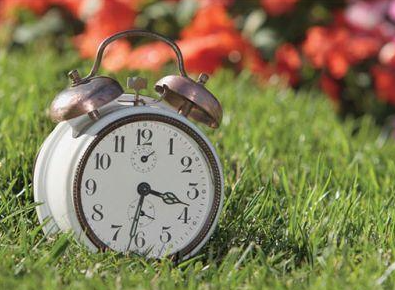
It is the last day of Daylight Saving Time! Tonight at 2 am we will turn back time to 1 am! Have you ever wondered why we do this?


Why Do We Change the Clocks?
Changing the clocks is not without controversy. Many wish the clocks would be left alone. So why did we start meddling with time in the first place?
According to NASA, Benjamin Franklin is credited with the concept of Daylight Saving Time. The basic idea is to make the best use of daylight hours by shifting the clock forward in the Spring and backward in the Fall. This would save energy and electricity usage by extending daylight hours.
Daylight Saving Time has been in use throughout much of the United States, Canada and Europe since World War I. In 1966, President Lyndon Johnson signed an act into law whereby Daylight Saving Time begins on the last Sunday of April and ends on the last Sunday of October each year. However, any State can opt out of Daylight Saving Time by passing a State law. Hawaii does not observe Daylight Saving Time and neither does most of Arizona.
For many years, most of Indiana did not observe Daylight Saving Time with the exception of 10 counties. Beginning in 2006, all of Indiana now observes Daylight Saving Time. However, as most of you already know, the state remains divided in two time zones.
In 2005, President Bush signed into law a new energy policy bill that would extend Daylight Saving Time by 4 weeks beginning in 2007: Daylight Saving Time begins at 2 a.m. on the second Sunday of March and ends at 2 a.m. on the first Sunday of November
Does it Save Time & Energy?
Technically, there is no way to save daylight, but by taking advantage of the daylight that is available each day, you can save energy by not having to use as much artificial light and thus it saves money. This is the main rationale for the change in time. By every individual using one hour less of artificial light during Daylight Saving Time, a period of more than 200 days, it equates to an enormous amount of savings as a nation.
However, opponents argue that actual energy savings are inconclusive, that DST can disrupt morning activities, and that the act of changing clocks twice a year is economically, socially and even physically disruptive and cancels out any benefit. Groups that have tended to oppose DST are farmers, transportation companies, and the indoor (or darkness reliant) entertainment business.
Sunshine Protection Act
While the US Senate passed the Sunshine Protection Act which would get rid of a time change twice a year for all Americans, it did not pass the House and is currently in limbo. While there are already multiple states that will not change their clocks tonight, it could be a while longer until it can or will become a new act from congress.


