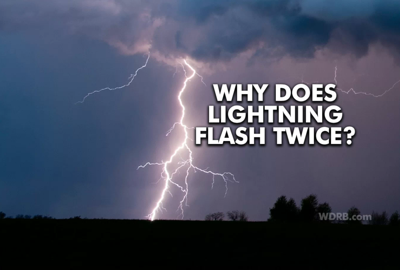
This is a question I (Hannah) have received a lot recently - "why does lightning flash twice?" You can see so many different flashes in the sky that only result in one reaching to the ground, so let's clarify a few things first. The two main types of lightning are cloud-to-ground and cloud-to-cloud (or intra-cloud). We will focus on cloud-to-ground here which is created by an uneven distribution of electrical charges within a cloud. The image below from the National Severe Storms Laboratory illustrates how those charges separate in a thunderstorm.
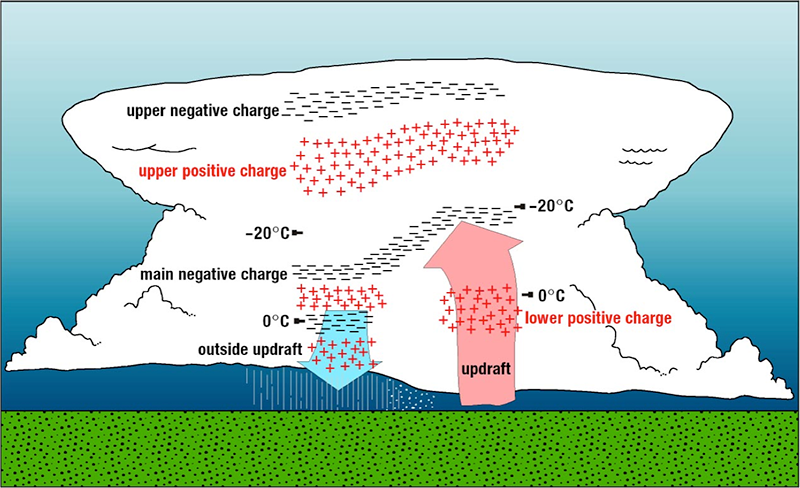
Charge distribution in a typical storm cloud. Image Credit: National Severe Storms Laboratory
All of those negative charges at the bottom of the cloud create a build-up of opposing (positive) charges in the ground below. Nature doesn't like sharp differences; it wants everything to be the same. Lightning serves as a bridge to connect the positive and negative charges in the cloud and ground and spread them out to be even again.
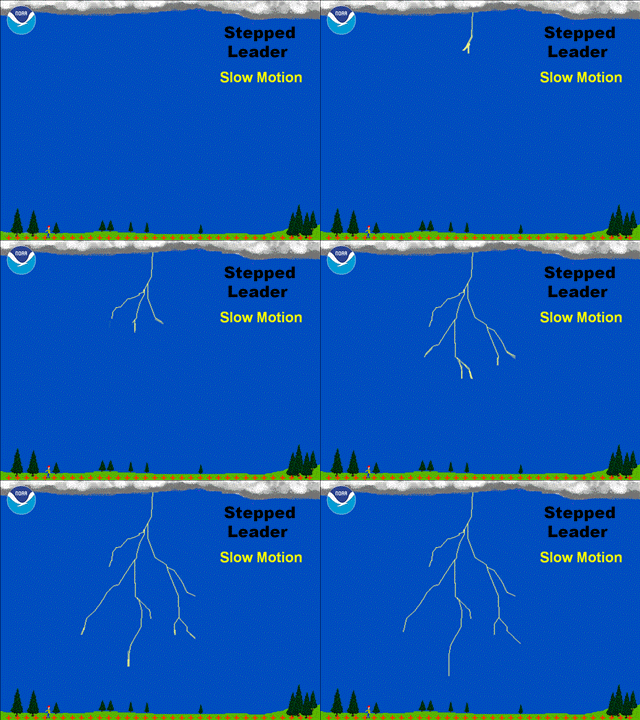
Credit: National Weather Service
Here's how that connection is made: small fingers called step leaders are sent down from the cloud. The step leader branches off looking for the path of least resistance through the sky down to the ground or tall object on the Earth. Watch the animation about to see how all of this works in slow motion. A much smaller finger of current extends upward from objects on the Earth. When the step leader reaches that smaller extension, a connection is made. That initial connection can flash if it's strong enough and the sky is dark enough, but the bigger flash you see is the actual discharge of current. When the positive and negative charges cross the bridge made in that connection to get everything back to normal, that is the flash most people associate with lightning.