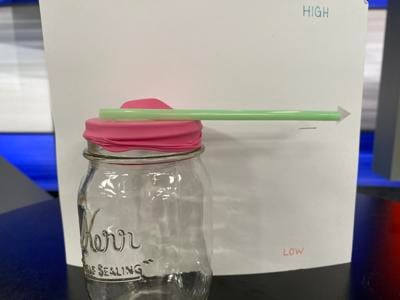
A barometer is the instrument we use to measure air pressure. At the bottom of this post, I’ll explain why air pressure is critical in forecasting the weather.
WHAT YOU NEED:
Short, wide-mouth jar
Balloon
Plastic straw
Scissors
Glue
Markers
One sheet of cardstock
WHAT YOU DO:
Cut the neck off the balloon and stretch the head of the balloon (the wide part) over the mouth of the jar.
If using a bendy straw, cut off the bendy part. We just need the long, straight part of the straw
Cut an arrow out of the cardstock. PRO TIP: the arrow stem must fit snugly inside the straw, so lay the straw down on your cardstock. Draw the arrow on the cardstock first, using the straw as a guide for how wide it should be, then cut along the lines you’ve drawn.
Glue the stem of the arrow to the inside of the straw then glue the empty end of the straw to the top of the balloon. (PRO TIP: give the glue time to dry before you finish assembling everything. It makes the rest of this a lot easier)
Set the cardstock against a wall or something sturdy that won’t move and place your jar directly in front of the cardstock.
With your marker, draw a line where the arrow is right now (after the glue has dried). Write “HIGH” above the line and “LOW” below the line.
HOW IT WORKS:
When the air pressure is HIGH, it pushes down harder on the top of the balloon which makes the tip of the arrow go up. When the air pressure is LOW, the air inside the jar pushes up on the balloon harder than the air outside which makes the tip of the arrow go down.
Check your barometer once a day and draw a line where the arrow is. Notice is it higher or lower than yesterday? Higher or lower than your base line? Connect those observations to what the weather is doing. When you observe high pressure, what does the sky look like? When you observe low pressure, what is the weather doing? Use all of these observations together over the next days, weeks, and months to see how pressure dictates weather.
- High pressure generally means clear sky because the air in the atmosphere is moving down. That’s a very stable air mass so it’s harder for clouds to form and rain to develop. Low pressure generally means more clouds, rain, storms, snow, etc. Low pressure means the air in the atmosphere is rising, which is unstable and leads to the development of those types of features.
DISCUSSION IDEAS:
What important weather information can a barometer tell us?


