




LOUISVILLE, Ky. (WDRB) – When the Louisville Metro Council approved a new city law regulating lobbying last year, it required companies, associations and others currying favor with Metro government to disclose the finer details of their work.
The ordinance that passed 25-0 in November 2022 mandated twice-a-year filings with the Louisville Metro Ethics Commission showing the “specific action, ordinances or resolutions” that lobbyists and their employers seek to influence.
The measure also directed the ethics commission to “endeavor” to make the lobbying forms publicly available online – so that people could see the disclosures without submitting time-consuming open records requests.
But the lobbying law has failed to live up to those transparency goals so far, a WDRB News review has found. An analysis of lobbying forms obtained through public records requests shows that most lobbyists and their bosses provided few details during the first round of reporting in 2023.
And more than a year after the law took effect, there is not yet a public portal for basic lobbying information – although the ethics commission announced steps this week that would create one.
For now, citizens wanting to know who is trying to influence their government – and, more importantly, in which ways -- are left largely in the dark. In filing after filing with the ethics agency, lobbyists and their employers simply provided vague descriptions of topics, such as “public safety,” “issues related to economic development” and “issues related to retail industry.”
Rarely was there enough detail to make it clear which specific legislation or other actions those organizations were pursuing.
WDRB reviewed 93 filings in which lobbyists and their employers acknowledged conversations with top city officials or agencies during the first half of the year and were told to list the specific actions they “sought to influence.” In just 12 filings did that happen, according to our analysis.
“Right now it's pitiful how much they have provided,” said Richard Beliles, Kentucky chairman of the Common Cause government watchdog group. By comparison, he noted that there is far more publicly available information for lobbying at the Kentucky statehouse – such as specific bill numbers.
“It’s really not fair to the public to not be able to have that information,” Beliles said of the Louisville law.

Former Louisville Metro Council member Bill Hollander, interviewed in 2020 (WDRB file photo).
Bill Hollander, the former Metro Council member who sponsored the lobbying measure before retiring from office, said “more specificity is needed if the ordinance is going to do what it was intended to do and what lobbying registrations in most cities do.
“The idea is that the public knows who is being paid to influence public decisions,” he said in an email. “To achieve that, you need to know what those decisions are and very general descriptions don’t do that.”
Hollander also called for the registration forms to be online and searchable. “If that requires a small investment, the Greenberg administration and Council should get behind it,” he said. “Restoring public trust in local government is worth the money.”
The ethics commission is preparing to make changes to the lobbying registration process after WDRB raised questions this fall about how the lobbying information was being reported, including a lack of specific information on the disclosure forms.
At its meeting Thursday, the commission announced it is working with Metro government’s information technology department to create an online platform where people can see who is meeting with certain city officials and on which specific matters and legislation.
The commission is aiming for an “outline” to be available in January, said its chair, Dee Pregliasco.
“Hopefully this will help us be in the 21st century when it comes to what information we should have available and it's easy for people, including our media people that are here,” she said, speaking to reporters at the meeting. “It'll be easier for you to access this information, as well as the public.”
The commission’s legal counsel, F. Todd Lewis, said he spoke with other cities about their online platforms at a recent conference of government ethics attorneys. “The whole idea of this whole exercise is to, No. 1, be easier for lobbyists to register, and, No. 2, for members of the public to go to our online platform and look at whatever it is they want to look at.”
Once it knows how much the project would cost, the commission plans to approach Metro government about funding. Lewis said as of late December, the commission has already spent 83% of its budget for the fiscal year that ends next June.
Law requires 'specific' details
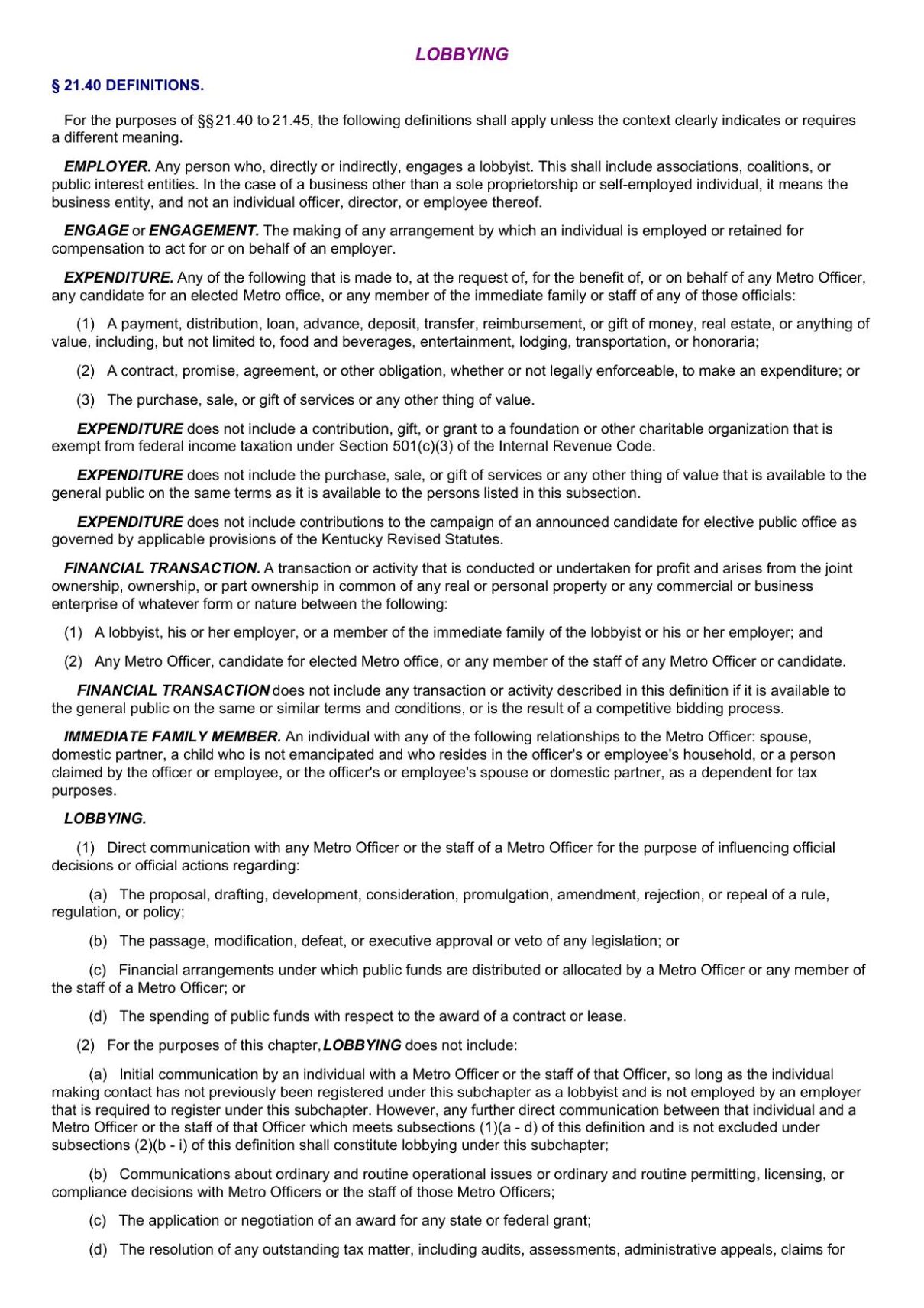
The ordinance approved last year defines lobbying as communicating with top city officials -- including Metro Council members, the mayor, deputy mayors and heads of Metro government departments – to influence official decisions or actions such as rulemaking, legislation and spending public funds, among other things.
It requires several disclosures with the ethics commission, an agency whose board members are appointed by Louisville’s mayor.
The first disclosure is a registration statement that asks for a “brief description of the ordinances, resolutions, or executive or legislative actions for which the lobbyist is or will be engaged in lobbying.” Those were due May 15 and covered lobbying between November 16 of last year and May 8.
It’s understandable if those initial forms only had general information, since lobbyists and their employers might not know which specific items they would be working on, said John Schaaf, former executive director of the Kentucky Legislative Ethics Commission.
But besides that initial filing, there are two more required each year. Updated lobbying statements are due every July 1, covering the December 16-June 15 period, and each January 1, covering June 16 through December 15.
Each updated statement should have specific responses, Schaaf said in an email, “because it simply asks for disclosure of the matters on which the lobbyist/employer have lobbied -- certainly something within their knowledge, and not requiring any speculation.”
It was those filings that WDRB analyzed, finding that many companies and other organizations that acknowledge they’ve lobbied Metro government didn’t give detailed answers.
For instance, asked to list the specific actions it tried to influence through “direct communication or contacts” with city officials during the December 15-June 15 period, the Building Industry Association of Greater Louisville wrote, “Issues related to land development and construction.”
Juva Barber, the association’s executive vice president, said her group is open to including more information, but she argued that there are many more interactions in Louisville with Metro government officials than in Frankfort, where lobbyists have to report bills and other actions they lobby during legislative sessions.
Barber also questioned whether all groups that lobby city officials, including those opposed to certain development projects, are properly registering with the ethics commission.
“All I ask is that it would be equitable among all groups that are advocating,” she said.
There are examples of filings that shed light on specific issues organizations are lobbying.
LG&E disclosed its work lobbying against a nonbinding Metro Council resolution this year that opposed the energy company’s effort to take land owned by Bernheim Arboretum and Research Forest for a planned natural gas pipeline in Bullitt County.

Kate Miller, Advocacy Director for the ACLU of Kentucky (WDRB photo).
The ACLU of Kentucky included its work fighting a new city jail and noted that it “sought to direct the city’s resources away from incarceration and toward alternatives," according to a form signed by its advocacy director, Kate Miller, in June. In another instance, the Louisville Zoo Foundation reported its lobbying for funding for its Kentucky Trails exhibit.
And in some cases, lobbyists’ initial registration papers provided more detail than the twice-a-year forms that ask for specific information.
Todd Blevins, Kentucky state director for the Humane Society of the United States, registered as a lobbyist with Metro government in late June, telling the ethics commission he would be specifically be working on an “Ordinance concerning retail sale of dogs and cats by pet stores.”
That measure, which banned retail pet stores from selling animals from puppy or kitten mills, passed in September.
Blevins said in an interview that he’s familiar with similar lobbying requirements in Frankfort and thought the Louisville directions were straightforward.
“I thought the instructions were pretty clear,” he said. “And so I followed them accordingly.”
Copyright 2023 WDRB Media. All rights reserved.


