


LOUISVILLE, Ky. (WDRB) -- Open government advocates said a new bill in the Kentucky legislature is an "all-out assault on transparency" that will weaken the open records law and add hurdles to get documents showing the work of public officials.
House Bill 509, introduced Monday by Republican Reps. John Hodgson and Jason Nemes and House Speaker David Osborne, creates a new definition for a public record and sets standards for elected and appointed officials using government email.
Hodgson, R-Fisherville, the bill's lead sponsor, told WDRB News on Wednesday that fears of widespread changes to the existing right-to-know law aren't warranted.
"Anything that's available right now would be available in the future," he said. "If anybody can point me to examples that this language would unintentionally exclude, I'm open to changing the bill to accommodate that."
And that happened. Hodgson said Friday afternoon he will eliminate the section of the bill that redefines public records after he had "stay-at-home moms from Oldham County and people like that talking to me that file open records requests and showed me hundreds of examples of how it might adversely affect that process."
Hodgson's plan to change the legislation was first reported by the Courier Journal.
In the initial HB 509, a public record is redefined as something that "documents, records, memorializes, or gives notice to a person outside the public agency of a transaction or final action." The bill lists examples of those actions: Awarding a contract, spending agency funds and announcing a public agency's event.
The Kentucky Press Association issued a three-page statement on the bill Wednesday, claiming that the new definition would be problematic. "Public agencies and employees perform tasks and communicate about countless things that are not 'transactions' or 'final actions,'" the statement said, adding that it believes "virtually all emails sent or received by public employees and officials" would be off limits.
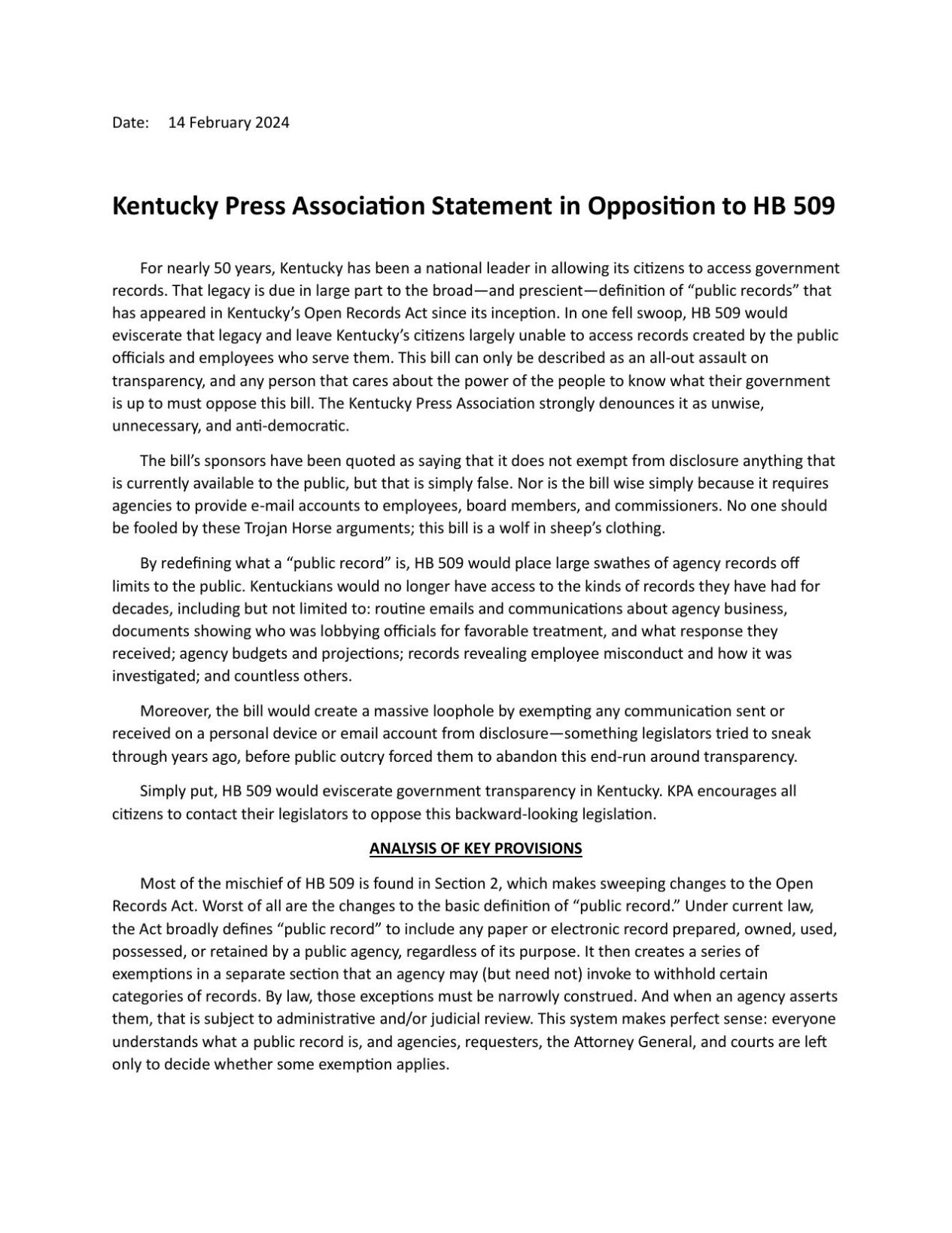
It calls the bill, as it was introduced, an "all-out assault on transparency."
First Amendment attorney Michael Abate argues that the measure would have sweeping consequences if enacted. He calls it a "very problematic bill that really would change things dramatically."
He and Jon Fleischaker, a lawyer who helped draft Kentucky's open meetings and records laws in the 1970s, wrote an op-ed this week arguing that the legislation would "eviscerate the public's right to know even the basic things about what the government is doing in its name."
The open records statute, which provides access to government documents upon request, is used frequently by citizens, media organizations, lawyers and political operatives to shed light on the workings of government.
Abate cited several main concerns with the legislation as it was filed.
First, he said, limiting records to those connected to a "final action" — which he notes the bill doesn't define — means that vast amounts of documents would be kept from public inspection.
"By imposing that limitation you have just taken away access to almost every record of an agency," he said in an interview. "You know, very few are 'final actions' — whatever that term means."

Kentucky Rep. John Hodgson, R-Fisherville. (WDRB Photo)
Second, Abate argues, the bill fundamentally changes how public agencies can classify records that are exempt from disclosure. As it now stands, a government entity must cite the specific part of Kentucky law that allows it to withhold a record.
Armed with that justification, a citizen can appeal to the Kentucky Attorney General to argue why the record should be released.
The original HB 509 revises the section of the current law including those exemptions, instead moving them into a new definition of what a public record does not include. It's that reorganization that Abate says concerns him.
If a public agency decides a record doesn't qualify as a public document, "they're going to send you a response back that says, 'No public records exist,' he said. "It's not going to say 'Here, we have records, but they're exempt, and here's why.' Which is what the law requires now. You're going to get a response that no records exist. End of story."
Abate said that will require requesters — from parents interested in school board records to journalists covering public agencies — to hire attorneys to pursue those cases through legal means.
Hodgson told WDRB Friday that he'll focus the revised bill on requiring public agencies to give give their officers, employees and board and commission members email accounts for their work.
Abate applauds that but, at the same time, questions why the bill exempts from disclosure information on a personal cellphone or other device. (The Kentucky Court of Appeals ruled in a case last fall involving the Kentucky Fish and Wildlife Commission that a lower court erred when it determined that records on personal devices weren't subject to open records laws.)
Abate, who represented the Kentucky Open Government Coalition in that case now at the Kentucky Supreme Court, said HB 509 would invite abuse.
"If I'm a school board member, and there's going to be a controversial vote coming up about some policy and I want to hide my thoughts from people, you know, I can have an illegal meeting over email as long as I keep it on Gmail or a text chain and nobody could ever see," he said.
Hodgson argues that the bill is meant to balance "the public's right to know and an individual's right to privacy" that will hopefully encourage more people to work in government. He emphasized that there are penalties in the legislation for someone who doesn't use a public agency email account for official business.
He said the bill is trying to put a stop to "frivolous" open records requests and those meant to "punish personal and political enemies."
Hodgson cited the Fish and Wildlife case, saying if the Supreme Court upholds the appeals court ruling "every person from governor to dog catcher that is sent a text message or a personal email discussing some matter of interest to some member of the public is subject to an open records requests that they legally have to respond to. And that consumes an enormous amount of time."
The bill has not yet been assigned to a House committee.
This story has been updated to reflect anticipated changes to the bill announced Friday.
Copyright 2024 WDRB Media. All Rights Reserved.


