
LOUISVILLE, Ky. (WDRB) -- Thousands of Louisville-area electric and gas customers who are behind on their bills will have to start catching up this month to avoid having their service cut off for the first time since the pandemic took hold in March.
The Kentucky Public Service Commission will allow utilities to resume disconnections as soon as Oct. 20, but the regulator is also mandating that utilities also automatically place customers with past-due balances into payment plans that last at least six months.
If customers do not keep up with the payment plans, utilities are free to disconnect their service starting Oct. 20 by following pre-pandemic protocols. Those disconnections have been prohibited since March 16. Meanwhile, late fees are still suspended through the end of the year, the commission said.

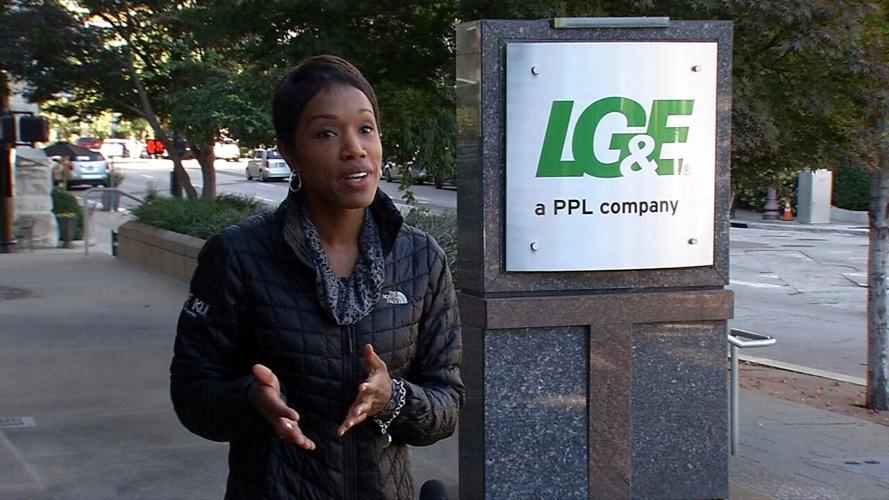
Louisville Gas & Electric spokeswoman Natasha Collins, Oct. 13, 2020.
Louisville Gas & Electric, the city’s main utility, said that “just under” 28,000 residential customers would be eligible for shut offs but for the moratorium. LG&E’s total customer base – residential, commercial and industrial – eligible for disconnection averaged just under 15,000 per month in 2019, spokeswoman Natasha Collins said.
She could not specify the number of residential customers facing disconnection this time last year.
“We know that this has been an incredibly challenging time,” Collins said Tuesday, adding that LG&E wants to offer customers flexibility in paying off their balances and to avoid shutting off service.
But as the Oct. 20 deadline approaches, the precise terms of those arrangements aren’t clear.
LG&E has asked the Public Service Commission for permission to deviate from the rules the commission laid out in September when it announced the end of the disconnection prohibition. The commission hasn’t ruled on LG&E’s requests, and a spokeswoman for the agency didn’t return a call on Tuesday.
While the agency wants utilities to automatically enroll delinquent customers into payment plans spreading their balances over at least six months, LG&E wants customers to have the option to “extend the due date a few more days” or for six months or a year, the utility said in an Oct. 5 filing.
“What we are asking is to be able to announce various payment plan options and for our customers to be able to choose the plan that best works for them before an automatic enrollment in a plan would kick in,” Collins said.
LG&E still proposes to automatically place customers who don’t choose a different option into a one-year payment plan, the utility said in a filing.
While Kentucky utilities are allowed to disconnect customers after Oct. 20, the commission stressed that they are not required to.
Louisville Water Co., which is owned by the city and not regulated by the commission, has indefinitely suspended disconnections during the pandemic. “And we actually do not have a start date in mind,” spokeswoman Kelly Dearing Smith said.
In the interview, Collins wouldn’t say whether LG&E would shut off customers who do not make payments on their plans. In a follow-up email, she said LG&E is awaiting word from the public service commission on its requests.
“Once we have that guidance, we plan to clearly communicate these details to our customers,” she said.
But in an Oct. 2 filing with the commission, LG&E said its approach “would empower residential customers with reasonable and extended payment options while also resuming disconnections for nonpayment to incentivize reasonable payments for service.”
Indiana customers already face shutoffs
Indiana, meanwhile, allowed its moratorium on disconnections to expire Aug. 14, and as of Monday, utilities in the Hoosier state are no longer required to offer six-month payment plans.
Utilities regulated by the Indiana Utility Regulatory Commission must still offer payment arrangements for at least three months, though they may begin charging the fees that had been suspended, said Stephanie Hodgin, spokesperson for the commission.
Unlike in Kentucky, Indiana utilities aren’t required to place customers who do not respond into payment plans.
“Payment plans are agreements between the customer and the utility and both need to be involved in order for there to be an agreement … If a customer does not enter into a payment arrangement with their utility, they could be required to pay the past due amount on their bill in full or face service disconnection,” Hodgin said in an email.
Clark County REMC, an electric cooperative serving Clark, Floyd, Scott, Jefferson and Washington counties, said on its website that disconnections resumed Sept. 15, but “we are doing all we can to help you get through these difficult times,” including offering payment arrangements, according to its website.
Duke Energy, which also serves southern Indiana, is still offering long-term payment plans in addition to extensions of “a week or two.”


