



(WDRB/InvestigatesTV) — Paul Cotter spent decades living the typical firefighter routine. When the alarm sounded, he’d step into his turnout gear – the specialized boots, pants, topcoat and helmet that’s worn to protect first responders from extreme heat and moisture – and be on the truck within seconds.
He looked at the uniform he wore day in and day out for years almost like a set of armor.
"It’s almost bulletproof," he said.
But after a cancer diagnosis, his wife, Diane, began to suspect the turnout gear he’d long been wearing may have played a role in his illness. Her instincts and advocacy led to groundbreaking research about the protective gear worn by firefighters – and a decade-plus fight to raise awareness about the toxic threads used to make it that contain chemicals linked to cancer.
"I became locked in full throttle because I could see what was being done," she said.

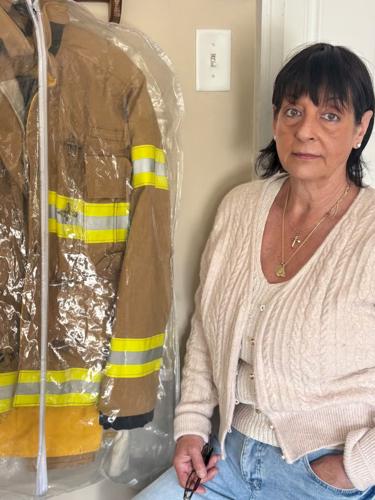
Whistleblower Diane Cotter stands with the turnout gear her husband wore that kicked off a decade-long advocacy effort to raise awareness about the PFAS contained in firefighter protective equipment. (Joce Sterman, InvestigateTV)
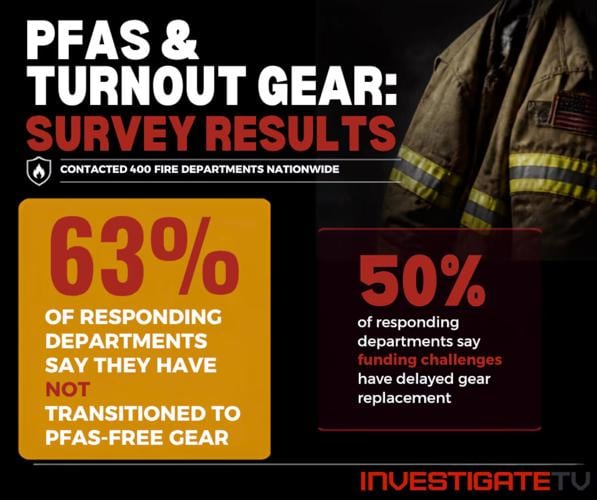
But despite Cotter’s efforts, InvestigateTV found fire departments across the country are still using turnout gear that contains PFAS– with a nationwide survey showing confusion about well-established science, challenges in paying for new gear and a reluctance to talk about the issue at all – keeping firefighters consistently in clothing that could put them at risk.
A list of 61 names
In 2014, Paul Cotter was promoted to lieutenant. The promotion came with a required physical that brought unexpected news: he had aggressive prostate cancer despite showing no symptoms of the disease.
"It came out of the blue and hit us like a ton of bricks," his wife Diane said.
As word spread about Cotter’s diagnosis, the couple’s phone kept ringing as other firefighters in their circle shared stories with an eerie similarity.
"I started a list. It’s a few pages long. There are 61 names on my list," he said. "These are just city firefighters I worked with in my 30-year era that I know personally. 61 guys, all with cancer."

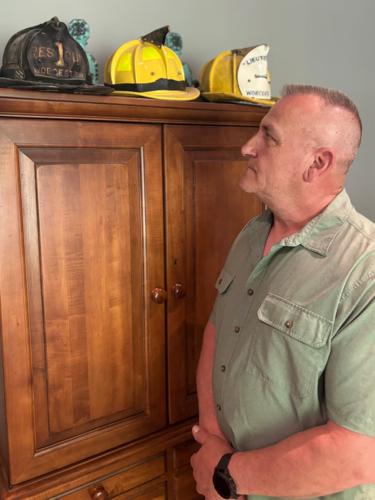
Paul Cotter, a firefighter who spent decades on the job, was diagnosed with an aggressive form of prostate cancer in 2014. The discovery kicked off what would eventually become a national movement to examine PFAS in turnout gear. (Joce Sterman, InvestigateTV)
Diane began investigating, looking for connections between the diagnoses and the gear the firefighters wore.
What started as a search for answers became a decade-long effort to expose what she described as a known danger that went unaddressed.
It was a fight that not only involved the companies involved in making turnout gear, but the nation’s fire union as well. And the battle took a toll, "It was devastating. I became a full-fledged alcoholic. I lost a tremendous amount of hair. I aged 15 years. I wasn’t sleeping. The fight was just crushing," Diane said.
Research and a reckoning
Even so, Cotter pushed on. In 2018, Diane successfully lobbied a researcher at Notre Dame University to start testing turnout gear from across the country for something called PFAS – a toxic set of so-called "forever chemicals" that studies have linked to cancer. Those chemicals repel water and resist heat, but research has shown PFAS have the ability to stick around in the environment and in the body.
The published study that followed in 2020 by Notre Dame professor Graham Peaslee found alarmingly high levels of PFAS in both new and used turnout gear, warning the chemicals can shed and be absorbed by the firefighters who wear it. Peaslee’s study was the first to identify firefighting protective gear as a pathway to PFAS exposure, saying "several important safeguards should be considered immediately for fire service personnel."
A 2023 government study conducted by the National Institute of Standards and Technology further confirmed Peaslee’s findings.
Yet an InvestigateTV survey of fire departments nationwide found that even years after that research and Diane Cotter’s consistent warnings, many fire departments are still utilizing turnout gear that contains PFAS - with some chiefs acknowledging they don’t see a problem.
Firefighters still wearing contaminated gear, with some disputing science
InvestigateTV contacted nearly 400 fire chiefs across the country and followed up with spokespeople for 150 of those departments as part of a survey on how leaders in the fire service are dealing with PFAS in their turnout gear.
Although there was some reluctance from many departments to respond - with some telling InvestigateTV they didn’t want to participate, and failing to provide answers explaining why.
The survey still drew responses from more than 20 states. Most departments that answered said their crews are still wearing gear that contains PFAS chemicals.

InvestigateTV surveyed fire departments across the nation, asking specific questions about their handling of PFAS in protective turnout gear. (Daniela Molina, InvestigateTV)
The top reason departments cited for not switching gear: cost. Estimates from fire experts show replacement of turnout gear runs as much as $6,000 per firefighter.
"That’s the biggest thing — when you simply don’t have the money, you have to continue working with what you’ve got despite the risks," said Kevin Ferrara, a former military firefighter and whistleblower who sounded alarms about use of a toxic firefighting foam used on military bases and airports that contains PFAS.
The dollars and cents of replacement gear are a major factor, as is the availability of equipment that can be reliably proven NOT to contain PFAS. But even when departments have the funds and available options for purchase – some still don’t believe it’s needed.
Fire chiefs in departments from coast to coast told InvestigateTV there’s murkiness when it comes to the potential dangers.
One survey respondent said, "Studies have been inconclusive at best as to the link between PFAS and firefighter cancer."
Another said of gear containing PFAS, "There’s no science indicating it is unsafe," while a third said, "I am not convinced."
"They say, ‘Oh, it’s a myth. You’re overthinking this.’ It’s beyond frustrating," Ferrara said.
Paul Cotter agreed, saying the skepticism seen in the survey runs deep within the ranks.
"Half the firemen out there today — they don’t believe the chemical is there," he said. "They don’t believe it’s dangerous. They don’t believe the companies would do that to us."
Fire union keeps focus on finding alternatives, as confusion on PFAS lingers
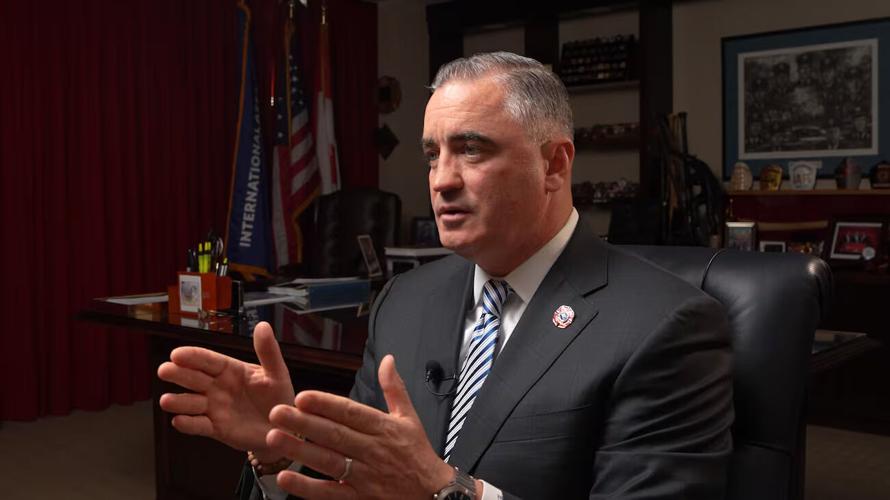
But some of the confusion about potential risks associated with PFAS in turnout gear may come from the fire union itself. For years, as whistleblowers like Diane Cotter screamed from the rooftops, the International Association of Firefighters accepted sponsorships and donations from gear manufacturers.
But in 2021, the IAFF membership voted on resolutions to stop accepting industry donations and rely on independent research about PFAS. That same year members also elected a new union leader who changed course on the chemicals. That man, Ed Kelly, a career firefighter in Boston who still rides the trucks, made the issue a priority.
"I’ve buried enough friends and colleagues to put all of my energies into going wherever the fight is to protect them," he said, emphasizing organizations including the International Agency for Research on Cancer have recognized firefighting as a top-level risk for cancer, with PFAS as a contributing factor. "So, it’s not just our opinion, it’s scientific fact."
Still, Kelly acknowledged that while the union "pounced" on the issue as soon as Notre Dame’s research provided clear evidence, the IAFF’s earlier position fell short.
"Looking further back — I wish the union had seen it for what it was before that," he said.

The International Association of Fire Fighters drastically changed its stance on PFAS in turnout gear after a significant vote by its members, and the election of Ed Kelly as General President in 2021. (Rod Curry, InvestigateTV)
The push for PFAS-free gear
Kelly said his focus is on getting toxin-free gear into fire departments nationwide. The IAFF supports the proposed PFAS Alternatives Act proposed in Congress. It would accelerate research into PFAS-free protective gear options and direct $25 million a year toward the effort.
In the meantime, the union is advising firefighters to wear turnout gear only when necessary and to wash frequently to minimize exposure.
As for fire chiefs who continue to dismiss the risk? Kelly had pointed words.
"Resign," he said. "They’re needlessly exposing the next generation of firefighters to carcinogens that they do not need to be exposed to. And if that’s where their heads are at - then their heads are up their ass."
The battle for accountability continues
Back in Worcester, Massachusetts, Paul Cotter is now in remission and enjoying retirement from the fire service. But for his wife, the fight continues.
Diane Cotter is a close follower of civil litigation that’s been filed against 20 companies that either manufacture turnout gear as well as the makers of the textiles and materials used to make them. That ongoing case alleges that the companies continued to make and/or distribute personal protective equipment containing hazardous carcinogenic chemicals, despite knowing they were unsafe.
InvestigateTV contacted all of those named defendants in that case.
Only one – PBI Performance Products, a textile manufacturer - provided a statement saying it has never used PFAS and its products do not contain the chemicals. 3M, another named defendant, said it does not comment on pending litigation. No other statements or responses were provided, despite repeated attempts.
As defense attorneys try to sway the judge to throw out the case, Cotter is trying to convince lawmakers there should be a hearing related to PFAS in turnout gear.
She’s spent years compiling a binder filled with documents and dozens of color-coded Post-It notes, highlighting what she considers the most damning evidence of wrongdoing as science made it clear PFAS was present in turnout gear.
Cotter wants accountability.

The kitchen table at the home of Paul and Diane Cotter is covered in media articles about their advocacy as well as color-coded binders containing documents related to PFAS in turnout gear that Diane has been amassing for years. (Joce Sterman, InvestigateTV)
She realizes that she is in a David-and-Goliath fight. But she warned not to dismiss a woman on a mission. "Someone that had no institution, no power. Just flaming arrows — a big keyboard warrior with a foul mouth."
Dain Jung, Virginia Welp, Brian Gring, Abigial White, Sydney Petrovich, Cameron Haughawout, Umer Farooq, Grace Bundy and Julianna Kummer with the Arnolt Center for Investigative Journalism at Indiana University contributed to this report.
Copyright 2026 Gray Media Group, Inc. All Rights Reserved.


