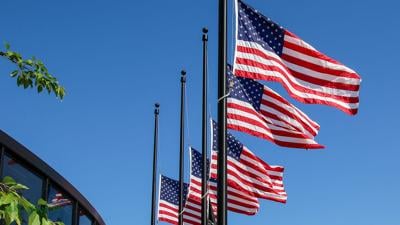

LOUISVILLE, Ky. (WDRB) – I kept waiting, on Wednesday, for some kind of official acknowledgment of the grim milestone passed in this nation – 100,000 dead in roughly three months, victims of the novel coronavirus.
I waited for the president to put it into perspective, or make some simple gesture, to acknowledge the loss. A presidential candidate made an effort, releasing a video. He said some nice things, then devolved into blaming his opponent.
My hope was that someone would attempt to recognize those who have died, and their families, that there would be some kind of acknowledgment at the highest levels that there has been suffering, not just with the sickness but because of the sickness.
After 9/11, George W. Bush went to New York City. After Sandy Hook, Barack Obama went to Newtown, Conn. When the Space Shuttle Challenger exploded, Ronald Reagan spoke words that we still remember. When Martin Luther King was assassinated, Bobby Kennedy stood on the back of a flatbed pickup and told a largely minority crowd in Indianapolis what had happened, then shared his thoughts. In the midst of the Civil War, Abraham Lincoln went to Gettysburg, where 7,058 were killed, and gave the most famous presidential speech in our nation’s history.
But Wednesday came and went with no such moment. And it is no surprise. Those moments require leaders to step outside of their own political struggles and speak to Americans as one people. And in this particular case, acknowledging the dead is to acknowledge in a small way our own failures. We like to celebrate our nation’s might. We’re not as good at addressing our shortcomings. Just look around.
This official silence is nothing new. It’s worth remembering that in 1918, there was not a word in public from President Woodrow Wilson about the flu pandemic that killed 675,000 Americans, even though Wilson contracted the flu himself.
CRAWFORD | Stopping for the coronavirus procession
As this pandemic began to take hold in this country, I wrote about the importance of slowing down, even stopping, as the funeral procession passes.
So it is up to each of us to come up with our own words, to do or say something to acknowledge what our leaders will not. Below are a few words of mine. I’d encourage you to take some time, at some point, to offer a few of yours, too:
A hundred thousand deaths. If we were to observe just 30 seconds of silence for each one, we would not speak for more than a month, around the clock.
Maybe it would be well to do that, to remember the lives lost, and to examine ourselves, as people, and as a nation.
We know the risks we live with in life. We know that we all will come to a day when we breathe our last. The hope for most of us is that we will have lived a long and good life, that we will get to say goodbye to our families, that we might have loved ones around us when we go.
None of you had that. Your solitary deaths are a pain to all of us. They could have been any of us, and could yet be.
We see you, and those you left behind. We have felt your fear, in a hospital, alone, or on the phone with a loved one, not knowing whether it would be your last conversation. We have seen your suffering when you couldn’t get to a parent or wife or husband who was dying. We have witnessed the bodies interred in mass graves in New York. We have heard your muffled cries at funerals that were too pitifully small. We have shared your grief that could not find its full expression.
We could not feel the pain in quite the way you have, but we can acknowledge it. We know it is there.
And we are sorry. We’re sorry that we see the number, 100,000, and cannot comprehend it or identify with it. We’re sorry that it becomes a statistic and not a life, not someone’s whole world. We’re sorry that we argue about it and debate it and try to minimize it, as if it represents something other than lives cut short.
This invisible epidemic among us has killed without respect for station. It has not cared about your income, your fame, your race, your creed, your age, or your location. It has not cared about your politics. Or religion. It has had no regard for whether you believed you would get it or not. It has preyed, as so much of life does, on our most vulnerable.
Today, we stop. We stop to acknowledge this tragic loss. At our best, we are a nation that conquers its enemies, supports its allies, meets its challenges, faces its shortcomings, honors its people and remembers its dead.
We remember you. And we dedicate ourselves to using your sacrifices as inspiration to do better, to value those who fought on your behalf not on foreign fields of battle but in our own hospitals, in our own cities and towns.
We must use this moment to remind ourselves that economic might without the wisdom to use it for the benefit of all our people is little more than pointless paper in a vault of regrets.
One hundred thousand. No amount of freedom, or wealth, or military might, can stop the inexorable march of death when it comes. But we can, in times of epidemic, rise to meet it, and we can use our vast human resources, of intelligence, compassion, will and courage, to find answers, develop cures, and spread hope, healing and comfort.
Sometimes, you have to stop to mourn the lost and comfort the hurting. Today, you who grieve, feel a nation grieving with you. Feel the arms of millions you will never know wrapping around your shoulders, and the heads of silent millions bowing to pray for you, and your loss.
We know the suffering does not end today, and not just the suffering of lives lost and loved ones missed. This virus has taken lives and livelihoods, and leaves behind grief and uncertainty.
May we, as individuals and as a nation, be wise enough to know that we face a common enemy and strong enough to face it with unity, not division. We owe it to those who have been lost, and to the lives that might still be saved.
Copyright 2020 WDRB Media. All Rights Reserved.


