
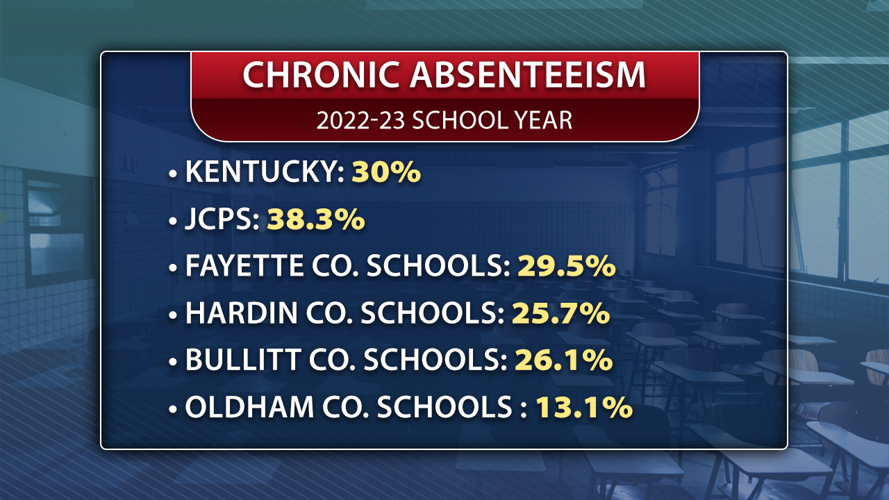


LOUISVILLE, Ky. (WDRB) -- Nearly one in every three Kentucky students are considered chronically absent — missing 10% or more of the school year.
Educators said the numbers have gotten worse over the years, and they're working to fix it.
While Kentucky's school halls and classrooms may have had students return in-person for the 2022-23 school year, not all students were there consistently.
"It has been a difficult transition back," said Aletha Fields, academic instructional coach at Iroquois High School. "Housing instability finances, transportation, issues of that nature."
It was Kentucky's first complete year back to in-person learning following the COVID-19 pandemic. State data shows nearly 30% of students missed more than 10% of the year, making those students chronically absent.
"We can't just lay all the blame at the foot of COVID. Maybe some of the things that COVID caused," said Donnie Wilkerson.
Wilkerson is part of the Kentucky Department of Education's Teacher Advisory Council, which focused on the issue of chronic absenteeism this month.
"I think you have to look at the whole picture of these elements," he said.
Breaking the numbers down, chronic absenteeism in Jefferson County Public Schools is 38%, higher than the state average, while other districts remain below. Students most likely to be chronically absent are those experiencing homelessness or are economically disadvantaged.

Data from Kentucky Department of Education
"What our society will look like when the literacy rate drops, when numeracy drops, it's going to be hard," said Fields.
Before the pandemic, 18% of Kentucky students were chronically absent. Wilkerson said the solution involves multiple groups of people — including teachers and lawmakers working together.
"Teachers themselves have to assume some of the responsibility for upping the game," said Wilkerson. "Sometimes that takes resources and those teachers may need to ask their district and state for help with those resources."
Students most likely to fall under the category of chronically absent come from families who are economically disadvantaged or homeless.
Tamara Reif oversees the Unity House shelter, where currently around 40 JCPS students live.
"Kids will get here, we do get them enrolled, they go to school and sometimes keeping them going to school, sometimes it is hard, living in a homeless shelter sometimes comes with stigma," Reif said.
While Unity House equips students with resources like clothes, school supplies, tutors and more, often transportation is the biggest hurdle.
"If your child has a doctor's appointment, you keep them home all day because you only have one TARC ticket to get get there and back," said Reif.
Reif said there are also a number of students who are homeless, and not in a shelter, that may fall under the chronically absent category.
"There is that population of homelessness that not everybody thinks about, or those that are doubled up somewhere on a couch and the same issues are present that are present in shelters, transportation issues, those kinds of things," Reif said. "I think the best thing is when somebody is experiencing a housing crisis and finds themselves homeless that when they get to shelter, things really start to turn around for them."
Copyright 2023 WDRB Media. All Rights Reserved.


