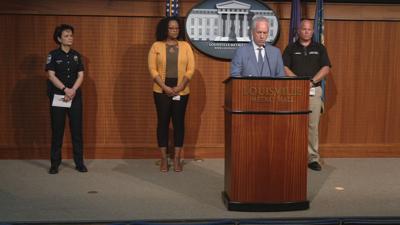
LOUISVILLE, Ky. (WDRB) -- Louisville's mayor, police chief and other officials outlined the city's planned expenditures for public safety Tuesday for the 2022 fiscal year.
The $1.04 billion budget allocation for public safety focuses on two key areas: police reform and violence prevention. It includes money to train officers "to better engage with the public," and also emphasizes violence prevention programs -- quadrupling the funds allocated for those programs from $5 million to $19 million.
That money will support the city's Office for Safe and Healthy Neighborhoods (OSHN).
The budget for FY22 includes $5 million for deflection and diversion programs that could provide social services to help when dealing with people with mental health issues, and those who may be homeless or abusing drugs.
The upcoming budget will invest in the following initiatives:
Group Violence Intervention: $500,000. The program is designed to "divert people from the path of gun violence, incarceration and tragedy.
Reimage: $500,000. A "collaboration with KentuckianaWorks that is helping to break the cycle of incarceration and recidivism by connecting justice-involved youth to education, training and careers."
Reconcilation: $600,000. This program will build on the "city's work to improve relationships between Louisville Metro Police and the larger community."
Evolve 502 Scholarships: $3 million. The money will be allocated to provide "last dollar" scholarships for 2021 JCPS graduate that qualifies. It sill cover students' tuition after federal and state aid have been applied. It also includes an "Opportunity Grant" of $1,000 per semester for students with household incomes less than $40,000.
LMPD Chief Erika Shields thanked the mayor and city council for "approving a budget that allows LMPD to target violent criminals in the most informed manner."
Shields praised the investment in programs that deal with "non-criminal demands" that officers face on a daily basis, as well as investments in critical technology like gunshot detection, body cameras, and license plate readers.
Shields was also complimentary of the investments in crime prevention, including OSHN's objective of stopping violence before it starts with the group violence intervention program. As she explained it, specially-trained officers and other OSHN staff will assess and assist people who may need help with paying funeral expenses, and other day-to-day expenses. Shields did say that the results of this program will not be "quantifiable."
In a written statement, Shields said that reducing gun violence is the department's top priority.
"We are examining progressive response models in the interruption of the cycle of violence in at-risk populations. Once identified, we are engaging in community outreach with government partners, like OSHN, and facilitating better pathways for those individuals."
Jody Meiman, Director of Emergency Services, said his department supports the city's deflection and diversion programs, and will be implementing something called a "Nurse Triage" program. Nurses will be stationed in the 911 communications center to assist with diverting some calls for service to resources other than police.
"They may need medical attention, but they don't necessarily need an ambulance to get them where they need to go, or police involvement," Meiman said.
Meiman said details about how the deflection program (which will operate out of emergency services) will work are still being developed with the program's partners that include University of Louisville, Spalding University and Seven Counties services. Their recommendations for operating the deflection program are expected within the next few weeks, Meiman said.
Meiman added that the budget does include money to replace the radio system for emergency services. "The radios they're currently using are beginning to end their life cycles so we're going to be able to determine who needs those radios and help create a safer communications procedure here in Jefferson County."
Copyright 2021 WDRB Media. All rights reserved.


