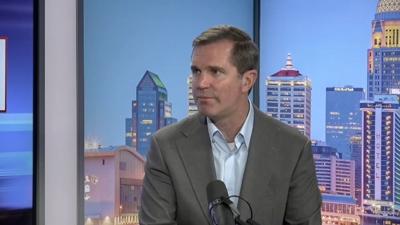



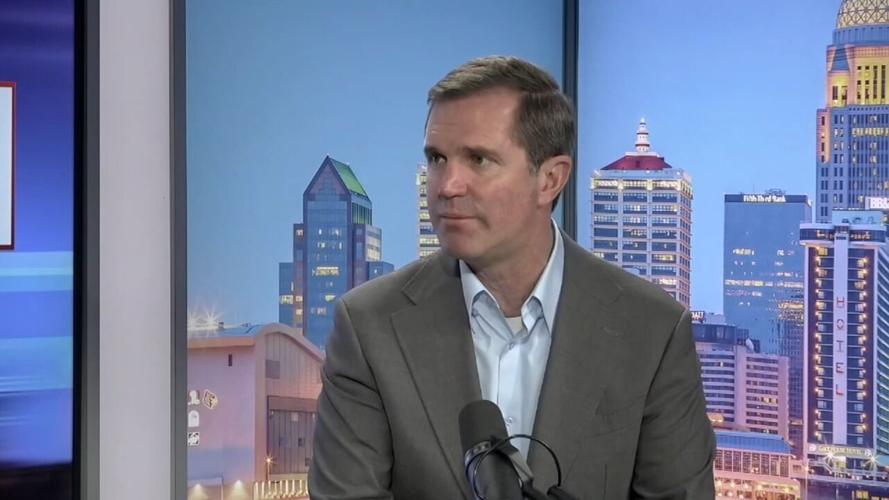
LOUISVILLE, Ky. (WDRB) -- Kentucky Gov. Andy Beshear stopped by the WDRB studio on Wednesday for an exclusive interview on a wide range of topics.
Beshear touched on his battle in the courts with the federal government, his administration's response to countless disasters in the state and the rumors of a potential presidential run.
You can watch his full interview above or read it below:
Q: "As 2025 winds down, it's often a time for many of us to reflect on the previous year and plan for what's ahead. I wonder what goes through the mind of Andy Beshear in a season like this."
Beshear: "Well, when I think about my job, I think about how we've had another year of both hardship but also success. On the hardship side, we've had three weather disasters along with the UPS plane crash. We've lost more than 50 Kentuckians combined amongst those — so a lot of families this Christmas that are going to have some empty chairs that we need to be thinking about and praying for. But on the success side, I think when we end this year, it will be the third-best year for economic development — for private sector investment — in our history. That means since I've been governor, we'll have the No. 1, 2 and 3 best years, and that's good for all Kentuckians. We're going to have a year where, when we announce the average incentivized wage — what people make in these jobs — I think it's going to knock people's socks off. And we had a year where we announced a lot of new affordable housing, especially in the east, as we rebuild from flooding, and in the west, while we continue to rebuild after those tornadoes. And maybe one outside group that should get us excited because of their news is Moody's. Moody's released a study where they said if every state was its own country, where would its economy be? Sadly, half of our states have slid into recession. Some of them are flat. But Kentucky is still growing. So I'm excited going into next year. We're going to have some real headwinds that we have to deal with. The federal tariff policy is impacting Kentucky's economy. It's increasing prices for our families everywhere, including the grocery store. And it's impacting economic development across America, because building that factory now costs you 20% or 30% more. The big, ugly bill, when it comes into effect, is going to make drastic cuts to rural health care. Those are some of the largest payrolls across Kentucky. But my job is not to have any excuses — to roll up my sleeves, to get out there and to do my best for the people of Kentucky."
Q: "You've joined in with some some federal lawsuits, I believe, is that correct? Tell me about some of those and the progress or updates on those that you've signed on to."
Beshear: "So whether it was my role as attorney general or now governor, my job isn't to be democratic governor. It's to be the best governor of Kentucky I can be. So when I see a federal policy that I believe is unlawful and hurts our people, I'm going to step up and do something about it. I go all the way back to when I was first attorney general. I sued the Obama administration when they had a policy that would hurt Kentucky. But the Trump administration right now is taking a lot of actions that simply aren't legal. They're trying not to provide funds that Congress passed a law on, like any other law on the books and said 'You shall provide them.' Most recently, we got them to back down from cuts to housing. I mean, right now, housing costs too much, and more people were actually going to fall into homelessness because of what they were going to do. We took them to court. They saw that they were going to lose, and now we're getting those funds. Look at AmeriCorps. AmeriCorps are in our schools, especially our struggling schools. They're in our soup kitchens, in our food pantries. They're out in rural Kentucky and Appalachia, helping in so many ways. The Trump administration tried to eliminate AmeriCorps even though it was funded. We went to court and we protected it. But maybe the most important one was when this president tried to be the very first in U.S. history not to fund SNAP, not to fund food assistance during a shutdown. He was willing to use starving Americans — seniors and children — as leverage in a political dispute. I believe that the statute says he has to fund it. So we took him to court, and we won, at least on partial benefits. But then our state employees came in late and worked through the night. We became the first state in the country to have those partial benefits on people's cards so that they could feed their families."
Q: "Where does that stand right now, with SNAP benefits?"
Beshear: "It's been restored, fully restored. We had an order that we believed we were going to get full benefits, but then when they came out of the government shutdown, they turned it back on. And again, our people came and worked through the night, and I'm so proud of those state employees. Now, the Trump administration is threatening to turn it off in states that won't turn over all the personal information of every, in this instance, Kentuckian, that's on SNAP. They don't get that information under the law. That is the personal data of our people, and if they're not entitled to it, I promise to protect that. Now, they're not going to be able to turn off SNAP benefits, because they already tried this, and we took them to court, and we won, and we'll do so again if we have to."
States who don't comply with a federal request for data on SNAP recipients face the threat of funding being withheld.
Q: "You mentioned affordable housing, and just on Monday, I was at St Vincent de Paul in Louisville. And they are very concerned about the potential of losing funding under this new Trump administration ... for permanent supportive housing. I talked to a guy's name was Steve, and he was fearful that he would end up back on the streets. Is there anything that you're doing at the state level or even signing on to at the federal level to try and protect that housing that exists in our communities like here in Louisville?"
Beshear: "My faith teaches me that we're supposed to fight for the lost, the lonely and the left behind, that people like Steve are where we ought to make sure that we're doing the right things — not to give a handout but a hand up to try to provide that one bit of help that might be the difference between stabilizing his life, helping him secure a full-time job because he has a full time place to live. What I tell him right now is we got those guidelines removed. Do I think they'll try again? Sadly, yes, because this administration doesn't care if people are kicked out on the street. But we will go back to court. We'll do everything we can to protect him. He might have a president that's trying to cut desperately needed help, but he's got a governor that's going to do everything he can to provide it."
Q: "You talk about that government shutdown, our nation's longest in its history. I wonder what that was like for you."
Beshear: "It was challenging. I fully understood the Democrats' position in that, right now, it's so hard to get by. It's so difficult to afford groceries. People can't take that vacation that they grew up taking with their family. Housing is challenging. Rent seems so expensive. Utility costs are going up across much of the rest of the nation. Yet, we had Congressional Republicans that voted 'Yes' on a tax cut for the wealthy but were refusing to vote at all for an extension of tax credits for hard-working Americans that otherwise couldn't afford health care. But I also knew that they were federal employees, 20,000 to 30,000 in Kentucky, that weren't getting a paycheck at all. And sadly, the president was willing to use starving Americans as leverage. So my goal was to do everything I could to help Kentuckians and I started by making sure they had enough to eat. From the fishes and the loaves to the Last Supper, again, my faith teaches me that food is life-saving. And in a country that grows enough, everybody should have enough. So we provided $5 million through an emergency order to food banks. We sent our National Guard in to make sure that all those dollars went to food and not having to hire more people. And we got through it and we got through it together. And while we did that 5 million, Kentuckians turned out. They donated money. They donated time. They they volunteered. And because of that, they took care of their neighbors. And I'm real proud of that."
Q: "Looking back on the shutdown, there were some implications in the shutdown-ending bill, some of which impact Kentucky — namely, the hemp ban, the ban on many of the products that exist within our booming industry here in Kentucky. What is your message to those people, those businesses that are supporting that industry, and is there anything that the state can do to step in and overturn some of the things that were in that bill."
Beshear: "So a state can't overturn federal law. So what Mitch McConnell is doing to the hemp industry could be devastating, at least to a large part of it. And it's also hypocritical. I mean, look, the federal government is saying to states 'You regulate marijuana, but we're going to regulate hemp.' That doesn't make any sense at all. This should be a state issue. And if it was regulated by the state, you would see us out there ensuring the safety and integrity of these products but not going as far as Senator McConnell has."
Governor Beshear warns Kentucky’s growing hemp industry could be seriously affected after a federal bill, part of the government shutdown resolution, included a measure that would ban many hemp products.
Q: "Looking back to 2025, there were some, some serious, devastating tragedies that happened across our state. And I know ... you've become, unfortunately, familiar with some of these things. You look back at the flooding in eastern Kentucky, you look at the tornadoes in London, in the Somerset area, where do we stand right now in rebuilding those communities? And what's your message to those families impacted?"
Beshear: "Well, my message is we're not going to stop until every structure and every life is rebuilt, and if you need proof of that, today is the four-year anniversary of the tornadoes that cut through western Kentucky. And yesterday, I handed out four additional sets of keys, because the last family that gets help is just as important as the first. So we're working across Kentucky — because so many areas were hit this year — to try to make sure that they have the assistance and the help. We were able to secure federal approvals at a time that it is now a lot harder, to where people could get some individual assistance. But we're going to make sure that we are there with those families through all the difficulties, and that includes the 14 individuals that lost their lives in that UPS plane crash, the 14 families that will be grieving this Christmas. I hope they know that we're not going anywhere, and we'll carry their grief — or some of it, if they'll let us — for the days and the weeks and the years ahead."
Q: "I wanted to ask you about that next. It was a tragic night for our community and really across the state. What was it like for you?"
Beshear: "So I was at work in in Frankfort, about to head to a different event, and somebody told me that there'd been a plane crash. We turned on the news, and within about 30 seconds, I turned and said 'We're headed to Louisville.' On the way, I was able to check in with the surrounding businesses. I talked to Ford's CEO, because that could have hit the Ford plan.t It was very close, with what, probably about 1,000 workers that were inside. I found out later it directly hit a friend of mine, Sean Garber's, business and took the lives of three of of his employees. On the way, you never know exactly what you're going to find, but you know that, as governor, you've got to be there, and you've got to show calm, but leadership. You've got to make sure that all the different groups are working together and you've got to make sure that people get information in a timely way. People are going to be scared. They're going to want to know was there anything toxic on the plane? And thankfully, there wasn't, and we got that news out fast. They want to know what the likelihood of the spread of the fire is going to be, or the contamination. And so my goal was to make sure, that night, we had a grip on all of those things. And then it was just a great job done by the mayor and his team and all of those fire departments. You want to talk about working together? Fifty different fire trucks from at least 13, I think, different fire departments all acting as one unit. Think about how big that blast was and how hot it was burning and how they kept it from spreading. That's a pretty major accomplishment that I know that they're proud of. I talked to a lot of them a couple days after."
Q: "There were so many businesses in that path of destruction there, many of which suffered some damage that is leaving them without jobs right now and without the ability to go back to work. How is the state supporting some sort of long-term economic recovery plan for the communities that are affected by what happened in that crash?"
Beshear: "So UPS has a couple of funds, and they're required by law to help step in and assist some of these businesses. And from what I hear, they are. What we're doing is looking for any additional ways that we can help what is not covered. And then we're making sure that we're monitoring the environmental cleanup, that we're making sure that the site is safe in the remediation, making sure that people in the surrounding community are safe. Our emergency management was there for a number of days. And so right now, the state itself is probably in a secondary role to UPS, which is out there working with a number of these businesses as well as the the city and some of its divisions."
Q: "Shifting gears now, I want to talk to you briefly just about JCPS, our state's largest school district. They're facing a massive budget deficit. Have you been following that? Have you been tracking it? What are your thoughts on that, and what is your message to the many families who are watching this, knowing that they are going to be impacted in some form or fashion?"
Beshear: "I think we're going to see deficits in budgets for public entities, states and others throughout America. Sadly, I don't think that JCPS is the only one that's that's going to face it. We had what was a growing economy that, because of a number of federal actions, is not going to grow at the rate that it would have. That's going to impact school systems. That's going to impact a lot of different areas. And our goal is going to be to do the best job we can. I have confidence in the new superintendent of JCPS, but they're going to have to put their financial house in order. The goal ought to be that students and families don't feel that. And so if they're going to make a decision on facilities, it ought to be based on which facilities are safe and which ones maybe are a little too old. It ought to be based on where there are other schools that that could absorb and wrap their arms around these families. I know they're gonna have to make tough decisions, but I hope they always make them putting the students first."
The governor said when he takes on a job, he gives it everything he has.
Q: "The last question for you is one I'm pretty sure that you get a lot of all the time, and you know what I'm going to ask. Your name has been on national headlines. You've been on network news. People are wondering: Are you gearing up for a presidential campaign?"
Beshear: "Well, when I take on a job, I give it everything I have. I hope people see that as my time as as governor, because where we've come from in the last six years — when people used to look down on Kentucky and now they're looking up to us — is pretty special for all of us as a people. This next year, I took on a job of being head of the Democratic Governors Association, so my sole focus is 36 races around the country. We've got to make sure that we're getting good leadership to people that aren't seeing it. Democratic governors create more and better jobs. They expand health care, not restrict it. And so that's my focus moving forward. But I am going to try to continue to be a national voice that's common sense, that finds common ground and gets things done and make sure that Kentucky has a seat at any table."
Top Stories:
19-year-old Kentucky State University student identified as victim of fatal shooting
JCPS student arrested after running off when gun set off weapons detector at Academy @ Shawnee
40-year-old Jefferson County abduction case solved after woman found alive in another state
Copyright 2025 WDRB Media. All Rights Reserved.


