

LOUISVILLE, Ky. (WDRB) -- The most unforgettable thing that Matt Simpson said about his spot on the American team that will compete in the Paralympics this week in Paris had little to do with his event — goalball.
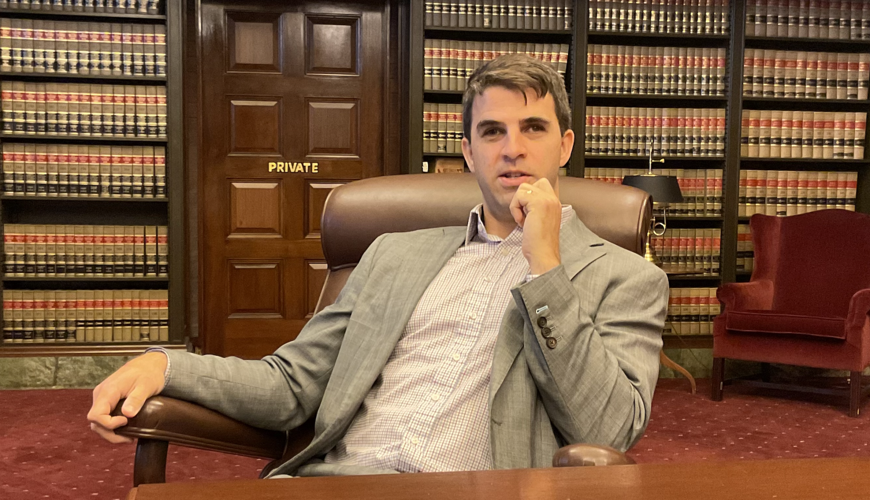
Before Simpson departed for Europe, we talked for 34 minutes in the second-floor library at the Gene Snyder Federal Courthouse.
About his third appearance in the Paralympics, including a silver medal performance eight years ago. About the challenge of beating Brazil, France and other gold medal contenders. About the assignment Simpson was completing, serving as a clerk for U.S. District Judge Benjamin Beaton.

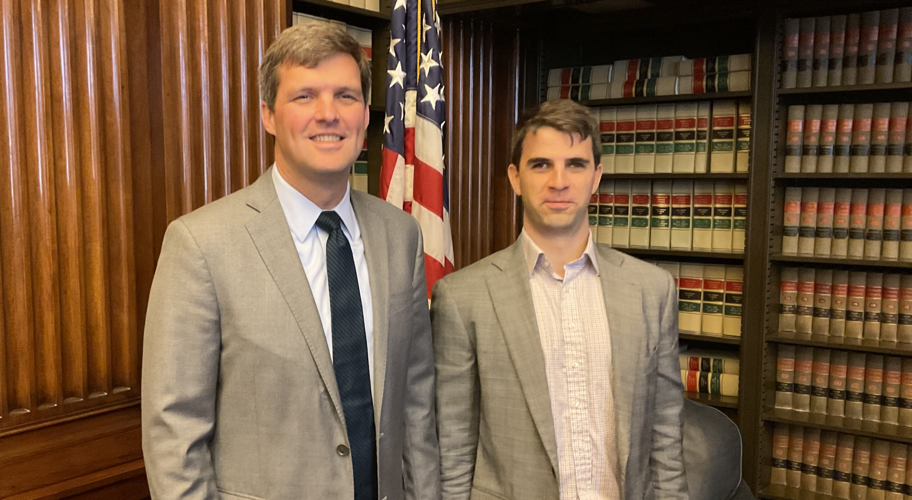
Matt Simpson, 34, has been competing in goal ball since he was 10 years old. He is a member of the US Paralympics team in Paris. WDRB Photo Rick Bozich
All of that was on video. All of it was interesting, difficult to distill into an 1,400-word internet story or 3-minute TV video package.
But after the camera and recorder went off, Simpson said something that told me everything about why he's a high achiever as an athlete as well as an attorney.
"Thank you," Simpson said. "Thank you for covering this as a sports story, not as a special interest story. As Paralympians, we love it when we're covered as athletes."
Savor the experience. An athlete at the highest level of his sport is what Simpson, 34, and his teammates will be while representing the U.S. in France the next two weeks. Their quest for a gold medal will begin with an opening match against Brazil Friday at 3 a.m. EDT.
'I just loved it'
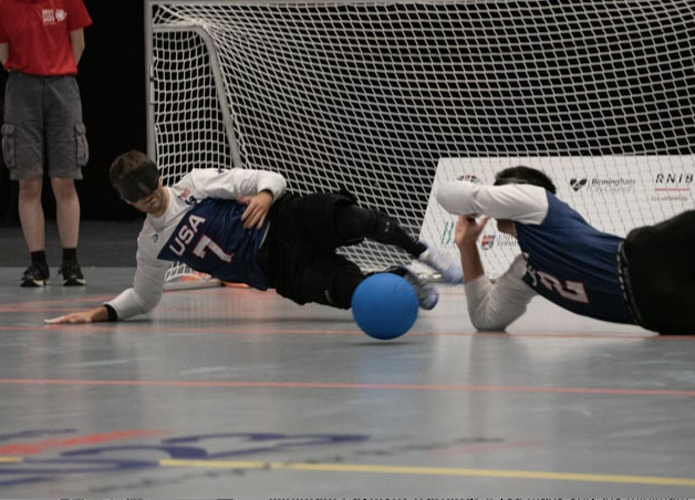
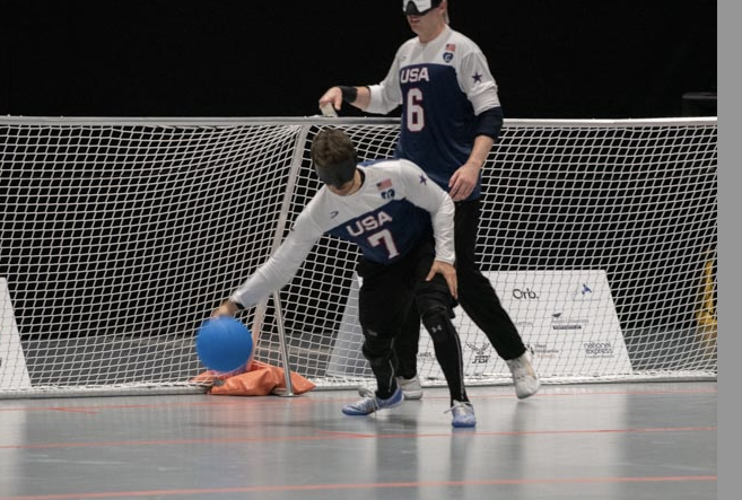
Goalball is a fiercely competitive 3-against-3 game played by athletes with visual impairment on a volleyball-sized court. The ball, slightly smaller than a basketball, carries a pair of embedded bells which can be heard through a half dozen holes.
"A giant cat toy," Simpson said, laughing.
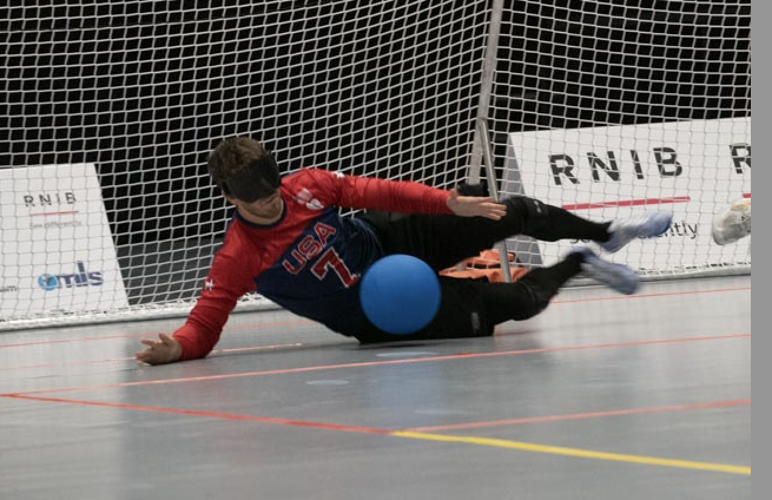
Wearing eyeshades, players remain on the ground and attempt to throw or roll the ball into the net, which is roughly 4 feet, 3 inches tall and stretches across the entire 30 feet at both ends of the court. The game is played in 12-minutes halves.
The requirement to throw the ball within 10 seconds after blocking or stopping it fuels the action. The best players, like Simpson, generally deliver their throws at speeds of nearly 55 mph.
Yes, there is a bit of a reverse-dodgeball element to it. Yes, blocking a ball with your body stings.
Ear-hand coordination rules. Simpson has that. He started to develop his skills while learning the game as a teenager growing up in suburban Atlanta. His journey continued through his undergraduate studies at Washington & Lee University in Lexington, Virginia, as well as law school at the University of Virginia.
But Simpson trained for the 2024 Paralympics at the gymnasium at St. Francis of Assisi church as well as at his home in the Highlands where he and his wife, Tricia, and their three children— Nellie, Sammy and JP — lived as he worked for Beaton.

Matt Simpson trained in Louisville this summer to compete for the U.S. in the Paralympics in France. (Photo courtesy of the U.S. Association of Blind Athletes)
His clerkship ended earlier this month. After Paris, Simpson will embark on legal career in Washington. But his fans in the federal courthouse and his Louisville neighborhood will be up in the middle of the night following his pursuit of his first gold medal.
"Matt has very thick skin, literally and physically," Beaton said. "He can take criticism in the office and maybe it has to do with the part of the sport that involves a really heavy ball being thrown at you and hurling yourself in front of it so there's a lot of scar tissue.
"I think physically and metaphorically that comes along with the sport and you can definitely see that in the resilience of Matt."
The Louisville attorney will compete in the Paralympics in Paris for the United States.
The resilience started as a child. Simpson was born with a genetic retina condition that resulted in him being legally blind from birth. He said he has essentially zero vision other than slight perception of light.
Simpson said he had an older sister who became a Division I soccer player. His parents took him to her events. He wanted to compete, too.
After trying swimming and other spots, Simpson was introduced to goalball when he was 10 years old at a sports camp run by the U.S. Association of Blind Athletes.
His competitive nature took it from there.
"My vision was not a factor for the first time in my life at goalball," Simpson said. "So I just loved it.
"I loved being on a team. I loved working toward a common goal. And I loved that once that blindfold was on and it was up to me, nobody was there to help me. Nobody was there to direct me. It was all up to me and my teammates."
Like any basketball player. Or soccer player. Or football player. Or baseball player. The menu of sports that Simpson could play was limited by his vision. His ability to train, focus, dream, compete and succeed was limited by nothing.
The Louisville attorney said 'inspiring' can be a touchy word for paralympians.
That is the message that percolates inside Simpson, the one he shares with athletes who are not dealing with disabilities as well as with athletes who are.
"I think the word 'inspiring' is always a touchy word for a lot of Paralympians," he said. "Because they say, 'Well, I don't want to be inspiring. I want to be the best athlete in the world who happens to be an amputee or the best athlete who happens to be blind.'
"That is 100% true. I don't wake up in the morning and lift five times a week because I want to inspire somebody. I do it because I want to win a gold medal.
"But, at the same time, it would be short-sighted of us not to recognize that we have great power to demonstrate to people not only what I can do as a person who's blind, but, to your point, what can someone else do when they think they're facing insurmountable limitations?

Matt Simpson (right) trained for the Paralympics in Paris this summer while serving as a law clerk for US District Judge Benjamin Beaton. WDRB Photo Rick Bozich
"And if they see, 'Wow, look at that, look at that guy running an 11-second 100 meters with an amputated leg or look at this blind guy out there on the goalball court doing extremely athletic things, that can't help but be inspiring.
"I think we should absolutely be willing to recognize what kind of positive impact we can have on people."
During his time in Louisville, Simpson teamed with Beaton to visit elementary schools. They set up goals, taped the court dimensions on the floor and put on blinders, encouraging children through a goalball demonstration.
"The lesson that came through the most was how these athletes were competing just as intensely, just as competitively, with just as much fun and enthusiasm as people playing other sports," Beaton said.
"They were just using other faculties to do so. It was amazing to watch."
'A huge honor'
Simpson credits his parents for supporting his commitment to competing and for never putting limitations on what he could achieve. That is another message Simpson remains determined to share.
"My parents never lowered their expectations for me, which helped me to never lower my expectations for myself," Simpson said.
"In my life, I've been fortunate to get to use my platform to parents of a lot of children that are blind as well as a lot of blind children.
"The world is happy to provide any assistance you may need in life. But the world is not going to have high expectations for a person with a disability because they don't know that they should and they don't necessarily think that is the right and compassionate thing to do.
Simpson will compete for the United States in the Paralympics this week in Paris.
"They think that the compassionate thing is to have pity and help you. And that is the crippling thing, right?
"The disability itself is often times surmountable. But the tyranny of low expectations is what we always have to fight against."
Low expectations will not be part of the experience for Simpson and his American teammates in Paris. Their pool, which includes Brazil, France and Iran, is the toughest of the four.
They must finish in the top two to advance to quarterfinal play, which begins Sept. 2. The gold medal will be decided Sept. 5.
Simpson won that silver medal in Rio De Janeiro in 2016. Three years ago the Americans finished fourth. For a competitor, finishing off the podium stings.
"Brazil has been the best team in the world for a very, very long time," Simpson said.
"But we're going to try to win a gold medal and do it in front of the world, wearing the red, white and blue, which is, of course, a huge honor."
Copyright 2024 WDRB Media. All Rights Reserved.


