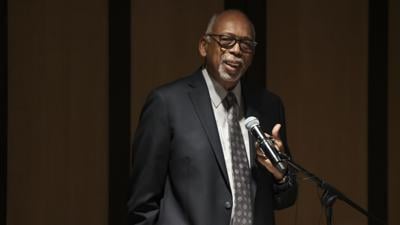

LOUISVILLE, Ky. (WDRB) -- I haven't heard Wade Houston give a ton of speeches, so when Simmons College of Kentucky athletic director Jerry Eaves passed me an invitation to the school's Tipoff Luncheon on Thursday, I wanted to listen.
Because when you've marched with Martin Luther King Jr. in Frankfort, coached alongside Denny Crum in Freedom Hall, raised and coached a future NBA star from this city, and built a business empire that stretches across the country, you've got some insights worth hearing.
In a restaurant meeting room, Houston stood up. Not to deliver a résumé, but to deliver a challenge. To give back. And to remind us why he does.
Back in 1964, Houston was a sophomore at the University of Louisville, the first Black scholarship basketball player. He had worked his way to the front row of a civil rights rally after a march where King was set to speak. Around him, the crowd buzzed about the celebrities. Mahalia Jackson, Harry Belafonte, Jackie Robinson. But Houston's eyes never left King.
"I just wanted to know what it was about him," he said. "What made him connect with people the way he did?"
Then King started to speak. The voice. The rhythm. The power.
"His speech was so mesmerizing," Houston said. "I always remember how impressed I was as a youngster."
He shared other stories, too. About growing up in Alcoa, Tennessee, watching his father work odd jobs after being laid off. About Muhammad Ali sitting in his living room, describing his brutal bout with Joe Frazier in the Philippines as "The closest thing to death." About his 55-year marriage to Alice, and business. About mentorship and second chances.
And about the importance of Simmons College to the city of Louisville.
That's what brought Houston — and a room full of coaches, city leaders, donors and dignitaries — to this event.
Because Simmons isn't just trying to build a basketball program.
It's trying to build a beachhead.
That was the word used by Simmons President Kevin Cosby, who has spent the past two decades resurrecting the historically Black college from near-extinction. When Cosby took over, Simmons had no land, no buildings, no students and no money. What it had was history.
Founded by formerly enslaved people in 1879, Simmons produced Kentucky's first Black doctors, lawyers and teachers. And then, like so many Black institutions, it faded. Pushed out. Scaled back. A victim of economic pressures, policy shifts and the slow erosion of attention.
Now, it's fighting its way back — through limited means but growing momentum. And as Cosby framed it, through strategy.
"The great challenge of west Louisville is the absence of institutions — strong families, strong schools," he said. "What west Louisville needs is beachheads. Simmons College is an important beachhead."
I've lived in Louisville most of my life. I've watched. I've studied. I know a lot of our history, though probably not enough. I feel like this city, and the courts, came at desegregation with good intentions.
I'm not sure, in that effort to help children, anyone realized they might be destabilizing neighborhoods. When Black children were bused out of their neighborhoods, they may have gone to nicer schools. What they left behind, though, were schools, and by extension, neighborhoods, that over time became detached from the very young people who could sustain them. And as those kids left on those busses before daylight, over time, so did the federal dollars attached to them — into neighborhoods that didn't need them as much.
I don't know what the right solution was. I'm not even sure my opinion would pass the scrutiny of scholarship. But I feel confident that something was taken, without enough being put back.
In college, I worked summer orientation at the University of Louisville, helping administer placement tests for students from across the city and state. Kids who needed a little extra help before starting college. Often from poorer areas, both within this city and some rural communities. U of L did that then because it had what it called an "urban mission."
Over time, that changed. U of L went bigger. More selective. It became a research institution. Earned higher rankings. Started running with a swankier crowd — and you can't get much swankier than the ACC. But many of the kids I used to see taking placement tests were quietly funneled to community colleges. Or nowhere at all.
Lost in all of it was something bigger for some kids in those neighborhoods: the dream of going to U of L. Of being part of something aspirational in your own city. Of reaching toward the glow of all those athletes and leaders you'd grown up watching.
That dream faded for a great many students. And a dream is a terrible thing to lose.
I think of Muhammad Ali, lying in the yard on Grand Avenue at night with his brother Rahman, looking up at the stars and telling him he was going to be something great. I don't know if kids like him still do that. I hope they do. But I don't know.
Dreams are a big deal.
"Sometimes," pastor and writer Frederick Buechner once wrote, "wishing is the wings the truth comes in on."
Simmons can be a part of bring dreams like that back.
That's what the luncheon was about.
That's why Pat Kelsey was there, cracking jokes about his days guarding now-Simmons coach DeJuan Wheat as a freshman point guard at Wyoming.
"Held him to 37," Kelsey said.
That's why Mayor Craig Greenberg talked about Simmons as not just an educational institution — but an economic engine for west Louisville.
Because this is the work.
Wade Houston has lived that kind of work.
"To whom much is given, much is expected," he said.
Then he looked around the room — at old teammates and new leaders, athletes and alumni, donors and volunteers — and offered one final charge:
"We might not be able to save the city," he said. "But we can save one child at a time."
I understand this is only marginally a sports column. But then, Simmons' sports programs are only marginally about sports. They are about opportunities and futures and creating an institution in an area that needs one.
That's what Simmons is trying to do.
That's the beachhead.
And it's worthy of support.
Quick Sips
MORE INFORMATION: To support Simmons' athletics or the school's other missions, visit the university's donation page here and click on "athletics."
KENTUCKY FALLS: Almost a week after Louisville suffered a 14-point loss to nationally ranked Kansas in an exhibition game, Kentucky fell by 14 to Georgetown on Thursday night. The Wildcats were playing without both of their starting point guards, but coach Mark Pope said Georgetown still exposed other problems that will need to be addressed with the regular season set to begin next week. Read about it here.
The Last Drop
"We love to divide people into categories -- black, white, rich, poor, urban, suburban, UK basketball teams, and then those of us who know what basketball is really all about – but the true difference between people is this: prepared, and unprepared. And Simmons College of Kentucky is preparing students to achieve greatness."
Kevin Cosby, president of Simmons College
Copyright 2025 WDRB Media. All Rights Reserved.


