

LOUISVILLE, Ky. (WDRB) – For the second time in a matter of weeks, the University of Louisville basketball program lost out on a big man recruit, in part because it was outbid. That’s not very novel. The University of Kentucky, in fact, may well have been outbid for both players, too.
That’s how recruiting works today. Players go, by and large, to the highest bidder, and U of L and UK both are outbidding other schools to get their share.
The thing that made those two big men so arresting, however, is the amount of the final bid. Great Osboro went to Washington for a reported $2 million for one season, making him the highest-paid known player in college according to Jonathan Givony of DraftExpress.
A freshman, Jayden Quaintance, was reportedly asking upwards of $1.5 million and as much as $2 million before committing to Arizona State.

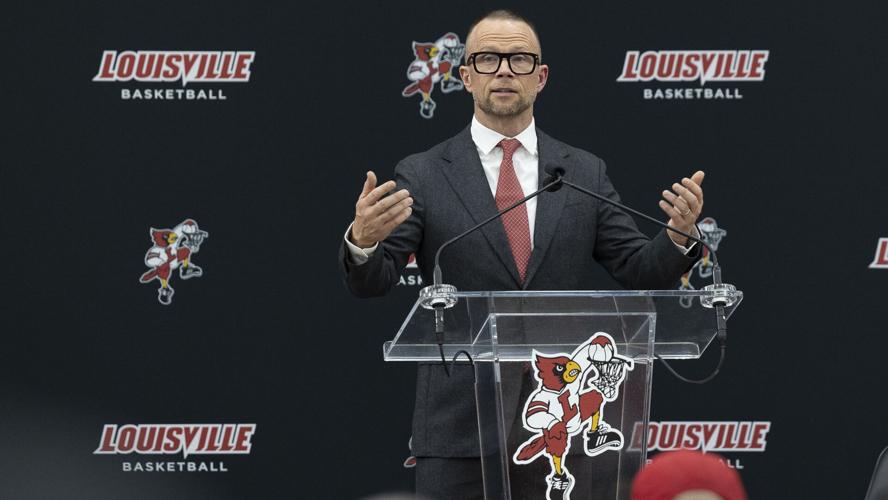
Louisville basketball coach Pat Kelsey.
The question isn’t whether Kentucky or Louisville could pay either player – or some other player -- that much money. For that matter, the amount of money Oscar Tshiebwe may well have made in his final season at Kentucky may have approached those amounts (and he was worth it).
But the fundamental question facing programs all over the nation is, how high do you go? For Louisville, with a coach making $2.3 million a year, can you really entertain anything close to $2 million a year for a single player?
And I know those payments come from two different places. One from the university, one from outside sources. But if a player is making almost as much of a coach, there’s a different dynamic. It exists in the NBA, and it can work. But it’s new to college.
And this is still college. At $2 million, you’re talking about a college student making as much money as some academic departments have as operating budgets.
Not that players don’t deserve the money, but for programs around the nation, there’s always the question of how much is too much for a single highly-touted player.
Why pay a guy $2 million? The player better be pretty special. Or very high profile. Or represent something to the fan base that will make the return on that money add up to more than the actual investment. There are those kinds of players.

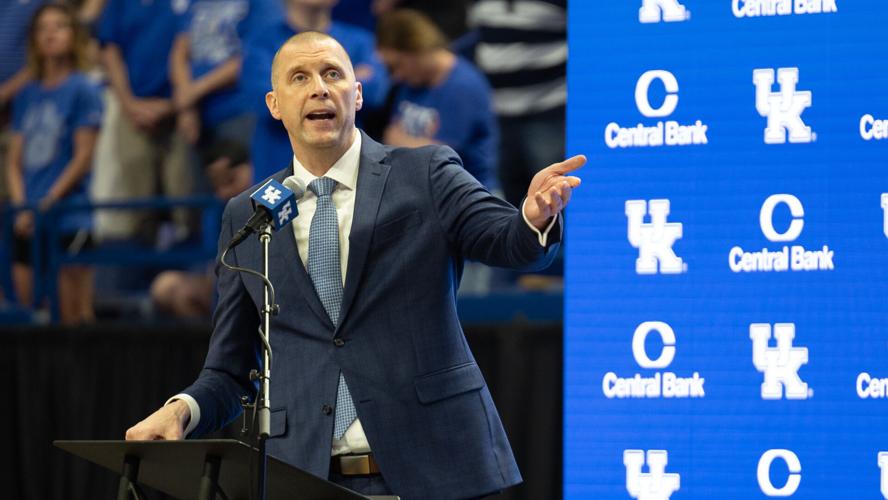
Scenes from Mark Pope’s introductory news conference as Kentucky coach in Rupp Arena.
Reed Sheppard at Kentucky, for instance, would be one of them. Tshiebwe was one of them. Is that guy out there for Louisville in the current landscape? Probably not.
The sweet spot in NIL is finding guys who are talented but still hungry. It’s about building a roster of just the right size to keep chemistry in a positive zone. Oh, and building a team, not just a roster, finding complimentary pieces still willing to play a team game in a professional setting.
And it’s not just in the men’s game. The women’s game is just as transactional. Louisville coach Jeff Walz said as much. He has a top recruiting class coming in next season, but you’re still watching social media with trepidation, hoping you don’t lose somebody.
“Now, unfortunately, it's really turning into a bidding war,” he said. “And, you know, there are some (women’s) programs right now that the word on the street is they’re looking at an NIL package of about $1.2 million a year. Some are up to $2 million a year. I mean, I don't blame the kids. You can't blame the players. It is what it is. If I'm out recruiting a kid, and I'm like, and we think you can earn $50,000, and then the school behind me comes in and says, I think you could earn $100,000, you know, everyone here, I think, has a job. And if somebody walked in and said, ‘I'll pay you twice as much as what you're making,’ I don't think any of you are going to say no. But you say, ‘our fans are so much better.’ Hey, when I check my bank account, you might not have the office you wanted with the other job. But when you get paid twice as much, I think you'll make the office look nice. So we work to figure out what works for us, what we can do to put a great team on the floor.”
On the men’s side, both Mark Pope at Kentucky and Pat Kelsey of Louisville have faced complete roster rebuilds. We’ve seen nothing like it in this state. Two new coaches. Two new rosters.
For either guy, coming in with a totally depleted roster in the past would’ve meant years of rebuilding. It took Rick Pitino years to truly rebuild both programs. In the current climate, every year is a rebuild.
“Five years ago, this rebuild would take several years,” Kelsey told Jeff Goodman in his Field of 68 After Dark Podcast Monday. “And, you know, in this day and age, it's more a professional sports model where there's a ton of roster management and talent acquisition every, single year. And this year is no different. So we're very confident we're going about this thing and meticulously evaluating every single, day recruiting our butts off.”
Yes a big wallet is important. But knowing how to manage that budget, and finding players who add value in multiple ways, that’s what is differentiating the top programs.
At Kentucky (and now Arkansas), John Calipari can amass as much talent as any coach in basketball. But are they they best teams?
Pope will look to do it a bit differently. And Kentucky fans are eager to see if he can.
The fact is, both schools may be outbid from time to time. This also is a fact – in the new college basketball economy, the biggest salary isn’t always the best use of the money. Sometimes it is, more often it isn’t.
Copyright 2024 WDRB Media. All Rights Reserved.