
This is the prologue to an occasional series examining the money, power and politics reshaping college athletics, from Congress and the courts to conference commissioners and the increasingly corporate structures behind modern college sports. Next: Part 1 — The New Reality.
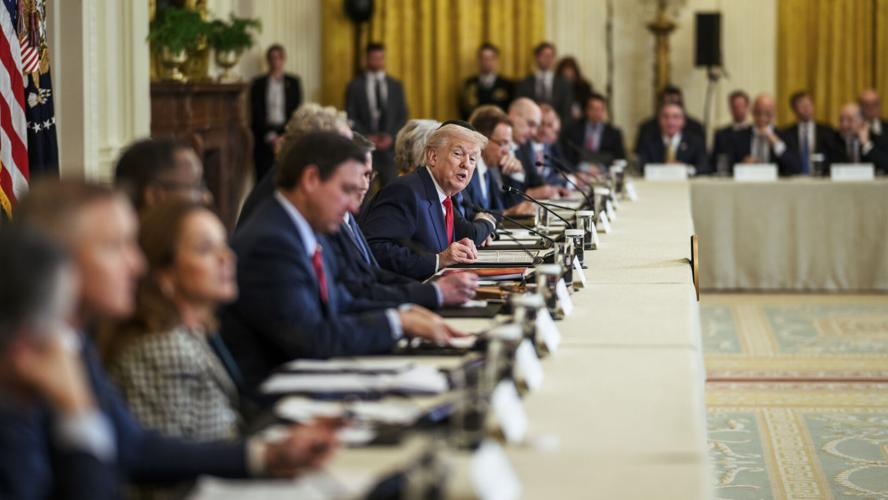
LOUISVILLE, Ky. (WDRB) — The East Room of the White House looked less like a rescue mission than a reunion tour.
There were commissioners in expensive suits. Television executives. Athletic directors. Billionaire donors. Politicians. Former coaches. Professional sports owners. Nick Saban. Greg Sankey. Charlie Baker. Adam Silver. Condoleezza Rice. Representatives from ESPN and FOX. Notre Dame. The SEC. The Big Ten. The Big 12. The ACC.
If college sports has a ruling class, much of it was sitting in that room.
Everybody but the players.
And now, after years of turning college athletics into a giant televised gold rush, they've arrived in Washington asking Congress to help restore order.
That's the funny part.
The people now trying to save college sports are, in large part, the same people who helped build the modern monster in the first place.
Not because they were evil. Because the money was too good. Everybody followed it.
Schools chased television contracts like prospectors chasing gold veins through the hills. Conferences stretched across time zones like old railroad empires. Coaches signed contracts big enough to buy small islands. Networks expanded inventory until Tuesday nights in February looked like an airport departures board.

And the NCAA sat in the middle like a mall cop trying to stop a casino robbery with a whistle.
Now here we are.
The latest proposals floating out of President Donald Trump's college sports reform roundtable include salary caps for coaches, restrictions aimed at slowing transfer movement, antitrust protection, new governing structures, possible pooling of media rights and a separate playoff concept for Group of Six schools.
In other words, the sport has finally become so chaotic that the people running it are now asking the federal government for help untangling it.
Which is a little like inviting Congress to fix your kitchen because you burned the toast.
Some of the ideas sound thoughtful. Some sound impossible. Some sound like they were scribbled on cocktail napkins somewhere between television negotiations and private jet departures.
Salary caps for coaches? Good luck explaining that to a football coach making $11 million while a university president quietly signs the extension with a ceremonial pen.
Pooling media rights? The SEC and Big Ten have spent the last decade treating their television contracts like sovereign wealth funds. They're not pooling anything.
Transfer restrictions? The courts have spent the last several years treating NCAA movement restrictions the way a chainsaw treats patio furniture.
And the centerpiece of all of it — the thing everybody really wants — is antitrust protection.
That's the golden ticket.
Because the old NCAA model finally collided with American law and lost.
For years, college sports operated on a beautiful little arrangement: everybody made money except the players. The coaches became millionaires. Commissioners became executives. Television contracts ballooned into the billions. Facilities turned into luxury resorts with locker rooms nicer than most hotel spas.
The athletes got scholarship checks and motivational speeches about "the student-athlete experience."
Then NIL arrived like a thunderstorm through an open window, and suddenly everybody discovered capitalism at the exact moment they stopped liking it.
Now the same industry that spent decades monetizing athletes is horrified to discover athletes have learned to monetize themselves.
And so the adults have gathered again. Not to stop professionalism. That ship sailed somewhere around the third billion-dollar television contract.
No, what they want now is controlled professionalism.
Professional sports without employee status. Free markets with restrictions. Revenue-sharing without unions. Player movement, but not too much player movement. Compensation, but preferably through mechanisms the schools themselves can control.
In other words: Everybody wants reform, right up until reform costs them power.
And perhaps the most revealing detail of the entire roundtable was not who attended.
It was who didn't.
No current college athletes were invited. That's remarkable when you think about it. The entire system is supposedly being rebuilt around athlete compensation, athlete movement, athlete rights and athlete employment questions — and the labor force itself wasn't sitting at the table.
Temple football player Khalil Poteat publicly questioned how decisions about the future of college athletics could be made without athletes represented in the room.
It was a fair question. It was also an obvious one. Which tells you something about how the people running this industry think about the people running through it.
This isn't really a fight about saving college sports anymore. College sports aren't dying.
The stadiums are full. The television ratings are enormous. The playoff keeps expanding. The money machine still hums like a casino floor at midnight.
This is a fight about control. Who controls the money. Who controls movement. Who controls labor. Who controls the future structure of a business that stopped behaving like an amateur model years ago.
The people at the top are finally admitting something the rest of America already figured out: The old system is gone. And the fight over the next one has moved out of NCAA headquarters and into Congress, courtrooms, conference offices, university boardrooms and private capital conversations.
Nobody fully controls college sports anymore. That's not a temporary glitch. It's the new reality.
Everybody wants control. Nobody has it.
And the athletes still aren't in the room.
Copyright 2026 WDRB Media. All Rights Reserved.