


LOUISVILLE, Ky. (WDRB) — For years, college sports leaders marched into Congress carrying the same message.
Help.
The courts have tied us in knots. The NCAA can't enforce its own rules. The transfer portal has become free agency. NIL has become a bidding war. Somebody needs to restore order.
In recent months, Congress finally answered the phone.
Which is when the fighting started.
The Protect College Sports Act — the bipartisan proposal championed by Sen. Ted Cruz of Texas and Sen. Maria Cantwell of Washington — is closer than any congressional solution has ever been.
It is also still in serious trouble.
Those two things can both be true.
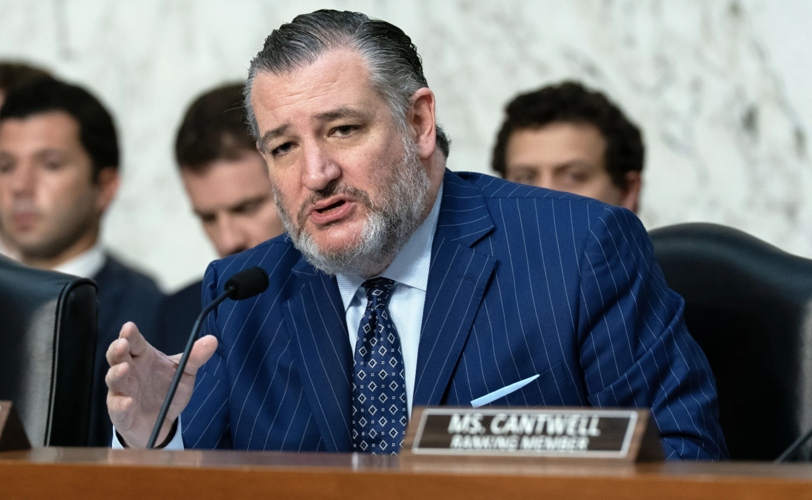
Wednesday's Senate Commerce Committee hearing made that clear.
Inside the hearing room, there was remarkable agreement. Outside it, opposition was gathering from almost every direction.
Nick Saban called the current system a Ferrari racing toward the Grand Canyon at 150 miles per hour. Longtime university president Gordon Gee called it an existential crisis. Notre Dame athletic director Pete Bevacqua warned of a future super league. The Pac-12's Teresa Gould spoke of a student-athlete experience increasingly squeezed by economic pressures.

Nobody showed up to argue that things are working. Nobody defended the status quo.
The debate in Washington is no longer whether college sports has a problem.
The debate is who gets to fix it. And who gets control of the money.
The bill itself reaches in a lot of directions. It would set national rules for transfers and eligibility. It would protect a scholarship even if an athlete blows out a knee or has a bad season, and guarantee it through the completion of a degree. It would require medical care during an athlete's career and for years after, fund a trust for long-term conditions like CTE, and bar a coach from overruling a team doctor. It would regulate the agents who have begun working their way down to high school athletes. It would require that women's programs get equal facilities, travel and championship treatment.
And then there is the provision everything actually revolves around. The bill would give schools and conferences the option to pool their media rights and sell them together, the same authority Congress long ago granted professional leagues like the NFL.
Follow the breadcrumbs long enough and they always lead back to television.
The hearing sounded like it was about revenue sharing, NIL, athletes' rights, the transfer portal, medical care and preserving non-revenue sports.
The fight is actually about television.
Gee, who has chaired the presidents of the Big 12, the SEC and the Big Ten, put the money on the table in plain numbers.
"College football already has twice the viewership of the NBA, but half the media revenue," Gee said. "Now that just seems to me to be to be unsustainable. It's something that we cannot really be able to even understand. I know firsthand from my time in the conferences that this is a serious problem. This bill provides the option to pool our rights … where the conferences and schools themselves would decide … whether to sell their rights together. The very fact that we have addressed this is so enormously important."
Gee told the committee college sports will leave more than $5 billion in media revenue on the table this year alone. Cantwell put the potential upside of pooling at an additional $4 billion to $8 billion a year, revenue she wants at least in part directed to women's and Olympic sports.
Grow the pie, Gee and others have suggested. Pool the rights, increase the contracts, share the revenue. He positioned it as an historic opportunity. But also warned, "I do believe that that window will close quickly."
The window. That's what this bill is really racing against.
Because Congress wants to save college sports by pooling more media money.
The SEC and Big Ten want Congress to save college sports without touching their money.
That is the conflict.
The two conferences deserve their say, and they made it Wednesday morning, before the hearing even began, in a joint statement opposing the bill as drafted.
They were careful to praise the goal. They support a national framework, they said, with a working transfer portal, clear eligibility and real protections for athletes. They appreciate the leadership of Cruz and Cantwell.
But they argued the bill leaves critical problems unsolved. It doesn't meaningfully override the patchwork of state laws. It doesn't give schools the protection they need to make and enforce consistent rules. It pushes ongoing rulemaking into Congress, which moves slowly. It might invite more litigation rather than less. And — their most disarming point — they warned the bill could alter the House settlement's revenue-sharing framework in a way that leaves fewer athletes receiving direct payments.
That last argument is the clever one. It lets the two richest conferences in America position themselves as the ones protecting the athletes' paychecks.
But notice what the statement never mentions.
Media rights.
The provision the SEC and Big Ten are circling, without naming it, is the one that would pool — and dilute — the very leverage that makes them the SEC and the Big Ten. National rules, yes. Shared leverage, no.
And here is the wrinkle that makes their opposition so revealing. The pooling provision is optional. Cruz and Gee both stressed it, more than once. No school, no conference is required to pool a single dollar.
Which raises a question the hearing never quite answered.
If pooling is optional, the SEC and Big Ten simply won't do it. Nothing in the bill says they have to. And if the two conferences sitting on the most valuable television rights in the sport decline to pool them, the bill's central revenue engine never really starts.
Most of the bill can stand without it. Scholarship protections, medical care, agent regulation, eligibility standards, none of those depend on shared media money.
But the whole "grow the pie" promise does. The money to save Olympic sports, women's sports and the schools on the margins comes from pooled rights. And the programs best positioned to grow that pie are precisely the ones least likely to share it.
So why fight an option you'd never exercise?
Because the option itself changes the math. Its mere existence hands everyone underneath the SEC and Big Ten a vehicle to sell collectively, to pool their leverage, to close the gap. The two conferences don't have to use the provision to be threatened by it.
In the committee hearing room, witnesses were remarkably consistent.
Saban warned that unchecked spending is becoming an arms race. He said at Alabama, collective spending went from roughly $2.7 million to $7 million, then $10 million. After he retired, he said, it jumped to $17 million and then $24 million. Some schools now field football rosters approaching $40 million.
"If we continue to do that," Saban said, "we're going to lose Olympic sports, we're going to lose non-revenue sports, we're going to lose scholarships."
Bevacqua echoed the concern. He argued the House settlement's revenue-sharing cap isn't really a cap, because third-party NIL money creates an enormous gray area.
"If we continue to have these runaway roster fees," he warned, "you're going to have a super league."
Even Cantwell, a Democrat from Seattle who probably disagrees with Cruz on almost everything else, framed the issue in nearly identical terms.
"The solution here is to grow the pie, not shrink it," she said.
Different voices. Different backgrounds. Same concern.
The current system rewards concentration. More money to fewer schools. More power to fewer conferences. More pressure on everyone else.
Which brings us back to why this bill remains in trouble.
The SEC and Big Ten have already raised their objections.
The Congressional Black Caucus has urged Congress to pause consideration, tying its request to the silence of college sports leadership on attacks against Black political representation, and to its own substantive concerns about accountability and athlete protections.
There are legitimate criticisms of the bill. Some are serious. Some may prove fatal.
Everybody now has a list of reasons this bill won't work. Very few people have explained what happens if nothing does.
Nobody who testified Wednesday seemed worried about Alabama football, or Ohio State, or Texas. Those programs will survive.
The concern was everything underneath them. The wrestlers, swimmers, tennis players, volleyball and baseball players. The scholarship athlete whose future changes because a college gave him or her an opportunity.
The hearing wasn't really about a bill. It was about a question.
Can college sports still function as a national enterprise? Or has the business already become too big for the sport that created it?
Congress may not have the answer. The Protect College Sports Act may not be the answer.
Closer than ever. Still in serious trouble.
Copyright 2026 WDRB Media. All Rights Reserved.


